Marble grave stele of a little girl
Artwork Details
- Title: Marble grave stele of a little girl
- Period: Classical
- Date: ca. 450–440 BCE
- Culture: Greek
- Medium: Marble, Parian
- Dimensions: Height: 31 3/4 in. (80.6 cm)
Width (top): 14 9/16 in. (37 cm)
Width (base): 15 1/2 × 4 in., 131 lb. (39.4 × 10.2 cm, 59.4 kg) - Classification: Stone Sculpture
- Credit Line: Fletcher Fund, 1927
- Object Number: 27.45
- Curatorial Department: Greek and Roman Art
Audio
832. Kids: Marble grave stele of a little girl
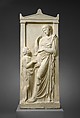
This is a stele, a carved piece of stone that was often put up, like a modern tombstone, when someone died. The one you see here, from ancient Greece, shows a young girl with her pet doves. It’s easy to see how sad the girl feels, and how much she loves her birds. The birds are obviously comfortable with her—one pecks her gently on the lips, and both seem content to stay in her arms.
The stele is made of marble, a smooth, hard stone that’s considered especially fine for carving sculpture. Here, the artist worked the marble with incredible skill. The girl’s robe falls in graceful folds, which have been carved so that you can see the way she’s standing. Try imitating her pose—her weight is on her right leg, and her left leg is bent. Her expression is serious, and the sculptor has captured a feeling of softness. Look at the hair falling gently down her back, and the tenderness with which she holds the birds. If someone made a carving of you, what would you be holding?
Listen to more about this artwork
More Artwork

Related Content



Research Resources
The Met provides unparalleled resources for research and welcomes an international community of students and scholars. The Met's Open Access API is where creators and researchers can connect to the The Met collection. Open Access data and public domain images are available for unrestricted commercial and noncommercial use without permission or fee.
To request images under copyright and other restrictions, please use this Image Request form.
Feedback
We continue to research and examine historical and cultural context for objects in The Met collection. If you have comments or questions about this object record, please contact us using the form below. The Museum looks forward to receiving your comments.
Content Notice
The Metropolitan Museum of Art presents over 5,000 years of art from around the world, and our online collection reflects ongoing work conducted over the course of our more than 150-year history. You may encounter objects or images that may be inappropriate for some viewers or information that may be outdated.