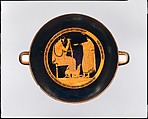
Terracotta kylix (drinking cup)
Exterior, athletes
The interior presents a lovely picture of a young woman at a laver. By her feet stands the bail amphora in which water was carried. She has her hair in a sakkos (snood) and wears a chiton that shows off the painter's skill in drawing and handling dilute glaze. The skyphos (deep drinking cup) and wineskin on the wall subtly introduce the symposium at which this cup was used and in which the youths on the exterior would soon participate.
Artwork Details
- Title: Terracotta kylix (drinking cup)
- Artist: Attributed to Douris
- Period: Archaic
- Date: ca. 500 BCE
- Culture: Greek, Attic
- Medium: Terracotta; red-figure
- Dimensions: H. 4 7/16 in. (11.2 cm)
width 13 5/8 in. (34.6 cm)
diameter 10 9/16 in. (26.9 cm) - Classification: Vases
- Credit Line: Gift of Norbert Schimmel, 1986
- Object Number: 1986.322.1
- Curatorial Department: Greek and Roman Art
Audio
1026. Terracotta kylix (drinking cup)
The elegant image of a woman bending over a basin of water fills the circular medallion at the bottom of this wine cup. In front of her, over the basin, hangs a drinking cup of another form, and behind her is a sakkos, a snood like the one she wears on her own head. She is gracefully attired, absorbed in her task, and alone.
Douris, the painter of this cup, shows a particular sensitivity to female figures. In his hands, this woman at her everyday task becomes a person of substance and distinction, not unlike the later portrayals of women at work in paintings by Chardin or Degas. The drinking cup would have been used at a symposium, an all-male drinking party that was closed to mothers, wives, and daughters. The man who used this cup at the symposium would have found this image at the bottom, before the wine was poured and of course after he had drunk it. The woman might have reminded him of the hetairai present with him at the party, or of his own wife at home.
On the other side of this case, you can see men with women who could and did attend symposia. These are hetairai, courtesans who operated outside the strictures of feminine respectability in classical Athens. The best hetairai were educated women of culture, admired for the range of their talents, as well as their physical charms. They might recite poetry or play music at the symposium, and certainly took part in conversation. The greatest hetairai commanded independent fortunes and the respect of distinguished men.
More Artwork
![Terracotta fragment of a kylix (drinking cup), Douris [DvB], Terracotta, Greek, Attic](https://images.metmuseum.org/CRDImages/gr/web-additional/DVB05424_1_ff.jpg)
Related Content

 Free to download
Research Resources
The Met provides unparalleled resources for research and welcomes an international community of students and scholars. The Met's Open Access API is where creators and researchers can connect to the The Met collection. Open Access data and public domain images are available for unrestricted commercial and noncommercial use without permission or fee.
To request images under copyright and other restrictions, please use this Image Request form.
Feedback
We continue to research and examine historical and cultural context for objects in The Met collection. If you have comments or questions about this object record, please contact us using the form below. The Museum looks forward to receiving your comments.
Content Notice
The Metropolitan Museum of Art presents over 5,000 years of art from around the world, and our online collection reflects ongoing work conducted over the course of our more than 150-year history. You may encounter objects or images that may be inappropriate for some viewers or information that may be outdated.