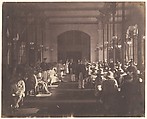
The Morning After "He Greatly Daring Dined"
pun based on the epitaph on Phaethon’s tomb from Ovid’s Metamorphoses: “Here Phaethon lies who in the sun-god’s chariot fared. And though greatly he failed, more greatly he dared.” In Greek mythology, Zeus struck down Apollo’s son Phaethon after he lost control of his father’s chariot. Hill may have recognized himself in the doomed figure of Phaethon as he attempted to harness and control the power of the sun to create his photographs.
Artwork Details
- Title: The Morning After "He Greatly Daring Dined"
- Photography Studio: Hill and Adamson (British, active 1843–1848)
- Artist: David Octavius Hill (British, Perth, Scotland 1802–1870 Edinburgh, Scotland)
- Artist: Robert Adamson (British, St. Andrews, Scotland 1821–1848 St. Andrews, Scotland)
- Date: 1843–47
- Medium: Salted paper print from paper negative
- Dimensions: Image: 19.7 x 14.6 cm (7 3/4 x 5 3/4 in.)
Mount: 14 3/4 in. × 10 3/8 in. (37.4 × 26.3 cm) - Classification: Photographs
- Credit Line: Gilman Collection, Gift of The Howard Gilman Foundation, 2005
- Object Number: 2005.100.354
- Curatorial Department: Photographs
More Artwork
![[Newhaven Fishwives], Hill and Adamson British, Scottish, Salted paper print from paper negative](https://images.metmuseum.org/CRDImages/ph/web-additional/DP352694.jpg)
Research Resources
The Met provides unparalleled resources for research and welcomes an international community of students and scholars. The Met's Open Access API is where creators and researchers can connect to the The Met collection. Open Access data and public domain images are available for unrestricted commercial and noncommercial use without permission or fee.
To request images under copyright and other restrictions, please use this Image Request form.
Feedback
We continue to research and examine historical and cultural context for objects in The Met collection. If you have comments or questions about this object record, please contact us using the form below. The Museum looks forward to receiving your comments.
Content Notice
The Metropolitan Museum of Art presents over 5,000 years of art from around the world, and our online collection reflects ongoing work conducted over the course of our more than 150-year history. You may encounter objects or images that may be inappropriate for some viewers or information that may be outdated.