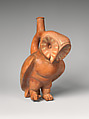
Spout-and-bridge bottle with owl head
To make a resist pattern, the vessel would be burnished and fired, and then the composition would be outlined with a watery paint that acted as a resist. The ceramic was fired again at a low temperature, causing the smoke to fill the uncovered surfaces. Finally, the resist was removed, revealing the orange color of the ceramic.
The Virú culture, also known as Gallinazo, thrived in the region of the Virú Valley. The Virú developed irrigation systems that allowed them to cultivate crops in the otherwise arid valleys of the coast. One of several successors to the earlier Cupisnique culture, the Virú were coeval with the early Moche culture. Scholars now believe that the Virú and Moche polities coexisted in certain locations early in their history, although the Moche inhabited a larger area than the Virú and subsequently dominated the northern coast of Peru.
Highly similar bottles have been excavated in recent years at Huanchaco, a seaside settlement in the Moche Valley, just north of the Virú Valley (see, for example, Campaña León and Prieto Burmester 2022:216, fig. 430).
References and Further Reading
Víctor Campaña León, Víctor, and Gabriel Prieto Burmester. Excavando Pampa La Cruz: Proyecto de Rescate Arqueológico Las Lomas de Huanchaco. Lima: Ediciones Rafael Valdez, 2022
Espinosa, Alicia, Isabelle Druc, et al. "The Chaîne Opératoire as an Approach to Distinguish Between the Ceramic Production of the Virú and the Moche Polities on the North Coast of Peru." Latin American Antiquity 35, no. 3 (2024), 672-693.
Millaire, Jean-François, and Magali Morlion, eds. Gallinazo: An Early Cultural Tradition on the Peruvian North Coast. Vol. 66. Los Angeles: Cotsen Institute of Archaeology Press, 2009.
Millaire, Jean-François, and Edward Eastaugh. "Geophysical Survey on the Coast of Peru: The Early Prehispanic City of Gallinazo Group in the Virú Valley." Latin American Antiquity 25, no. 3 (2014), 239-255.
Artwork Details
- Title: Spout-and-bridge bottle with owl head
- Artist: Virú artist(s)
- Date: 150 BCE–500 CE
- Geography: Peru, North Coast
- Culture: Virú
- Medium: Ceramic
- Dimensions: H. 4 7/8 × W. 5 1/4 × D. 6 in. (12.4 × 13.3 × 15.2 cm)
- Classification: Ceramics-Containers
- Credit Line: The Michael C. Rockefeller Memorial Collection, Gift of Arthur M. Bullowa, 1974
- Object Number: 1978.412.261
- Curatorial Department: The Michael C. Rockefeller Wing
More Artwork
Research Resources
The Met provides unparalleled resources for research and welcomes an international community of students and scholars. The Met's Open Access API is where creators and researchers can connect to the The Met collection. Open Access data and public domain images are available for unrestricted commercial and noncommercial use without permission or fee.
To request images under copyright and other restrictions, please use this Image Request form.
Feedback
We continue to research and examine historical and cultural context for objects in The Met collection. If you have comments or questions about this object record, please contact us using the form below. The Museum looks forward to receiving your comments.
Content Notice
The Metropolitan Museum of Art presents over 5,000 years of art from around the world, and our online collection reflects ongoing work conducted over the course of our more than 150-year history. You may encounter objects or images that may be inappropriate for some viewers or information that may be outdated.