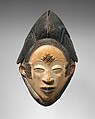
Sagbé(?) face mask
Sagbé, also pronounced sakpé or zagbé (Holas 1962, 118–19), guards against one of the gravest dangers of village life. In the dry season, when wind and dry thatch can turn a single cooking fire into a disaster for an entire village, the mask enforces the rules that keep fire under control (Fischer 1978, 21). A woman who neglects the order to put out her fire may be called before the elders and required to bring a fine chicken and rice (Marron 2004, 132). The Dan author Mamadou Kamara, who grew up within the mask hierarchy at Séma, described sagbé in 1992 as the tutelary mask of the Diomandé against house fires and bush fires (Kamara 1992, 20). Writing in 1962 about the neighboring Toura, northern neighbors of the Dan, the ethnologist Bohumil Holas found their sagbé nearly identical to the Dan masks of the same name. He described a nervous, irritable character whose outbursts were redeemed by irresistible clowning. He also noted that it carried more sacred weight than the other masks of its category, most of which were entertainers (Holas 1962, 118–19). The sagbé joins discipline and comedy. The figure that enforces a rule meant to save lives can also make a village laugh. More importantly, sagbé masks do not speak, rather they communicate using their left hand. A guékia, or assistant to the mask, translates into words the sagbé’s message.
The proposed attribution remains speculative given the work's incomplete state. Masks with a projecting lower face have often been grouped together (Fischer and Himmelheber 1984, 81). A Dan audience would not have relied on the carved face to tell these genres apart (Fischer 1978, 19). Sagbés are more recognizable through their costumes which have leaves incorporated into their headdresses, head-to-toe boubous, and short raffia skirts. They hold a branch or stick used to threaten or sometimes hit teenagers who venture too confidently into the performance area.
Yann Petit, 2026
Jane and Morgan Whitney Fellow
Artwork Details
- Title: Sagbé(?) face mask
- Artist: Dan artist
- Date: 19th–mid-20th century
- Geography: Côte d'Ivoire, western region; Liberia, northeastern region
- Culture: Dan peoples
- Medium: Wood
- Dimensions: H. 11 1/8 x W. 5 1/2 x D. 3 1/4 in. (28.3 x 14 x 8.3 cm)
- Classification: Wood-Sculpture
- Credit Line: The Michael C. Rockefeller Memorial Collection, Bequest of Nelson A. Rockefeller, 1979
- Object Number: 1979.206.55
- Curatorial Department: The Michael C. Rockefeller Wing
More Artwork

Research Resources
The Met provides unparalleled resources for research and welcomes an international community of students and scholars. The Met's Open Access API is where creators and researchers can connect to the The Met collection. Open Access data and public domain images are available for unrestricted commercial and noncommercial use without permission or fee.
To request images under copyright and other restrictions, please use this Image Request form.
Feedback
We continue to research and examine historical and cultural context for objects in The Met collection. If you have comments or questions about this object record, please contact us using the form below. The Museum looks forward to receiving your comments.
Content Notice
The Metropolitan Museum of Art presents over 5,000 years of art from around the world, and our online collection reflects ongoing work conducted over the course of our more than 150-year history. You may encounter objects or images that may be inappropriate for some viewers or information that may be outdated.