Bark Painting
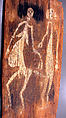
The well-balanced composition of this painting features the bodies of a snake and crocodile tracking upwards towards a large-limbed bird, likely an emu or cassowary, who fills the entire width of the bark. The body of each is outlined; the interior then divided into sections and infilled with fine, crosshatched lines in yellow, white and black to create a vivid, highly textured and dynamic surface. The artist showcases a wealth of detail: a flourish of feathers cascading down the bird’s back; the scaly, supple skin of the snake whose flickering tongue can perhaps just be glimpsed under the bird’s tail; the spiny tail and splayed feet of the crocodile, gripping the ground as its snout meets the neck of the bird. These may be animals with totemic or ancestral associations significant to the artist, or brought together in the painting tor the re-telling of a local story, one that may hint at prohibition or warning; or the painting may be more secular and figurative in design, a manual guide intended to map the habits of local species and their interactions.
The painting was likely produced in the 1940s or 1950s at the Groote Eylandt Mission or the camp at Umbakumba, which by that period had become an enclave for artists and the center of the commercial bark painting industry. The first missionaries on the island encouraged artists to produce portable barks that could be sold to provide income for the Mission. Artists began transferring the painted designs that previously decorated human bodies, rock shelters and the inner walls of bark huts onto bark panels. Designs associated with secret or sacred knowledge remained restricted to certain artists and ceremonies. By the middle of the twentieth century, when the current work was produced, Anindilyakwa paintings were becoming internationally recognized and represented in Australian galleries and private collections overseas.
Artwork Details
- Title: Bark Painting
- Date: mid-20th century
- Geography: Australia, Arnhem Land, Northern Territory
- Culture: Anindilyakwa
- Medium: Bark, paint
- Dimensions: H. 19 x W. 12 1/2 in. (48.3 x 31.8 cm)
- Classification: Bark-Paintings
- Credit Line: The Michael C. Rockefeller Memorial Collection, Bequest of Nelson A. Rockefeller, 1979
- Object Number: 1979.206.1461
- Curatorial Department: The Michael C. Rockefeller Wing
More Artwork
Research Resources
The Met provides unparalleled resources for research and welcomes an international community of students and scholars. The Met's Open Access API is where creators and researchers can connect to the The Met collection. Open Access data and public domain images are available for unrestricted commercial and noncommercial use without permission or fee.
To request images under copyright and other restrictions, please use this Image Request form.
Feedback
We continue to research and examine historical and cultural context for objects in The Met collection. If you have comments or questions about this object record, please contact us using the form below. The Museum looks forward to receiving your comments.
Content Notice
The Metropolitan Museum of Art presents over 5,000 years of art from around the world, and our online collection reflects ongoing work conducted over the course of our more than 150-year history. You may encounter objects or images that may be inappropriate for some viewers or information that may be outdated.