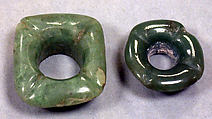
Earflares
Along with jewelry, Olmec artists worked jade into delicate masks ( MMA 1977.187.33 ), celts ( MMA 1989.314.4 ), and ritual paraphernalia ( MMA 1979.206.1145 ).
Jade was seen as a living, animate substance. The Olmec associated jade and other greenstones with water, mist, and vegetation, believing greenstone gave off a vapor that helped things grow (Filloy Nadal 2017). These associations with fertility and abundance were formed in the Olmec period and continued to influence later Mesoamerican people.
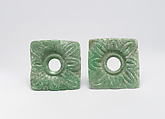
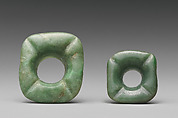
Ear ornaments originated as objects of personal adornment, going on to play essential roles in the constructing of personal and public identity. The earliest earflares recovered archaeologically are made of ceramic and bone. Jade examples first appear in Central Mexico in the Early Formative period, around 1200 BCE. Figurines most commonly show religious specialists wearing jade earflares, while other important persons wore different forms of jade ear decoration. Analysis of the colossal heads carved by Olmec artists at San Lorenzo, for example, suggests these rulers wore jade earrings in the form of tubes and plugs (Clark and Colman 2014:175). Jade earflares are uncommon in the archaeological record of this period, with only a handful recovered from Early Formative Mexican highland sites like Tlatilco and San José Mogote.
By the Middle Formative period, around 700 BCE, jade earflares were an important marker of status in Central Mexico, the Gulf Coast, and the Soconusco. Nearly all elite burials at La Venta, an Olmec site, contained jade earflares (Clark and Colman 2014:151, 183). Those at La Venta were often incised with complex, cosmically significant iconography emphasizing avian and serpentine attributes. Over the Middle Formative period, jade earflares were employed as representations of authority. They were embedded within a complex semiotic system related to dress, personal adornment, and meaning. Some were too big to be physically worn and may have been venerated as personal heirlooms or used for religious rituals.
Jade earflares like these continued to be worn by high-status individuals, such as kings, nobility, and religious specialists across Mesoamerica. Wearing jade jewelry was both a sign of access to foreign goods and the ability to command labor. Once inserted into a perforation in the earlobe, they would have taken on new symbolic meanings. The Maya associated earflares with metaphorical entrances to the underworld, as well as portals into the body (Houston, Stuart, Taube 2006:158). Earflares also represented divine ears, with elite hearing facilitated through the passageways and caves of the earflares. The jade material adds a new element to these portals, building on the construction of elite power through supernatural ability.
Caitlin Reddington Davis
Sylvan C. Coleman and Pam Coleman Memorial Fund Fellow, 2025-2026
References
Kovacevich, Brigitte and Michael C. Callaghan. “Fifty Shades of Green: Interpreting Maya Jade Production, Circulation, Consumption, and Value.” Ancient Mesoamerica 30(3):457-472, 2019.
Clark, John E. and Arlene Colman. “Dressed Ears as Comeliness and Godliness.” In Wearing Culture, Heather Orr and Matthew Looper, eds., pp. 145-206. Boulder: University Press of Colorado, 2014.
Fernández Sánchez, Pablo. “El jade Olmeca como elemento de prestigio, producción, y comercio.” In Expresiones materiales del poder en el contexto arqueológico del México prehispánico, Niklas Schulze, Miguel Nicolas Caretta, and Becket Lailson, eds., pp. 69-92. Mexico: Universidad Autónoma de San Luis Potosí, 2020.
Filloy Nadal, Laura. “Forests of Jade: Luxury Arts and Symbols of Excellence in Ancient Mesoamerica.” In Golden Kingdoms: Luxury Arts in the Ancient Americas, Joanne Pillsbury, Kim Richter, and Timothy Potts, eds., pp. 66-77. Los Angeles: Getty Publications.
Gillespie, Susan D. and Michael Volk. “An Archaeological Evaluation of the Olmec ‘Royal Tombs’ at La Venta, Mexico.” Ancient Mesoamerica 34(3): 640-649, 2022.
Houston, Stephen D., David Stuart, and Karl Taube. The Memory of Bones: Body, Being, and Experience Among the Classic Maya. Austin: University of Texas Press, 2006.
Taube, Karl. Olmec Art at Dumbarton Oaks. Washington, D.C.: Dumbarton Oaks Research Library and Collection, 2004.
Artwork Details
- Title: Earflares
- Artist: Olmec artist(s)
- Date: 900 – 400 BCE
- Geography: Mexico, Mesoamerica
- Culture: Olmec
- Medium: Jade
- Dimensions: A: H. 13/16 x D. 1 5/8 in (2.1 x 4.1 cm)
B: H. 7/8 x D. 1 5/8 in (2.2 x 4.1 cm) - Classification: Stone-Ornaments
- Credit Line: Gift of Arthur M. Bullowa, 1989
- Object Number: 1989.314.2a, b
- Curatorial Department: The Michael C. Rockefeller Wing
More Artwork
Research Resources
The Met provides unparalleled resources for research and welcomes an international community of students and scholars. The Met's Open Access API is where creators and researchers can connect to the The Met collection. Open Access data and public domain images are available for unrestricted commercial and noncommercial use without permission or fee.
To request images under copyright and other restrictions, please use this Image Request form.
Feedback
We continue to research and examine historical and cultural context for objects in The Met collection. If you have comments or questions about this object record, please contact us using the form below. The Museum looks forward to receiving your comments.
Content Notice
The Metropolitan Museum of Art presents over 5,000 years of art from around the world, and our online collection reflects ongoing work conducted over the course of our more than 150-year history. You may encounter objects or images that may be inappropriate for some viewers or information that may be outdated.