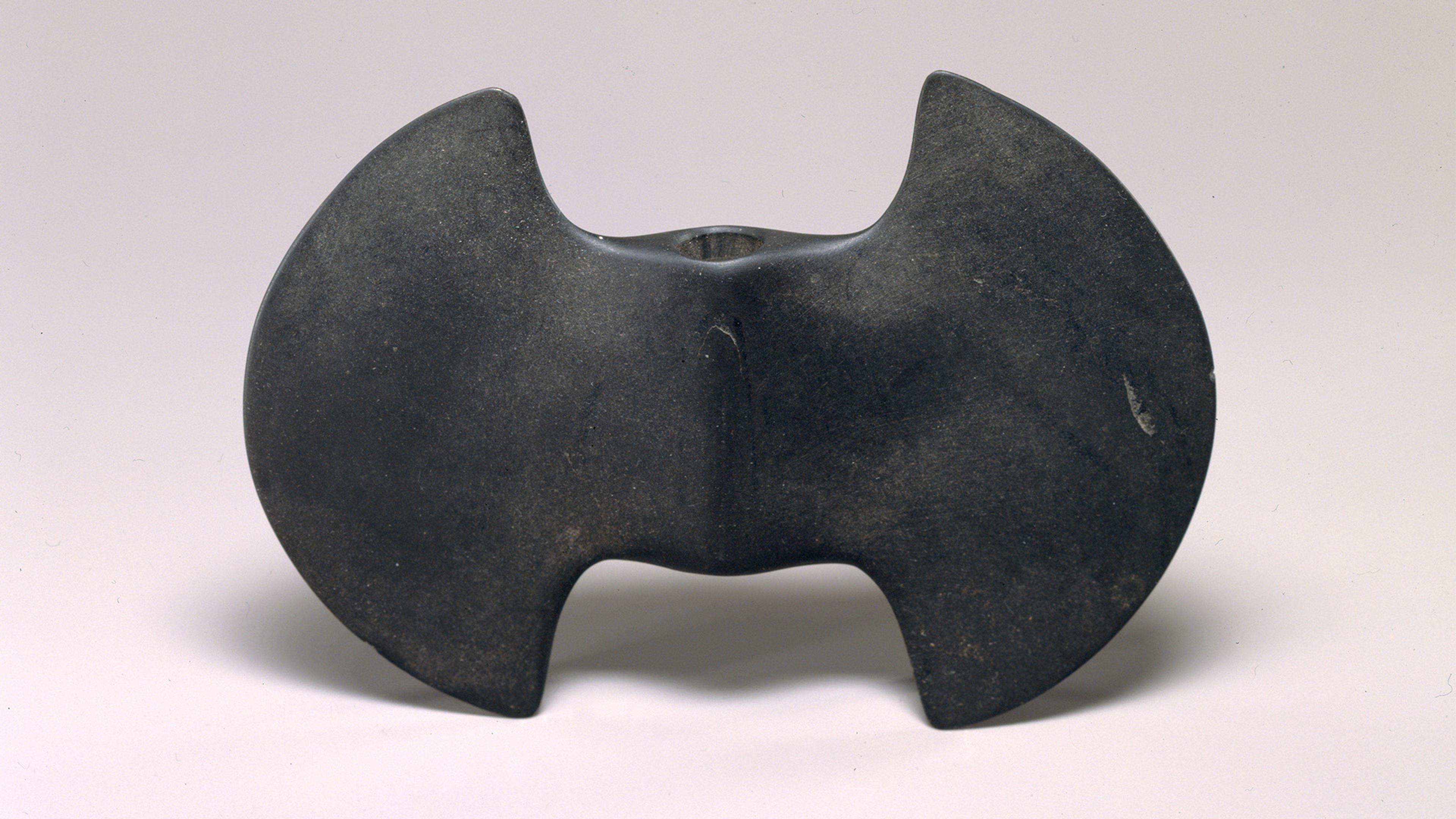
Bannerstone, Double-Bitted Axe
The Indigenous sculptor chose soft sedimentary shale to carve this Double-Bitted Axe bannerstone. Thinning the curved edges to a millimeter in width, this bannerstone is exceedingly fragile. Parallel to the perforation they carved a pointed edge on both sides, accentuating the near perfect symmetry of the composition. On one side the ridge has chipped in what could be archaic or historic period wear. The perforation is masterfully drilled with a hollow reed leaving noticeable even concentric circles on the inside. Though there are a few chips on the thin edges of the stone, there is no sign of wear at the perforation. Given the unusually soft geologic material and thin flanges of this stone, this carefully sculpted bannerstone may have been intended for extraordinary rather than everyday display. 2011.254.13 is written in red on one of the curved edges.
Anna Blume, Professor of the History of Art, Fashion Institute of Technology, State University of New York 2023
References and Further Reading
Knoblock, Byron. Bannerstones of the North American Indian. LaGrange: LeGrange: Bryon Knoblock, 1939.
Lutz, David L. The Archaic Bannerstone: Its Chronological History and Purpose From 6000 B.C. to 1000 B.C. Newburg: David L. Lutz, 2000.
Sassaman, Kenneth. “Craftworks of Structure.” The Eastern Archaic Historicized. New York: AltaMira Press, 2010, pp. 97-142.
Bannerstone Project. Fashion Institute of Technology, https://bannerstone.fitnyc.edu/
Artwork Details
- Title: Bannerstone, Double-Bitted Axe
- Date: 6000–1000 BCE
- Geography: United States, Illinois
- Culture: Archaic
- Medium: Shale
- Dimensions: H. 3 × W. 4 3/4 × D. 5/8 in. (7.6 × 12.1 × 1.5 cm)
- Classification: Stone-Ornaments
- Credit Line: Ralph T. Coe Collection, Gift of Ralph T. Coe Foundation for the Arts, 2011
- Object Number: 2011.154.13
- Curatorial Department: The Michael C. Rockefeller Wing
More Artwork


Related Content
Research Resources
The Met provides unparalleled resources for research and welcomes an international community of students and scholars. The Met's Open Access API is where creators and researchers can connect to the The Met collection. Open Access data and public domain images are available for unrestricted commercial and noncommercial use without permission or fee.
To request images under copyright and other restrictions, please use this Image Request form.
Feedback
We continue to research and examine historical and cultural context for objects in The Met collection. If you have comments or questions about this object record, please contact us using the form below. The Museum looks forward to receiving your comments.
Content Notice
The Metropolitan Museum of Art presents over 5,000 years of art from around the world, and our online collection reflects ongoing work conducted over the course of our more than 150-year history. You may encounter objects or images that may be inappropriate for some viewers or information that may be outdated.