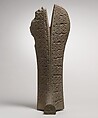
Palma with canines
Events are sometimes implied by the imagery of stone ballgame sculpture; hachas in the form of human heads and hands, for example (see MMA 1979.206.1042 and .371), likely reference human capture and sacrifice, but the direct depiction of a narrative moment such as this one is extremely rare. The reinterpretation of the base of the palma as a temple platform suggests that the scene shown here is an otherwise unknown mythic event reinterpreted as sacred ritual.
Palmas are one of the categories of stone sculpture that are associated with ballgame regalia, although they would not have been worn while playing the game. The curved base of this example suggests placement over the curved surface of a yoke (see MMA 1979.206.445), but there is no visible means of attachment, and the combined weight of the two pieces would have severely restricted the player’s movements. It is more likely that these are replicas of ballplayer gear made of lighter materials such as leather, wood, and cloth, and that the stone versions were given out as trophies or placed in tombs as offerings.
Patricia J. Sarro, 2024
Further Reading
Blanco Padilla, Alicia, Bernardo Rodríguez Galicia, and Raúl Valadez Azúa. Estudio de los cánidos arqueológicos del México Prehispánico. Instituto Nacional de Antropología e Historia; Instituto de Investigaciones Antropológicas, Universidad Nacional Autónoma de México, 2009.
Ceremonial Sculpture of Veracruz. New York: Long Island University, 1987.
Earley, Caitlin C. “Stone Sculpture and Ritual Impersonation in Classic Veracruz.” Metropolitan Museum Journal (2019), pp. 8-25, fig. 5.
Scott, John F. “Dressed to Kill: Stone Regalia of the Mesoamerican Ballgame”. In The Sport of Life and Death, The Mesoamerican Ballgame, E. Michael Whittington, ed, pp. 50-63 New York: Thames and Hudson, 2001.
Shook, Edwin M. and Elayne Marquis. Secrets in Stone: Yokes, Hachas and Palmas from Southern Mesoamerica. Philadelphia: American Philosophical Society, 1996.
Artwork Details
- Title: Palma with canines
- Artist: Classic Veracruz artist(s)
- Date: 800–1100 CE
- Geography: Mexico, Mesoamerica, Veracruz
- Culture: Classic Veracruz
- Medium: Stone, pigment (probably hematite)
- Dimensions: H. 8 11/16 x W. 4 1/2 x L. 4 5/16 in. (22 x 11.5 x 11 cm)
- Classification: Stone-Sculpture
- Credit Line: Museum Purchase, 1900
- Object Number: 00.5.1419
- Curatorial Department: The Michael C. Rockefeller Wing
More Artwork
Research Resources
The Met provides unparalleled resources for research and welcomes an international community of students and scholars. The Met's Open Access API is where creators and researchers can connect to the The Met collection. Open Access data and public domain images are available for unrestricted commercial and noncommercial use without permission or fee.
To request images under copyright and other restrictions, please use this Image Request form.
Feedback
We continue to research and examine historical and cultural context for objects in The Met collection. If you have comments or questions about this object record, please contact us using the form below. The Museum looks forward to receiving your comments.
Content Notice
The Metropolitan Museum of Art presents over 5,000 years of art from around the world, and our online collection reflects ongoing work conducted over the course of our more than 150-year history. You may encounter objects or images that may be inappropriate for some viewers or information that may be outdated.