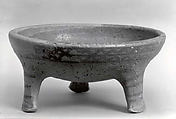
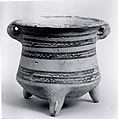
Tripod bowl
It is often thought that the inhabitants of Luristan in this period were pastoral nomads, who moved with their herds from the high valleys of the Zagros during the summer to lowland pastures in the winter. This theory arises from the dearth of evidence for settlements, and the occurrence of isolated cemetery sites. At the same time, the infrastructure necessary for bronze working, an important industry in Luristan, suggests that some sedentary settlements must have existed. In all likelihood these settlements were not located on mounds, but at lower elevations near water sources where agriculture could be practiced. This is probably the case with Kamterlan II, where an earlier settlement was replaced around 2000 B.C. by another, lower one, and the site at the top of the mound subsequently became a cemetery.
Artwork Details
- Title: Tripod bowl
- Period: Middle Bronze Age
- Date: ca. 2000–1600 BCE
- Geography: Iran, Luristan, Kamterlan II
- Culture: Iran
- Medium: Ceramic
- Dimensions: 3.5 in. (8.89 cm)
- Credit Line: Rogers Fund, 1943
- Object Number: 43.89.4
- Curatorial Department: Ancient West Asian Art
More Artwork
Research Resources
The Met provides unparalleled resources for research and welcomes an international community of students and scholars. The Met's Open Access API is where creators and researchers can connect to the The Met collection. Open Access data and public domain images are available for unrestricted commercial and noncommercial use without permission or fee.
To request images under copyright and other restrictions, please use this Image Request form.
Feedback
We continue to research and examine historical and cultural context for objects in The Met collection. If you have comments or questions about this object record, please contact us using the form below. The Museum looks forward to receiving your comments.
Content Notice
The Metropolitan Museum of Art presents over 5,000 years of art from around the world, and our online collection reflects ongoing work conducted over the course of our more than 150-year history. You may encounter objects or images that may be inappropriate for some viewers or information that may be outdated.