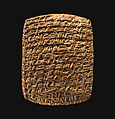
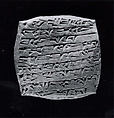
Cuneiform tablet: statement before witnesses
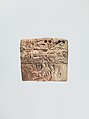
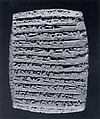
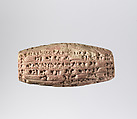
The merchants’ private archives contained all types of texts including legal documents. This tablet, a statement before witnesses, was originally sealed in a clay envelope or case (66.245.20b) before being archived for future consultation. The cuneiform text, read from left to right, records a dispute over a share in a capital-investment between the merchant Idi-Ishtar and two men filing on behalf of an unnamed woman, the wife of Salliya, who wanted to buy a share of Idi-Ishtar’s investment capital from a third party. Idi-Ishtar explains why the woman cannot take over the share before the two witnesses, who then use their seals to finalize his statement.
Artwork Details
- Title: Cuneiform tablet: statement before witnesses
- Period: Middle Bronze Age–Old Assyrian Trading Colony
- Date: ca. 20th–19th century BCE
- Geography: Anatolia, probably from Kültepe (Karum Kanesh)
- Culture: Old Assyrian Trading Colony
- Medium: Clay
- Dimensions: 5.7 x 4.8 x 2.1 cm (2 1/4 x 1 7/8 x 7/8 in.)
- Credit Line: Gift of Mr. and Mrs. J. J. Klejman, 1966
- Object Number: 66.245.20a
- Curatorial Department: Ancient West Asian Art
More Artwork
Related Content
 Free to download
Research Resources
The Met provides unparalleled resources for research and welcomes an international community of students and scholars. The Met's Open Access API is where creators and researchers can connect to the The Met collection. Open Access data and public domain images are available for unrestricted commercial and noncommercial use without permission or fee.
To request images under copyright and other restrictions, please use this Image Request form.
Feedback
We continue to research and examine historical and cultural context for objects in The Met collection. If you have comments or questions about this object record, please contact us using the form below. The Museum looks forward to receiving your comments.
Content Notice
The Metropolitan Museum of Art presents over 5,000 years of art from around the world, and our online collection reflects ongoing work conducted over the course of our more than 150-year history. You may encounter objects or images that may be inappropriate for some viewers or information that may be outdated.