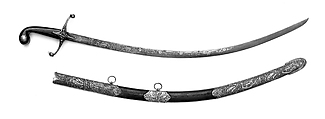
Saber with Scabbard and Carrying Belt
Artwork Details
- Title: Saber with Scabbard and Carrying Belt
- Goldsmith: Stamped with what may be the mark of Georg Hoffmann (Polish, Breslau (now Wrocław, Poland), recorded 1596–1609)
- Date: early 17th century
- Culture: Polish
- Medium: Steel, gold, silver, leather, wood, textile, semiprecious stones
- Dimensions: L. 37 1/2 in. (95.2 cm); L. of blade 31 1/2 in. (80 cm); Wt. of saber (a) 2 lb. 1 oz. (936 g); Wt. of scabbard (b) 2 lb. 3 oz. (992.2 g); Wt. of belt (c); 5 oz. (141.7 g)
- Classification: Swords
- Credit Line: Bashford Dean Memorial Collection, Funds from various donors, 1929
- Object Number: 29.158.716a–c
- Curatorial Department: Arms and Armor
Audio
4430. Saber with Scabbard and Carrying Belt
NARRATOR: This bejeweled sabre was created in Poland or Hungary during the mid-sixteenth century, but its design draws heavily on Islamic prototypes. Curator Pierre Terjanian.
PIERRE TERJANIAN: The fascination for Islamic ornament, both in terms of jewelry, clothing, and weapons came very much from the fact that the Ottomans were at the gates of Western Europe by 1529. Typical of an Islamic sword of the period is the blade that swells at the end and is curved. If you look at the tip, it's much broader. It's essentially a slashing weapon. And then also the hilt—the part that protects the hand—which has even a curved pommel—the part that serves as a counterweight for the rest of the weapon. The presence of stones and other gems on the mounts for the scabbard are also typical of Ottoman or Turkish style.
This was part of a set of twelve similar swords that were kept in the armory of the Princes-Electors of Saxony. They had a collection known as the Turkish Chamber, in which they had both Turkish objects, and objects made in the Turkish style, which they both admired but also used in ceremonies, in festivals, and so on. It was extremely fashionable to organize festivals, which could include masquerades and dancing, but also tournaments, in which all the participants would be dressed in the Oriental style.
NARRATOR: Press play to see what the participants in one of these festivals looked like.
More Artwork
Research Resources
The Met provides unparalleled resources for research and welcomes an international community of students and scholars. The Met's Open Access API is where creators and researchers can connect to the The Met collection. Open Access data and public domain images are available for unrestricted commercial and noncommercial use without permission or fee.
To request images under copyright and other restrictions, please use this Image Request form.
Feedback
We continue to research and examine historical and cultural context for objects in The Met collection. If you have comments or questions about this object record, please contact us using the form below. The Museum looks forward to receiving your comments.
Content Notice
The Metropolitan Museum of Art presents over 5,000 years of art from around the world, and our online collection reflects ongoing work conducted over the course of our more than 150-year history. You may encounter objects or images that may be inappropriate for some viewers or information that may be outdated.