Armored Cavalryman
Artwork Details
- Title: Armored Cavalryman
- Date: 18th–19th century
- Culture: Tibetan, and possibly Bhutanese and Nepalese
- Medium: Steel, iron, gold, silver, copper alloy, brass, wood, leather, textile, bone, horn, silk, hair, turquoise, lead
- Dimensions: as mounted, H. approx. 55 in. (139.7 cm)
- Classification: Armor
- Credit Line: 36.25.2ii, .25, .351, .476, .583a–d, h–k, .2174, .2461, .2505, .2557a, b: Bequest of George C. Stone, 1935; 1974.160.10: Bequest of Joseph V. McMullan, 1973; 1970.164.7a, b: Gift of Mrs. Faïe J. Joyce, 1970; 1997.214.6: Purchase, Rogers Fund and bequest of Stephen V. Grancsay, by exchange, 1997; 2006.269: Purchase, Arthur Ochs Sulzberger Gift, 2006
- Object Number: 36.25.25,.28,.351,.476,.583,.842,.2174...
- Curatorial Department: Arms and Armor
Audio
4437. Armored Cavalryman
NARRATOR: Arms and armor may seem incongruous with Tibetan Buddhism, but Tibet actually has a long military tradition, stretching back to the Tibetan Empire of the seventh and eighth centuries. And The Met has one of the most extensive collections of Tibetan arms and armor in the world. You can see some examples in this case. Curator Donald LaRocca.
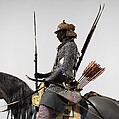
DONALD LAROCCA: The figure in the center of the case shows a Tibetan cavalryman as his arms and equipment would’ve been used from the seventeenth century through the eighteenth century and nineteenth century. This type of equipment remained in use for ceremonial purposes right up to the middle of the twentieth century, which is why we know how it should be put together. The rider wears a steel helmet with gilded decoration. He wears a coat of mail that’s made up of hundreds of interlocking iron rings.
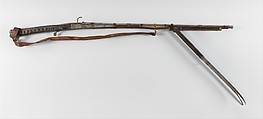
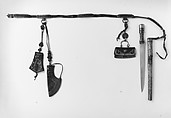
NARRATOR: He also carries a musket on his back, as well as a quiver of arrows and a bow case suspended from his hips.
DONALD LAROCCA: Horseback archery was very important across Asia, and the Tibetans were expert at riding and shooting at the same time. Someone equipped in this way would be expected to be able to ride, shoot his musket, and fire the bow and arrow. And in fact, that was part of the events at the Prayer Festival in which this type of armor was worn up until the 1950s.
More Artwork
Research Resources
The Met provides unparalleled resources for research and welcomes an international community of students and scholars. The Met's Open Access API is where creators and researchers can connect to the The Met collection. Open Access data and public domain images are available for unrestricted commercial and noncommercial use without permission or fee.
To request images under copyright and other restrictions, please use this Image Request form.
Feedback
We continue to research and examine historical and cultural context for objects in The Met collection. If you have comments or questions about this object record, please contact us using the form below. The Museum looks forward to receiving your comments.
Content Notice
The Metropolitan Museum of Art presents over 5,000 years of art from around the world, and our online collection reflects ongoing work conducted over the course of our more than 150-year history. You may encounter objects or images that may be inappropriate for some viewers or information that may be outdated.