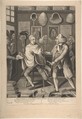
The Bostonians Paying the Excise-Man, or Tarring & Feathering
The action in the foreground centers on the punishment, a few weeks later, of a loyalist tax collector, John Malcom. This American-born servant of the British government had a violent temper and delighted in the abuse his authority. On January 24, 1774, as Malcolm argued with a shoemaker and Tea-party participant, he opened the man’s head with a blow from his cane. When angry Bostonians surrounded the assailant’s house, he taunted them and injured one with a sword. Malcom was then tarred and feathered, dragged to the Liberty Tree, threatened with hanging, and forced to drink tea until he foreswore his loyalty to the crown. After a long recuperation, he traveled to London to seek remuneration and never returned to Boston.
To bring the disparate scenes together, the artist moved the Liberty Tree—a hundred-year-old elm and patriot rallying spot—from near the Boston Common to the harbor, hung a noose from one branch, and placed an upside-down copy of the 1765 Stamp Act on its trunk as a reminder of the tax that first sparked American protest. While patriot leaders condemned Malcom’s treatment, they could not prevent Parliament from passing the Intolerable Acts, drafted to repress activism and force restitution for the ruined tea. When the British army occupied Boston in 1775, loyalists felled the Liberty Tree and used it for firewood (see 24.90.31–24.90.35 for all the prints in the Sayer and Bennett series).
Artwork Details
- Title: The Bostonians Paying the Excise-Man, or Tarring & Feathering
- Artist: Attributed to Philip Dawe (British, ca. 1745–1809?)
- Publisher: Robert Sayer and John Bennett (British, active 1774–83)
- Date: October 31, 1774
- Medium: Mezzotint and etching
- Dimensions: Sheet: 14 in. × 10 1/8 in. (35.6 × 25.7 cm)
Plate: 15 9/16 × 10 15/16 in. (39.5 × 27.8 cm) - Classification: Prints
- Credit Line: Bequest of Charles Allen Munn, 1924
- Object Number: 24.90.32
- Curatorial Department: Drawings and Prints
More Artwork
Related Content

 Free to download
Research Resources
The Met provides unparalleled resources for research and welcomes an international community of students and scholars. The Met's Open Access API is where creators and researchers can connect to the The Met collection. Open Access data and public domain images are available for unrestricted commercial and noncommercial use without permission or fee.
To request images under copyright and other restrictions, please use this Image Request form.
Feedback
We continue to research and examine historical and cultural context for objects in The Met collection. If you have comments or questions about this object record, please contact us using the form below. The Museum looks forward to receiving your comments.
Content Notice
The Metropolitan Museum of Art presents over 5,000 years of art from around the world, and our online collection reflects ongoing work conducted over the course of our more than 150-year history. You may encounter objects or images that may be inappropriate for some viewers or information that may be outdated.