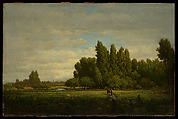
The Edge of the Woods at Monts-Girard, Fontainebleau Forest
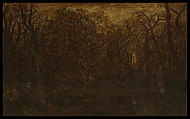
As related by Rousseau’s friend and biographer Alfred Sensier, this painting represents part of the woods at Fontainebleau where the trees—some hundreds of years old—were vulnerable to harvesting, a practice the artist bitterly opposed. Although the composition reflects seventeenth-century Dutch prototypes, its contemporary resonance is elucidated by the poignant contrast between the saplings in the recently cleared opening at the left and the aged specimens at the right. After working on the panel for two years, Rousseau dated it, a rare gesture signifying that he considered it particularly successful. The painting was included in Rousseau’s triumphant display at the Universal Exposition of 1855.
Artwork Details
- Title: The Edge of the Woods at Monts-Girard, Fontainebleau Forest
- Artist: Théodore Rousseau (French, Paris 1812–1867 Barbizon)
- Date: 1852–54
- Medium: Oil on wood
- Dimensions: 31 1/2 x 48 in. (80 x 121.9 cm)
- Classification: Paintings
- Credit Line: Catharine Lorillard Wolfe Collection, Wolfe Fund, 1896
- Object Number: 96.27
- Curatorial Department: European Paintings
Audio
6054. The Edge of the Woods at Monts-Girard, Fontainebleau Forest
NARRATOR—This late landscape by Théodore Rousseau represents a clearing in the Fontainebleau Forest. Rousseau made a handsome living by exploiting the public's growing fascination with the natural environment. But he was also deeply distressed by the negative impact that tourism and the timber industry were having on the Fontainebleau Forest. He may have even conceived of this painting as a kind of reproach to those who threatened to destroy it.
This work was first exhibited in Paris at the Universal Exposition of 1855.Its meticulously detailed but rugged execution is typical of Rousseau's mature style. Seventeenth-century Dutch painting provided a precedent for this vigorous approach to landscape. But many of Rousseau's contemporaries considered his paintings mere sketches that were unworthy of public display.
This debate over finish continued well into the end of the century, culminating with the critical debates over Impressionist technique in the 1870s and 1880s.
Along with Corot, whose works hang in an adjacent gallery of the museum, Rousseau was the chief representative of naturalistic landscape painting in France during the first half of the nineteenth century. He is regarded as the leader of the "Barbizon School"—a loose group of painters of rural life who lived and worked in the tiny villaige of Barbizon in the western edge of the Fontainebleau Forest. You can see other works by Barbizon artists elsewhere in these galleries.
More Artwork
Related Content
 Free to download
Research Resources
The Met provides unparalleled resources for research and welcomes an international community of students and scholars. The Met's Open Access API is where creators and researchers can connect to the The Met collection. Open Access data and public domain images are available for unrestricted commercial and noncommercial use without permission or fee.
To request images under copyright and other restrictions, please use this Image Request form.
Feedback
We continue to research and examine historical and cultural context for objects in The Met collection. If you have comments or questions about this object record, please contact us using the form below. The Museum looks forward to receiving your comments.
Content Notice
The Metropolitan Museum of Art presents over 5,000 years of art from around the world, and our online collection reflects ongoing work conducted over the course of our more than 150-year history. You may encounter objects or images that may be inappropriate for some viewers or information that may be outdated.