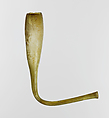
Glass Drinking Horn
Artwork Details
- Title: Glass Drinking Horn
- Date: 575–625
- Geography: Made in Italy (North)
- Culture: Langobardic (?)
- Medium: Glass
- Dimensions: 8 1/4 x 2 3/4 in. (21 x 7 cm)
Other (Ht. ): 5 3/4 in. (14.6 cm) - Classification: Glass-Vessels
- Credit Line: Edward C. Moore Collection, Bequest of Edward C. Moore, 1891
- Object Number: 91.1.1407
- Curatorial Department: Medieval Art and The Cloisters
Audio
2765. Glass Drinking Horn
NARRATOR: Graceful, feathered red and white forms decorate this light green glass drinking horn. It was probably made in Northern Italy, possibly in the sixth or seventh century.
Lisa Pilosi is a Conservator in the Sherman Fairchild Center for Objects Conservation, responsible for the glass at The Metropolitan Museum’s collection.
LISA PILOSI: Glass drinking vessels in the shape of horns are relatively rare and are thought to imitate actual horns. Like other vessels that cannot stand on their own, the implication is that the drinker must empty the cup in one go.
This medieval glass drinking horn is an example of the survival of the Roman glass making tradition. The invention of glass blowing, around the middle of the first century BC, was the most important Roman contribution to the development of glass making. Glass blowing allowed objects to be made quickly (and) cheaply…so that glass was available to a much wider sector of society. Blowing continued to be the principle method of manufacturing glass objects in medieval Europe.
(This) horn has been reconstructed from…fragments. It was felt…that it was not necessary to fill in missing areas, because the shape of the vessel was apparent, and modern museum goers can appreciate that an object, which is over a thousand years old, has had a rather checkered history.
More Artwork
Related Content
 Free to download
Research Resources
The Met provides unparalleled resources for research and welcomes an international community of students and scholars. The Met's Open Access API is where creators and researchers can connect to the The Met collection. Open Access data and public domain images are available for unrestricted commercial and noncommercial use without permission or fee.
To request images under copyright and other restrictions, please use this Image Request form.
Feedback
We continue to research and examine historical and cultural context for objects in The Met collection. If you have comments or questions about this object record, please contact us using the form below. The Museum looks forward to receiving your comments.
Content Notice
The Metropolitan Museum of Art presents over 5,000 years of art from around the world, and our online collection reflects ongoing work conducted over the course of our more than 150-year history. You may encounter objects or images that may be inappropriate for some viewers or information that may be outdated.