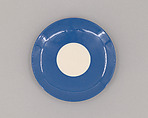
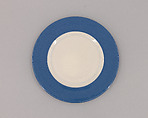
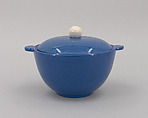
Lamelle Delphinium Blue Teapot Stand
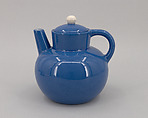
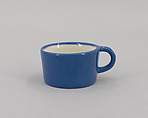
Karasz designed this teapot stand for Buffalo Pottery as part of a tea set. The simple pattern of the tea set, in Delphinium Blue and white, reflects both her Central European training and her experience in Java, where she spent time ca. 1930. The set was marked "Buffalo China," a "Lamelle Patented Design," in reference to a lamination process developed by Buffalo Pottery, in which a clay center was inlaid into vitreous china to produce wares that were stronger and more resistant to breakage than china alone.
Artwork Details
- Title: Lamelle Delphinium Blue Teapot Stand
- Designer: Ilonka Karasz (American (born Hungary) Budapest 1896–1981 New York, New York)
- Manufacturer: Buffalo Pottery (Buffalo, New York) (American)
- Date: ca. 1934
- Medium: Glazed ceramic
- Dimensions: 3 5/8 × 5 1/4 × 5 1/4 in., 1.2 lb. (9.2 × 13.3 cm, 13.3 × 0.5 kg)
- Classification: Ceramics-Pottery
- Credit Line: Purchase, Theodore R. Gamble Jr. Gift, in honor of his mother, Mrs. Theodore Robert Gamble, 1983
- Object Number: 1983.178.2
- Rights and Reproduction: © Ilonka Karasz
- Curatorial Department: Modern and Contemporary Art
More Artwork
Research Resources
The Met provides unparalleled resources for research and welcomes an international community of students and scholars. The Met's Open Access API is where creators and researchers can connect to the The Met collection. Open Access data and public domain images are available for unrestricted commercial and noncommercial use without permission or fee.
To request images under copyright and other restrictions, please use this Image Request form.
Feedback
We continue to research and examine historical and cultural context for objects in The Met collection. If you have comments or questions about this object record, please contact us using the form below. The Museum looks forward to receiving your comments.
Content Notice
The Metropolitan Museum of Art presents over 5,000 years of art from around the world, and our online collection reflects ongoing work conducted over the course of our more than 150-year history. You may encounter objects or images that may be inappropriate for some viewers or information that may be outdated.