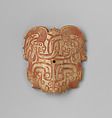
Annular disk (bi)
Artwork Details
- 新石器時代 良渚文化玉璧
- Title: Annular disk (bi)
- Period: Neolithic period, Liangzhu culture (ca. 3200–2000 BCE)
- Date: mid-3rd millennium BCE
- Culture: China
- Medium: Jade (nephrite)
- Dimensions: H. 6 1/8 in. (15.6 cm); W. 5/16 in. (.8 cm)
- Classification: Jade
- Credit Line: Rogers Fund, 1917
- Object Number: 17.118.43
- Curatorial Department: Asian Art
Audio
7330. Ritual Object (Bi), Part 1
[GONGS PLAYING]
The Neolithic Chinese jade disks located on the back wall of this case are ritual objects known as bi. As many as forty such bi disks might be buried with the body of a person of high social status, along with jade jewelry and pottery vessels. In burials, they were often placed on a corpse’s chest, above the head, and encircling the body. This use suggests that in addition to serving as tokens of rank, bi may also have played a symbolic or magical role in purifying the soul for its journey into the afterlife.
These striking jade objects demonstrate the technical skill achieved by the Neolithic Chinese. Jade is harder than steel, so making these objects demanded an enormous amount of sawing, grinding, and polishing with quartz, sand, or other abrasives. Even more amazing are the resulting forms—completely pared down to smooth, simple, circular abstractions that look very modern.
From Neolithic to modern times, Chinese civilization has invested great significance in jade. While green jade is the most well known type in the West, pure white jade is the most prized by the Chinese. Because the stone makes a clear and sonorous sound when struck, jade has long been a symbol of purity and moral rectitude.
Listen to more about this artwork
More Artwork
Research Resources
The Met provides unparalleled resources for research and welcomes an international community of students and scholars. The Met's Open Access API is where creators and researchers can connect to the The Met collection. Open Access data and public domain images are available for unrestricted commercial and noncommercial use without permission or fee.
To request images under copyright and other restrictions, please use this Image Request form.
Feedback
We continue to research and examine historical and cultural context for objects in The Met collection. If you have comments or questions about this object record, please contact us using the form below. The Museum looks forward to receiving your comments.
Content Notice
The Metropolitan Museum of Art presents over 5,000 years of art from around the world, and our online collection reflects ongoing work conducted over the course of our more than 150-year history. You may encounter objects or images that may be inappropriate for some viewers or information that may be outdated.