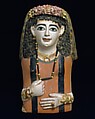
Mask of a woman with corkscrew locks and bangs
Like the painted mummy portraits, the masks suggest strongly individualized appearances and affect Roman fashions in hairstyle, jewelry, and dress. They follow, however, a somewhat different pattern. For example, female masks may have coiffures that combine Roman arrangements of the upper part of the hair with long corkscrew locks that were considered typically Egyptian.
Despite the seeming individuality of the masks, most faces were made in a mold. Distinguishing details were worked in the plaster with a spatula or knife. The ears were added separately, and sometimes eyes were inlaid with glass or stone. The mask was then frequently painted or gilded.
This woman's waved hairstyle is based on Roman court fashion, but three hanging corkscrew curls behind the ears and a short fringe of curls over the forehead and in front of the ears seem to reflect a local style. Toward the back of her head, above her ears, are traces of a smooth area that once represented a pillow. In general earlier Roman-period masks such as this one show the deceased as if reclining on a bier with the head on a pillow, while later masks have the head raised as if the deceased is rising from the bier. The underneath edge of this example is flat where it is meant to be attached to a body covering of wood or other materials.
Artwork Details
- Title: Mask of a woman with corkscrew locks and bangs
- Period: Roman Period
- Date: 50–150 CE
- Geography: From Egypt
- Medium: Plaster, paint
- Dimensions: H. 23.5 × W. 19.2 × D. 11.2 cm (9 1/4 × 7 9/16 × 4 7/16 in.)
- Credit Line: Funds from various donors, 1900
- Object Number: 00.2.16
- Curatorial Department: Egyptian Art
More Artwork

Related Content
 Free to download
Research Resources
The Met provides unparalleled resources for research and welcomes an international community of students and scholars. The Met's Open Access API is where creators and researchers can connect to the The Met collection. Open Access data and public domain images are available for unrestricted commercial and noncommercial use without permission or fee.
To request images under copyright and other restrictions, please use this Image Request form.
Feedback
We continue to research and examine historical and cultural context for objects in The Met collection. If you have comments or questions about this object record, please contact us using the form below. The Museum looks forward to receiving your comments.
Content Notice
The Metropolitan Museum of Art presents over 5,000 years of art from around the world, and our online collection reflects ongoing work conducted over the course of our more than 150-year history. You may encounter objects or images that may be inappropriate for some viewers or information that may be outdated.