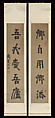
Poem on beautiful ladies
Zhou was an avid patron of contemporary artists-including a number of Ming loyalists-collecting their works and chronicling their lives in his Record of Paintings Viewed (Du Hua Lu, 1673), which gives short biographical sketches of seventy-eight painters. He also formed an important collection of ancient and modern seals.
Zhou's interest in archaic scripts is revealed in his distinctive writing style, which also reflects the later seventeenth-century taste for the bizarre and idiosyncratic. Here, Zhou has transcribed one of his poems in a formal regular script with exaggerated diagonals and stiff rectilinear forms that recall the monumental characters carved
into Six Dynasties (220–589) stone steles.
In Zhou's poem the imagery of thwarted romance serves as a metaphor for the frustrated ambitions of the loyal official pursuing recognition and rank:
[The lovely ladies] Peach Root and Peach Leaf
need not urge me,
Like the beautiful clear waves, I may not linger.
Dewy flowers bloom from the frost,
Like a windborne maiden that comes from
the moon.
My heart's desire is to be united with the
Milky Way,
Yet my timid mind doubts I will ever see the
full moon.
As the sun sets through the leaves I know not
where to gaze,
As jade pendants tinkle from within the
white clouds.
Song of Beauties on Ice, by Zhou Lianggong of Daliang [Kaifeng]
Lent by a Private Collection
L.2003.44.1
Artwork Details
- 清 周亮工 麗人行冰上同薗次賦 軸
- Title: Poem on beautiful ladies
- Calligrapher: Zhou Lianggong (Chinese, 1612–1672)
- Period: Qing dynasty (1644–1911)
- Date: mid-17th century
- Culture: China
- Medium: Hanging scroll; ink on silk
- Dimensions: Image: 78 1/8 × 17 5/8 in. (198.4 × 44.8 cm)
Overall with mounting: 92 3/4 × 23 5/8 in. (235.6 × 60 cm)
Overall with knobs: 92 3/4 × 27 in. (235.6 × 68.6 cm) - Classification: Calligraphy
- Credit Line: Promised Gift of Julia and John Curtis
- Curatorial Department: Asian Art
More Artwork
Research Resources
The Met provides unparalleled resources for research and welcomes an international community of students and scholars. The Met's Open Access API is where creators and researchers can connect to the The Met collection. Open Access data and public domain images are available for unrestricted commercial and noncommercial use without permission or fee.
To request images under copyright and other restrictions, please use this Image Request form.
Feedback
We continue to research and examine historical and cultural context for objects in The Met collection. If you have comments or questions about this object record, please contact us using the form below. The Museum looks forward to receiving your comments.
Content Notice
The Metropolitan Museum of Art presents over 5,000 years of art from around the world, and our online collection reflects ongoing work conducted over the course of our more than 150-year history. You may encounter objects or images that may be inappropriate for some viewers or information that may be outdated.