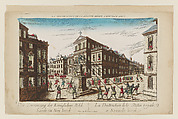
Réprésentation du feu terrible à nouvelle Yorck, que les Américains allumé pendant la nuit du 19. septembre 1776 (Representation of the terrible fire at New York, that the Americans lit during the night of September 19, 1776)
The print belongs to a popular type known as "Vues d'optique," "Perspektivansichten," or Perspective Prints—horizontal images whose titles often are printed in mirror-writing. When viewed through a perspective glass or zograscope—a device that contains a concave lens and mirror—the text becomes readable and the reversed image appears three-dimensional. Specially designed peep boxes also enhanced viewing. First published in Augsburg, then replicated in Paris, the print comes from a group of New York subjects that show British ships landing troops in lower Manhattan on September 15, 1776, occupying soldiers marching up Broadway, and a fire devastating the city shortly afterward. The group demonstrates broad European interest in events taking place across the Atlantic.
Artwork Details
- Title: Réprésentation du feu terrible à nouvelle Yorck, que les Américains allumé pendant la nuit du 19. septembre 1776 (Representation of the terrible fire at New York, that the Americans lit during the night of September 19, 1776)
- Engraver: Anonymous, French, 18th century
- Artist: After Franz Xavier Habermann (German, Habelschwerdt, Glatz 1721–1796 Augsburg)
- Publisher: Basset (Paris)
- Date: ca. 1778
- Medium: Hand-colored etching and engraving
- Dimensions: Image: 9 1/8 × 15 1/16 in. (23.2 × 38.2 cm)
Sheet: 11 × 16 in. (27.9 × 40.6 cm) - Classification: Prints
- Credit Line: The Edward W. C. Arnold Collection of New York Prints, Maps and Pictures, Bequest of Edward W. C. Arnold, 1954
- Object Number: 54.90.1415
- Curatorial Department: Drawings and Prints
More Artwork
![L'Entré triumphale des Troupes royales a Nouvelle Yorck – Der Einzug der Königlichen Volcker in Neu Yorck [The Triumphal Entry of Royal Troops into New York], Anonymous, French, 18th century French, Hand-colored etching and engraving](https://images.metmuseum.org/CRDImages/dp/web-additional/DP-44758-001.jpg)
Research Resources
The Met provides unparalleled resources for research and welcomes an international community of students and scholars. The Met's Open Access API is where creators and researchers can connect to the The Met collection. Open Access data and public domain images are available for unrestricted commercial and noncommercial use without permission or fee.
To request images under copyright and other restrictions, please use this Image Request form.
Feedback
We continue to research and examine historical and cultural context for objects in The Met collection. If you have comments or questions about this object record, please contact us using the form below. The Museum looks forward to receiving your comments.
Content Notice
The Metropolitan Museum of Art presents over 5,000 years of art from around the world, and our online collection reflects ongoing work conducted over the course of our more than 150-year history. You may encounter objects or images that may be inappropriate for some viewers or information that may be outdated.