Hook-Mask (Garra or Gra)
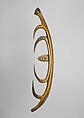
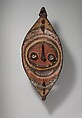
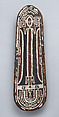
Each type of hook-mask figure is broadly associated with a different category of spirits. While interpretation of their imagery varies, the hook features of the flat mask panels are typically interpreted as hornbill’s beaks, while the longer, more extended images tend to be identified as stylized catfish, the hooks representing their curling whiskers. The flat, mask-like images were the focus of male initiation rites and hunting and were linked to senior men, elders of the clan and forest spirits. The association with hornbills derives from the fact that the birds nest in locations where bush spirits are known to dwell. Furthermore, the consumption of hornbills themselves, as well as the use of their spectacular feathers and beaks, were the reserve of initiated elders. When not in use, the images were stored in the men’s ceremonial house along with other sacred objects or suspended from the rafters, safely concealed from uninitiated eyes. The more slender hooklike figures tend to be associated with water spirits and were ideally immersed in swamps or other watery places. Although all garra figures fall into these two broad categories, each portrays a specific spirit whose name and powers were intimately known to the individual man who owned it.
Artwork Details
- Title: Hook-Mask (Garra or Gra)
- Date: 16th-19th century
- Geography: Papua New Guinea, Upper Korowari region
- Culture: Bahinemo people
- Medium: Wood, traces of pigment
- Dimensions: H. 29 × W. 9 × D. 6 1/2 in. (73.7 × 22.9 × 16.5 cm)
- Classification: Wood-Sculpture
- Credit Line: Gift of Ceil and Michael Pulitzer, 2014
- Object Number: 2014.752
- Curatorial Department: The Michael C. Rockefeller Wing
More Artwork
Related Content
Research Resources
The Met provides unparalleled resources for research and welcomes an international community of students and scholars. The Met's Open Access API is where creators and researchers can connect to the The Met collection. Open Access data and public domain images are available for unrestricted commercial and noncommercial use without permission or fee.
To request images under copyright and other restrictions, please use this Image Request form.
Feedback
We continue to research and examine historical and cultural context for objects in The Met collection. If you have comments or questions about this object record, please contact us using the form below. The Museum looks forward to receiving your comments.
Content Notice
The Metropolitan Museum of Art presents over 5,000 years of art from around the world, and our online collection reflects ongoing work conducted over the course of our more than 150-year history. You may encounter objects or images that may be inappropriate for some viewers or information that may be outdated.