Villa of Maecenas
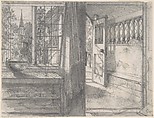
Tree at left; villa in background on cliff; water at right.
"Once thought to be the Villa of Maecenas, this architectural complex is now identified as the sanctuary of Hercules, built in the first century B.C. Situated on the edge of the cliff, it is east of the ancient Lain town TIbor, a civitas foederata of Rome. This town was a favorite resort of patricians and is known to have been the site of elegant villas built by Maecenas and others. Haden's journals at Glasgow University Library mention his visit to Tivoli on April 16, 1844.
The print is in the same direction as the preliminary sketch in BMPD. The drawing is annotated 'Mecenas Villa at Tivoli April 17 1844.'
State I: A view of an ancient rectangular building situated on the crest of a cliff."
[Source: Schneiderman, p. 45]
"Trial Proof: (a) One impression only; touched with brown chalk, and in the collection of Harris B. Dick. The original drawing from which the plate was etched is in Coll. H."
[Source: Harrington, p. 3]
Artwork Details
- Title: Villa of Maecenas
- Artist: Sir Francis Seymour Haden (British, London 1818–1910 Bramdean, Hampshire)
- Date: 1844
- Medium: Etching and brown chalk; trial proof a (Harrington); only state (Schneiderman)
- Dimensions: Sheet (trimmed): 4 1/8 × 6 5/16 in. (10.5 × 16 cm)
- Classification: Prints
- Credit Line: Harris Brisbane Dick Fund, 1917
- Object Number: 17.3.262
- Curatorial Department: Drawings and Prints
More Artwork
Press the down key to skip to the last item.
Research Resources
The Met provides unparalleled resources for research and welcomes an international community of students and scholars. The Met's Open Access API is where creators and researchers can connect to the The Met collection. Open Access data and public domain images are available for unrestricted commercial and noncommercial use without permission or fee.
To request images under copyright and other restrictions, please use this Image Request form.
Feedback
We continue to research and examine historical and cultural context for objects in The Met collection. If you have comments or questions about this object record, please contact us using the form below. The Museum looks forward to receiving your comments.
Content Notice
The Metropolitan Museum of Art presents over 5,000 years of art from around the world, and our online collection reflects ongoing work conducted over the course of our more than 150-year history. You may encounter objects or images that may be inappropriate for some viewers or information that may be outdated.