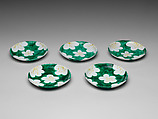
Set of Five Camellia-Shaped Side Dishes (Mukōzuke) with Camellia Patterns
Ogata Kenzan, the younger brother of Kōrin, studied the pottery techniques of Nonomura Ninsei (active ca. 1646–94) before establishing the Narutaki kiln in northwest Kyoto. His numerous sets of tableware were likely created in a workshop setting, with the assistance of multiple craftsmen. Despite this collaborative production, Kenzan’s own exceptional talent as a designer is clearly evident in these works.
Artwork Details
- 尾形乾山工房作 色絵椿文輪花向付 5口
- Title: Set of Five Camellia-Shaped Side Dishes (Mukōzuke) with Camellia Patterns
- Artist: Workshop of Ogata Kenzan (Japanese, 1663–1743)
- Period: Edo period (1615–1868)
- Date: 18th century
- Culture: Japan
- Medium: Stoneware with white slip under and polychrome enamels over transparent glaze (Kyoto, Kenzan ware)
- Dimensions: Diam.(each); 4 1/8 in. (10.5 cm)
- Classification: Ceramics
- Credit Line: Gift of Florence and Herbert Irving, 2019
- Object Number: 2019.193.56a–e
- Curatorial Department: Asian Art
More Artwork
Research Resources
The Met provides unparalleled resources for research and welcomes an international community of students and scholars. The Met's Open Access API is where creators and researchers can connect to the The Met collection. Open Access data and public domain images are available for unrestricted commercial and noncommercial use without permission or fee.
To request images under copyright and other restrictions, please use this Image Request form.
Feedback
We continue to research and examine historical and cultural context for objects in The Met collection. If you have comments or questions about this object record, please contact us using the form below. The Museum looks forward to receiving your comments.
Content Notice
The Metropolitan Museum of Art presents over 5,000 years of art from around the world, and our online collection reflects ongoing work conducted over the course of our more than 150-year history. You may encounter objects or images that may be inappropriate for some viewers or information that may be outdated.