Dress
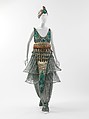
This short evening dress with a zigzag pattern appears to conflate Near and Middle Eastern costume in its details but cites with astonishing closeness a costume designed by Bakst for Nijinsky. A sketch for Nijinsky's role as the Hindu prince in Diaghilev's Le festin (1909) shows a fitted tunic with cap sleeves worn over tight trousers. Poiret's design with a gold- lamé plastron-shaped insert at center front, which disrupts an angled decorative waistband, is a direct reference to Bakst's drawing. The designer, however, has modified Bakst's costume in other details. The sleeves in the original costume are excised, and the whole garment is elongated to calf length. Poiret has relaxed the line of Bakst's tunic and introduced a body-skimming ease. By pleating fullness along the bottom edge of the insert, he created movement in the skirt. Poiret underscored his evocation of royal India through his selection of a richly rainbow-patterned lamé that recalls the gold-shot silks of maharajahs.
Artwork Details
- Title: Dress
- Designer: Paul Poiret (French, Paris 1879–1944 Paris)
- Date: ca. 1925
- Culture: French
- Medium: silk, leather
- Credit Line: Gift of Mrs. Kenneth Maconochie, 1951
- Object Number: C.I.51.47
- Curatorial Department: The Costume Institute
More Artwork
Press the down key to skip to the last item.
Related Content
 Free to download
Research Resources
The Met provides unparalleled resources for research and welcomes an international community of students and scholars. The Met's Open Access API is where creators and researchers can connect to the The Met collection. Open Access data and public domain images are available for unrestricted commercial and noncommercial use without permission or fee.
To request images under copyright and other restrictions, please use this Image Request form.
Feedback
We continue to research and examine historical and cultural context for objects in The Met collection. If you have comments or questions about this object record, please contact us using the form below. The Museum looks forward to receiving your comments.
Content Notice
The Metropolitan Museum of Art presents over 5,000 years of art from around the world, and our online collection reflects ongoing work conducted over the course of our more than 150-year history. You may encounter objects or images that may be inappropriate for some viewers or information that may be outdated.