The Oracle
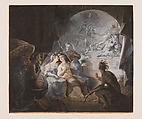
Seated at left Scotia and Hibernia express concern but receive reassurance from Britannia. Only America, perched on a bale of trade goods apart from the others, seems alarmed. The procession on the screen centers on George III as Concord—a crowned figure who holds an unstrung bow and wears a Garter Star. Accompanying the king are Plenty, who holds a cornucopia, and Liberty with a Phrygian Cap atop a staff—suggesting Britain’s political ideals and commercial wealth. Truth with a mirror and Justice with pair of scales follow, near putti who hold a banner lettered "Publick Credit," an orrery, and implements used in painting, sculpture, and architecture to symbolize Britain’s financial, scientific, and artistic achievements. At right, Fame blows a trumpet to force threatening forms associated with American discord to flee—a two-headed man with a reptilian tongue, a demon with flames for hair, and a hissing serpent.
Dixon conceived this image as Britain absorbed news of the Boston Tea Party, which had taken place on December 16, 1773. Parliament saw the event as an attack on East India Company property and responded by closing Boston's port and passing the Intolerable Acts to restrict colonial self-government. While American colonists were not the intended audience for this print, many would no longer have seen George III as a bringer of peace and prosperity. Viewers of all political stripes would have recognized the serpent at lower right as a symbol of America. Two decades before, Benjamin Franklin centered a political cartoon titled "Join or Die" on a dismembered snake and Dixon intends his rearing serpent to signal the colony’s untested strength.
The Met’s collection contains a second impression of this print (83.2.2083) where an unidentified artist overpainted Father Time’s hopeful projection to turn it into a warlike scene. This change must have followed the outbreak of conflicts in Massachusetts in the spring and summer of 1775. Dixon’s image was also copied many times; examples in the collection include an anonymous French print of ca. 1775 (83.2.2810 and 24.90.1426), an engraving by Carl Guttenberg issued in Nuremberg in 1778 (83.2.2081 and 83.2.2082), and an anonymous British print of 1783 (83.2.2094).
Artwork Details
- Title: The Oracle
- Artist: John Dixon (Irish, Dublin ca. 1740–1811 London)
- Publisher: John Dixon (Irish, Dublin ca. 1740–1811 London)
- Date: 1774
- Medium: Mezzotint
- Dimensions: Sheet (trimmed to image): 20 1/16 × 23 7/16 in. (51 × 59.5 cm)
- Classification: Prints
- Credit Line: The Elisha Whittelsey Collection, The Elisha Whittelsey Fund, 1967
- Object Number: 67.797.45(b)
- Curatorial Department: Drawings and Prints
More Artwork
Research Resources
The Met provides unparalleled resources for research and welcomes an international community of students and scholars. The Met's Open Access API is where creators and researchers can connect to the The Met collection. Open Access data and public domain images are available for unrestricted commercial and noncommercial use without permission or fee.
To request images under copyright and other restrictions, please use this Image Request form.
Feedback
We continue to research and examine historical and cultural context for objects in The Met collection. If you have comments or questions about this object record, please contact us using the form below. The Museum looks forward to receiving your comments.
Content Notice
The Metropolitan Museum of Art presents over 5,000 years of art from around the world, and our online collection reflects ongoing work conducted over the course of our more than 150-year history. You may encounter objects or images that may be inappropriate for some viewers or information that may be outdated.