Marble torso of a figure
This exquisite fragment preserves the abdomen and thighs of a large female figure. It is broken at the middle of the abdomen and just above the knees. The surface is very well preserved with accretions in the grooves and on the back. The white marble has a banded structure enhanced by differential weathering. The pubic area is defined by the rounded contours of the upper thighs and the curvature of the lower belly. The pubic area may originally have been painted to further define it. Traces of two fingers from the right hand grasping the left side indicate that the figure belongs to the canonical folded arm type with the left arm above the right. The back is very straight with a vertical incised line defining the spine. The full rounded thighs are divided in the front and back by deep vertical grooves. The buttocks are flatly modeled compared to the thighs. The fragment belongs to an unusually large figure, which Getz-Gentle estimates was more than a meter long.
Seán Hemingway, Wendy Walker, Federico Carò
Artwork Details
- Title: Marble torso of a figure
- Period: Early Cycladic II
- Date: ca. 2700–2500 BCE
- Culture: Cycladic
- Medium: Marble
- Dimensions: Height: 12 7/16 in. (31.6 cm)
Width: 6 5/16 in. (16.1 cm)
Depth: 3 5/8 in. (9.2 cm)
Thickness:3 3/8 in. (8.5 cm) - Classification: Stone Sculpture
- Credit Line: Leonard N. Stern Collection, Loan from the Hellenic Republic, Ministry of Culture
- Object Number: L.2022.38.40
- Curatorial Department: Greek and Roman Art
Audio
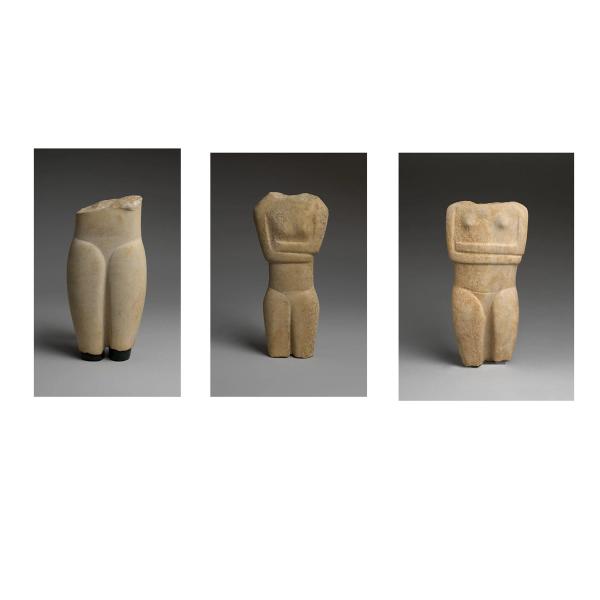
1335. Marble torsos (ca. 2700–2500 BCE)
Narrator: Knowing that the objects in this gallery date back to a society that lived four to five thousand years ago, you might think that the damage and weathering to these figurines was due to being buried for so long.
But the story is actually more intriguing: The best-preserved surfaces were probably covered by earth and the breaks are not necessarily from the ravages of time.
These objects have been deliberately broken and then left in large deposits together, which when discovered are sometimes referred to as “hoards.” Many of these were discovered in the twentieth century on the island of Keros, which sits between the larger islands of Amorgos and Naxos.
The archaeologist Giorgos Gavalas, has worked extensively on the island and spent a long time studying these figures.
Gavalas: The breakage also looks to be quite systematic. It's always at the place between the shoulders and the neck and also at the knees. They were not just broken randomly, they were broken intentionally, and they were deposited as broken.
Narrator: Since the breakage of these objects was planned and specific – and not recent - archaeologists theorize that this area on Keros was a “maritime sanctuary.” That means Cycladic people would have travelled there in order to make these offerings of broken objects and to intentionally deposit them together in a particular area.
Gavalas: We have understood that there is a specific ritual or habit to deposit in this area, broken parts of figurines and most of them come from individual pieces.
Narrator: The details of the “specific ritual” Giorgos mentions are lost to time, but theories range from a symbolic killing of the object to a way of preventing bad energy coming from the dead to the living.Maybe this island offered a kind of spiritual protection in these sanctuaries.
Content Notice
The Metropolitan Museum of Art presents over 5,000 years of art from around the world, and our online collection reflects ongoing work conducted over the course of our more than 150-year history. You may encounter objects or images that may be inappropriate for some viewers or information that may be outdated.