Marble bowl
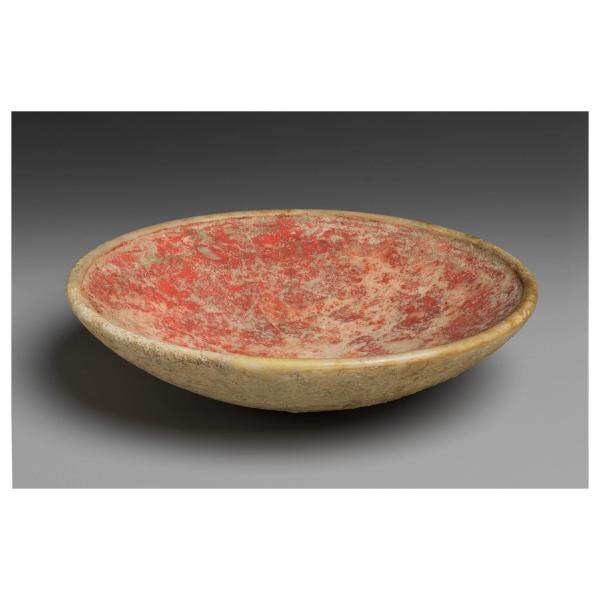
This shallow bowl, carved from white marble, is intact except for two damaged areas along the rim. One is a relatively small loss that has been filled. The larger loss has been repaired using a marble fragment from a similar type of vessel. The fragment was bonded in place and filled along the join. There are a few areas of encrustation near the rim and covering the underside. A layer of red pigment identified as cinnabar extends over most of the interior of the vessel.
The bowl has a slightly recessed base and a thickened, rolled rim that would have helped to prevent spillage. Containers and bowls with traces of pigments, such as the cinnabar in this example, suggest that some utilitarian vessels were used to mix paints applied to Cycladic figures and, perhaps, human bodies in both life and death.
Alexis Belis, Federico Carò, and Wendy Walker
Artwork Details
- Title: Marble bowl
- Period: Early Cycladic II
- Date: ca. 2700–2400/2300 BCE
- Culture: Cycladic
- Medium: Marble
- Dimensions: Height: 2 5/16 in. (5.8 cm)
Diameter: 8 7/16 in. (21.5 cm)
Thickness: 1/4 in. (.7 cm) - Classification: Stone Sculpture
- Credit Line: Leonard N. Stern Collection, Loan from the Hellenic Republic, Ministry of Culture
- Object Number: L.2022.38.76
- Curatorial Department: Greek and Roman Art
Audio
1336. Marble Bowl (ca. 2700–2400/2300 BCE)
Narrator: We’ve all heard the expression “Hidden in plain sight.” When you look at this bowl with the naked eye, it’s easy to assume that when it was made almost 5000 years ago it was not brightly colored. But there’s still red color on its surface. Typically, there’s little evidence like this that remains. I wanted Archaeologist Sandy MacGillivray to explain to me how those secrets are unlocked.
MacGillivray: We're looking at a bowl with a very, very thick red mineral pigment that we'veanalyzed here at The Met and found is composed of mercury sulfide, which makes it ancient cinnabar, what the Romans knew as vermilion.
Narrator: Mercury sulfide? Isn’t that a really dangerous chemical?
MacGillivray: One of the effects of mercury sulfide that we know very well from the modern world - think mercurochrome - when you have too much exposure to it, will give you hallucinations. And your body views it as a bit of a toxin. And so the mercurochrome could have been used as well to put people into a kind of trance state. So it may be that this cinnabar was also used in an oracular ceremony as well.
Narrator: You mentioned your own theory that this could be connected to the practice of consulting oracles...
MacGillivray: We know from the ancient world in Greece, where women, mature women, were perhaps smoking bay leaves and people from all over the world - kings and princes and diplomats - would go to consult this oracle on their future, on decisions to make, what trade journeys they should be going on. It may be then that what we’re looking at is evidence for a similar prehistoric oracle, perhaps centered on the island of Keros.
Content Notice
The Metropolitan Museum of Art presents over 5,000 years of art from around the world, and our online collection reflects ongoing work conducted over the course of our more than 150-year history. You may encounter objects or images that may be inappropriate for some viewers or information that may be outdated.