Terracotta frying pan
This nearly intact cylindrical, open vessel has a slightly convex decorated base with low walls that taper outward, and a short, broad handle that lends it the appearance of a frying pan. The base and handle are conceived as one piece that protrudes beyond the short walls with a vertical rounded rim. The short handle, forked at the end, rises at an oblique angle from the base.
The underside of the base is covered with a dense stamped and incised decoration. Bands of geometric and curvilinear themes rendered by hand are separated by incised lines and filled with kaolin. Pairs of stamped triangles with reverse tips follow the outline of the handle and base. A band of stamped spirals separates the outer band from another one stamped with reversed triangles. In the center of the base is a partially preserved design featuring a central spiral from which radiate two stamped bands of reversed triangles. In between the radials are more stamped spirals. This type of vessel is discussed in detail by J. E. Coleman.(1) The clay and the decoration look similar to examples from Syros.(2)
The vessel is made of a micaceous red clay. There are traces of beige burial accretions in recessed areas of the decoration and on an older loss on the rim near the handle, as well as in the pitted area below the opposite interior rim. The surface of the vessel is worn with scattered scrapes, scratches and small chip losses. One long crack extends from the lip near the handle toward the center of the vessel. Multiple additional cracks are visible on the interior. A chipped area on the decorated base was restored with smoother pinkish-red fill. Since the fill material is less dense than the terracotta, the restored area appears darker or less opaque on the X-ray image.
Georgios Gavalas and Linda Borsch
(1) J.E. Coleman, 1985. “Frying pans of the Early Bronze Age Aegean,” American Journal of Archaeology, 89.2, 191-219, where similar examples are discussed and illustrated, see pl.36, fig. 19, pl. 37, fig. 31.
(2) See also J. Ramstorf , Kykladen I, Die fruehe Bronzenzeit Grab und Siedlungsbefuende, Bonn 2000, Syros, Chalandriani grave 377, Athens NAM 5153, Taf.55.1. p.123, Taf. 131.1.
Artwork Details
- Title: Terracotta frying pan
- Period: Early Cycladic II
- Date: ca. 2700–2400/2300 BCE
- Culture: Cycladic
- Medium: terracotta
- Dimensions: Height: 1 11/16 in. (4.3 cm)
Width: 6 1/4 in. (15.9 cm)
Length: 8 5/16 in. (21.1 cm)
Diameter: 6 7/8 in. (17.4 cm)
Thickness: 1/4 in. (.6 cm) - Classification: Stone Sculpture
- Credit Line: Leonard N. Stern Collection, Loan from the Hellenic Republic, Ministry of Culture
- Object Number: L.2022.38.160
- Curatorial Department: Greek and Roman Art
Audio
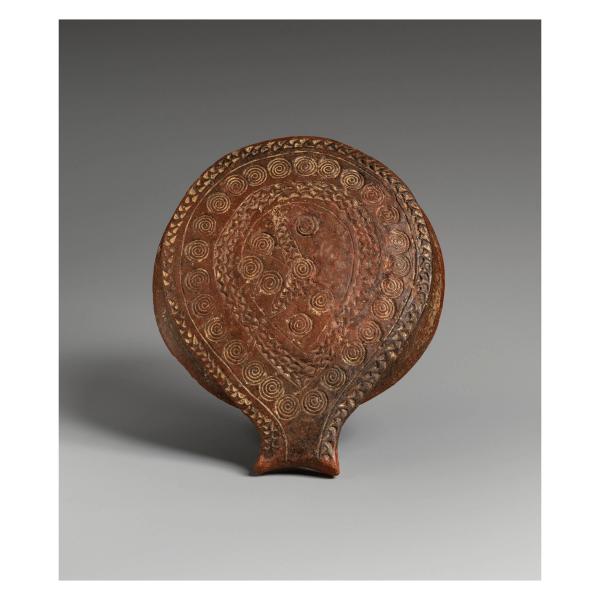
1338. Terracotta frying pan (ca. 2700–2400/2300 BCE)
Narrator: Can you picture an area strewn with islands and rock forms? In Bronze Age Greece, it makes sense that the Cycladic people were deeply connected to the sea and sailing. Archaeologist Sandy MacGillivray explained that today we benefit from innovations in Satellite technology, but they would’ve relied on their knowledge of the natural world to navigate. Which was where this object came in. Why do people refer to it as a “frying pan”?
MacGillivray: One thing we know for certain is that this was not a frying pan. The side that would have been set into the fire is the decorated side and these are never burnt or blackened.
Narrator: You mentioned it was made before the potter’s wheel was even invented.
MacGillivray: It's a brown clay artifact that's handmade. And it’sessentially a bowl with a flat base that is then decorated. The motifs on them have to do largely with stars and with ships.
Narrator: It’s worth mentioning that these objects have been found in graves, but they’ve also been found in settlements where people lived. So, they were almost certainly used by the owners during life, too.Do we know how it was it used?
MacGillivray: When you fill it with water, it means that you will always have access to a level surface. And because of the astral and maritime motifs, that allows me to go off into a fairly wonderful theory, that they were in fact used as astrolabes, that is, star catchers. Up until very, recently, you needed an astrolabe to tell you what time it is during the night and what direction you're going in. So we know that they're veryin tune with the stars and they see the stars as a great timepiece.
Narrator: That’san interesting theory. I understand an astrolabe is an ancient instrument used for measuring the positions of stars and planets – to help with navigation, telling time, and determining latitude - by aligning with celestial objects. Think of it as an early GPS for astronomers and sailors.
MacGillivray: Upon death, the soul then could be given the sort of tool it needs to navigate its way back into the stars. In ancient Greek philosophy, think of Plato and his colleagues, when we die, we go back to the stars. And so what better way to find your way back than to use an astrolabe.
Narrator: I had to go look up that quotation from Plato, one of the most famous ancient Greek philosophers and a student of Socrates: "He who lived well during his appointed time was to return and dwell in his native star, and there he would have had blessed and congenial existence."
Content Notice
The Metropolitan Museum of Art presents over 5,000 years of art from around the world, and our online collection reflects ongoing work conducted over the course of our more than 150-year history. You may encounter objects or images that may be inappropriate for some viewers or information that may be outdated.