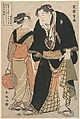
Sumo Wrestlers Inariyama and Matsuozaki
A disciple of Katsukawa Shunshō (1726–1793), Shun’ei emerged as a prolific and commercially successful woodblock print artist. Most active from the mid-1780s through the 1790s, he is credited as one of the first artists to popularize the emerging okubi-e, or “big head,” style of actor portraits.
The subcategory of sumo prints by Katsukawa artists emerged in the 1780s when Shunshō created print designs in response to the remarkable popular appeal of the wrestler Tanikaze Kajinosuke (1750–1795), who between 1778 and 1782 managed to achieve an unprecedented string of sixty-three consecutive wins. Only in 1782 did he finally face defeat by a relative newcomer, Onogawa Kisaburō (1758–1806). Shunshō and his student Shunkō (1743–1812) were pioneers of sumo print design. In the following generation, after Shunshō’s retirement, Shun’ei carried on the tradition of sumo prints, as did Katsukawa Shun’rō (1760–1849), who soon cut his ties with the Katsukawa school to establish himself as an independent artist and adopted the now-renowned art name Katsushika Hokusai (for examples of his rare sumo prints, see JP741 and JP742).
Artwork Details
- 勝川春英画 「稲荷山 松尾崎」
- Title: Sumo Wrestlers Inariyama and Matsuozaki
- Artist: Katsukawa Shun'ei (Japanese, 1762–1819)
- Period: Edo period (1615–1868)
- Date: ca. 1807
- Culture: Japan
- Medium: Wood-block print (nishiki-e); ink and color on paper
- Dimensions: Vertical ōban; 12 ¾ x 8 ¾” (32.4 x 22.2 cm)
- Classification: Prints
- Credit Line: Gift of the Pinkowitz family, 2025
- Object Number: 2025.796.4
- Curatorial Department: Asian Art
More Artwork
Research Resources
The Met provides unparalleled resources for research and welcomes an international community of students and scholars. The Met's Open Access API is where creators and researchers can connect to the The Met collection. Open Access data and public domain images are available for unrestricted commercial and noncommercial use without permission or fee.
To request images under copyright and other restrictions, please use this Image Request form.
Feedback
We continue to research and examine historical and cultural context for objects in The Met collection. If you have comments or questions about this object record, please contact us using the form below. The Museum looks forward to receiving your comments.
Content Notice
The Metropolitan Museum of Art presents over 5,000 years of art from around the world, and our online collection reflects ongoing work conducted over the course of our more than 150-year history. You may encounter objects or images that may be inappropriate for some viewers or information that may be outdated.