Untitled
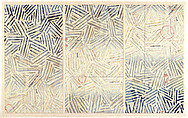
In Untitled, a work Johns made at the age of eighty-eight, mortality is the subject matter. Working between paper and plastic, Johns chose supports that hold time differently. One feels the ink pressed and placed like a wrinkle on the former; in the latter, the ink slips and slides like a fugitive memory. The skeleton has an obvious relationship to the memento mori, a trope that typically suggests the inevitability of death, but here assumes different guises: unadorned, wearing a top hat and holding a cane, listing to one side; even jumping rope. Some sheets place the skeleton figure in an open, abstract space; others embed the figure in a clustered one, inhabited by other motifs that have run through Johns’s practice such as the stone wall, the newspaper, the snowman, and the stick figure. Where the artist’s signature is present, it is stencilled. Indecipherable script in one sheet appears like inverted text in a mirror but has no evident correlation to something readable. The multiplicity of figures and methods of presentation in the work suggest not so much the finality of one death, but the small ends we meet every day. The art historian Michael Ann Holly has written beautifully on this late style: "Smiling skeletons, sinister skulls, stick figures, snowmen, dissolving figures—not so much a style as a constellation of elegiac subjects that face us with intransigence and difficulty. Visual valedictions to an art of contradiction: absence and presence, seen and unseen, disenchantment and pleasure, incompleteness and sublimity, melancholy and joy, agitation and silence, death and beauty."[2]
[1] The artist quoted in "His heart belongs to DADA," Time 73, May 4, 1959 (reprinted in Kirk Varnedoe, ed. Jasper Johns, Writings, Sketchbook Notes, Interviews, New York, 1996, p. 82).
[2] Michael Ann Holly in Carlos Basualdo and Scott Rothkopf, Jasper Johns: Mind/Mirror, Exh. cat., Philadelphia Museum of Art, 2021, pp. 278–79.
Artwork Details
- Title: Untitled
- Artist: Jasper Johns (American, born Augusta, Georgia, 1930)
- Date: 2018
- Medium: Ink on paper or plastic, 24 sheets
- Dimensions: Each: 11 1/2 × 8 in. (29.2 × 20.3 cm)
- Classification: Works on Paper
- Credit Line: Gift of Marguerite Steed Hoffman, 2025
- Object Number: 2025.845a–x
- Curatorial Department: Modern and Contemporary Art
More Artwork

Research Resources
The Met provides unparalleled resources for research and welcomes an international community of students and scholars. The Met's Open Access API is where creators and researchers can connect to the The Met collection. Open Access data and public domain images are available for unrestricted commercial and noncommercial use without permission or fee.
To request images under copyright and other restrictions, please use this Image Request form.
Feedback
We continue to research and examine historical and cultural context for objects in The Met collection. If you have comments or questions about this object record, please contact us using the form below. The Museum looks forward to receiving your comments.
Content Notice
The Metropolitan Museum of Art presents over 5,000 years of art from around the world, and our online collection reflects ongoing work conducted over the course of our more than 150-year history. You may encounter objects or images that may be inappropriate for some viewers or information that may be outdated.