The Met Fifth Avenue and The Met Cloisters are closed December 25 for Christmas.

Search the collection

Filter By

Object Type / Material
Geographic Location
Department
Date
Show Only:
  • As part of the Met's Open Access policy, you can freely copy, modify and distribute this image, even for commercial purposes.
    APIPublic domain data for this object can also be accessed using the Met's Open Access API
  • Objects with changed or unknown ownership in continental Europe between 1933-1945. Learn more
Showing 2,776 results for Possibly Carthaginian
Sort by:
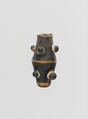
Bi-conical glass bead, Glass, Possibly Carthaginian
Possibly Carthaginian
ca. 4th century BCE
Glass bead, Glass, Carthaginian
Carthaginian
2nd half of 4th century BCE
Glass head pendant, Glass, Carthaginian
Carthaginian
mid-4th to 3rd century BCE
Carthaginian
early 3rd century BCE
Glass bead, Glass, Carthaginian
Carthaginian
mid-4th century BCE
Glass bead, Glass, Carthaginian
Carthaginian
mid-4th century BCE
Glass eye beads, Glass, Carthaginian
Carthaginian
2nd half of 4th century BCE
Glass bead, Glass, Carthaginian
Carthaginian
mid-4th century BCE
Ball, sling, Clay, Carthaginian
Carthaginian
ca. 1st half of 2nd century BC
Ball, sling, Clay, Carthaginian
Carthaginian
ca. 1st half of 2nd century BC
Glass head pendant, Glass, Phoenician or Carthaginian
Phoenician or Carthaginian
mid-4th–3rd century BCE
Glass face bead, Glass, Phoenician or Carthaginian
Phoenician or Carthaginian
mid-4th–3rd century BCE
Glass face bead, Glass, Phoenician or Carthaginian
Phoenician or Carthaginian
late 5th–mid-2nd century BCE
Glass head pendant, Glass, Phoenician or Carthaginian
Phoenician or Carthaginian
5th century BCE
Glass head pendant, Glass, Phoenician or Carthaginian
Phoenician or Carthaginian
5th century BCE
Glass head pendant, Glass, Phoenician or Carthaginian
Phoenician or Carthaginian
ca. 450–300 BCE
Greek, Carthaginian
310–270 BCE
Hunting Sword with Scabbard, Joseph Deutschmann  German, Steel, silver, ivory, wood, leather, German, possibly Munich
Joseph Deutschmann
ca. 1740
Armor of Henry II, King of France (reigned 1547–59), Jean Cousin the Elder  French, Steel, gold, silver, leather, textile, French, possibly Paris
Jean Cousin the Elder
Baptiste Pellerin
ca. 1555
Ceremonial Object in the Shape of an Ax, Bronze alloy, Indonesia, possibly Sulawesi
Indonesia, possibly Sulawesi
ca. 100 BCE–300 CE
Helmet (Sallet), Steel, iron, gold, silver, cloisonné enamel, leather, textile, Spanish, possibly Granada
Spanish, possibly Granada
late 15th–early 16th century
Nyonganyonga, Wood, shell, metal, beads, Possibly Barwe People
Possibly Barwe People
ca. 1900
Glass pendant in the form of a bird, Glass, Phoenician or Carthaginian
Phoenician or Carthaginian
425–200 BCE
Glass head pendant, Glass, Phoenician or Carthaginian
Phoenician or Carthaginian
3rd–2nd century BCE
Glass head pendant, Glass, Phoenician or Carthaginian
Phoenician or Carthaginian
3rd–2nd century BCE
Glass head pendant, Glass, Phoenician or Carthaginian
Phoenician or Carthaginian
3rd–2nd century BCE
Glass head pendant, Glass, Phoenician or Carthaginian
Phoenician or Carthaginian
6th–5th century BCE
Glass bead with knobs, Glass, Phoenician or Carthaginian
Phoenician or Carthaginian
5th–3rd century BCE
Glass bead with knobs, Glass, Phoenician or Carthaginian
Phoenician or Carthaginian
5th–3rd century BCE
Glass eye bead, Glass, Phoenician or Carthaginian
Phoenician or Carthaginian
4th–3rd century BCE
Glass eye bead, Glass, Phoenician or Carthaginian
Phoenician or Carthaginian
4th–3rd century BCE
Glass face bead, Glass, Phoenician or Carthaginian
Phoenician or Carthaginian
end of 5th–mid-2nd century BCE
Glass eye beads, Glass, Phoenician or Carthaginian
Phoenician or Carthaginian
4th–3rd century BCE
Glass pendant in the form of a ram's head, Glass, Phoenician or Carthaginian
Phoenician or Carthaginian
4th century BCE
Gold earring with glass head pendant, Gold, glass, Phoenician or Carthaginian
Phoenician or Carthaginian
3rd–1st century BCE
Gold earring with a glass pendant in the form of a demonic mask, Gold, glass, Phoenician or Carthaginian
Phoenician or Carthaginian
1st half of the 5th century BCE
Horn, Watur possibly, Bamboo, Asmat people
Watur possibly
mid-20th century
Scenes of the Passion, Boxwood, feathers, gold, enamel, possibly Mexican
possibly Mexican
16th century
Hercules with the Coat of Nessus, Unidentified sculptor, Bronze, marble, possibly French
Unidentified
17th century
Hercules and Antaeus, Bronze, with red-brown natural patina, and remains of dark brown lacquer., possibly Italian
possibly Italian
probably 19th century