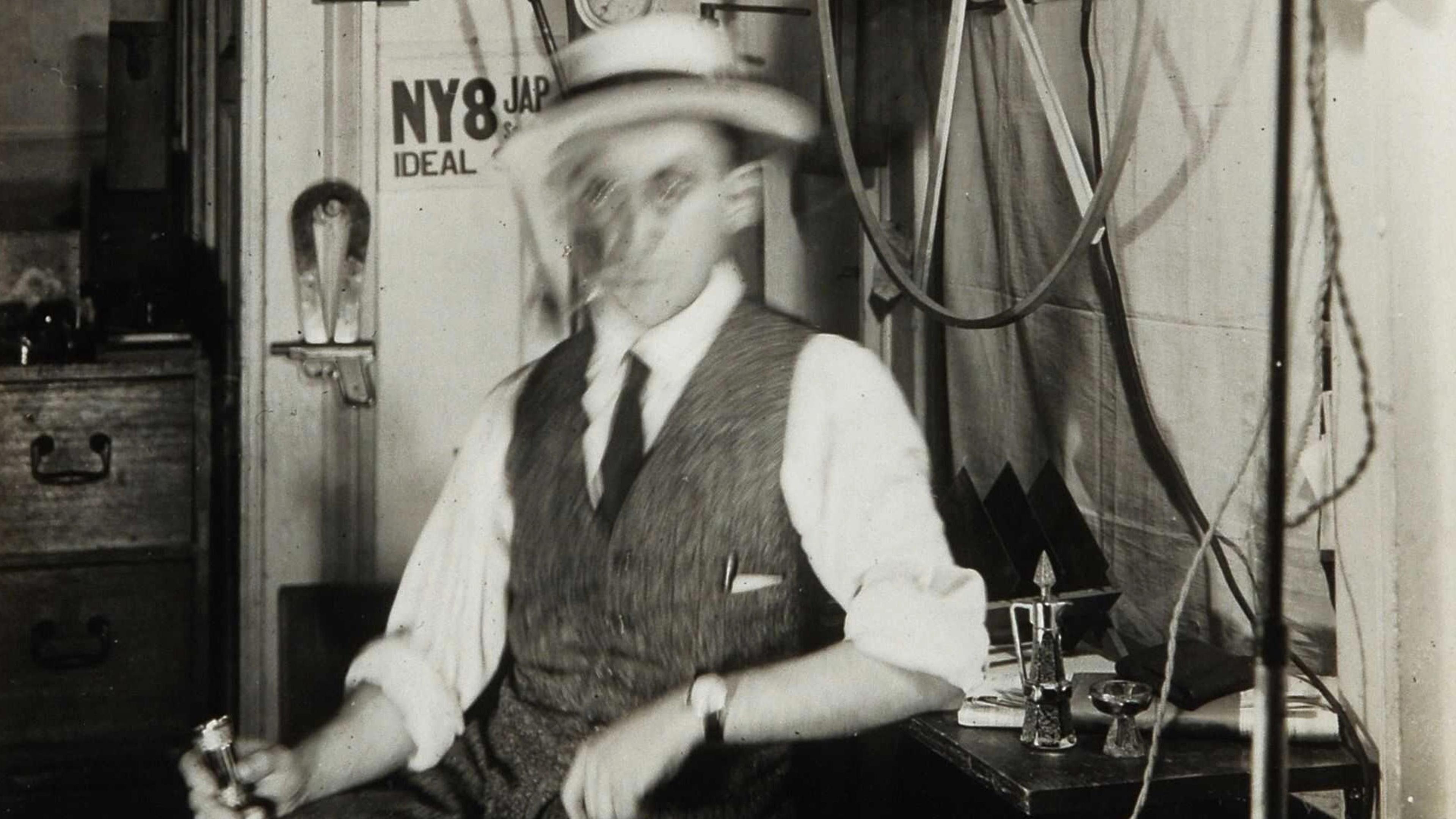
In December 1920, when Man Ray was still in New York and “New York Dada” had yet to be named, he began corresponding with Tristan Tzara and Francis Picabia about Dadaglobe, the planned but ultimately unrealized anthology they were currently preparing in Paris.[1] Among the photographs and texts Man Ray enthusiastically sent for this ambitious volume was a photographic self-portrait seen through a “screen of smoke” (fig. 1).[2] Also in the group was a photograph titled (in English) By Products. The latter work has not been definitively identified but was likely an image Man Ray made in 1920 depicting the charred remains of matches, cigarettes, and paper among ashes strewn on the floor of his West Eighth Street studio. This photograph might be considered a corollary to Man Ray’s self-portrait, also shot in his studio, in which he presented himself as a neatly dressed thinker rather than a maker, someone who selected his artworks rather than fabricated them. A “by-product,” by dictionary definition, is an “incidental or secondary product made in the manufacture or synthesis of something else.”[3] The photograph of detritus, one might argue, captures the by-products of Man Ray’s artistic process of sitting, thinking, and smoking.
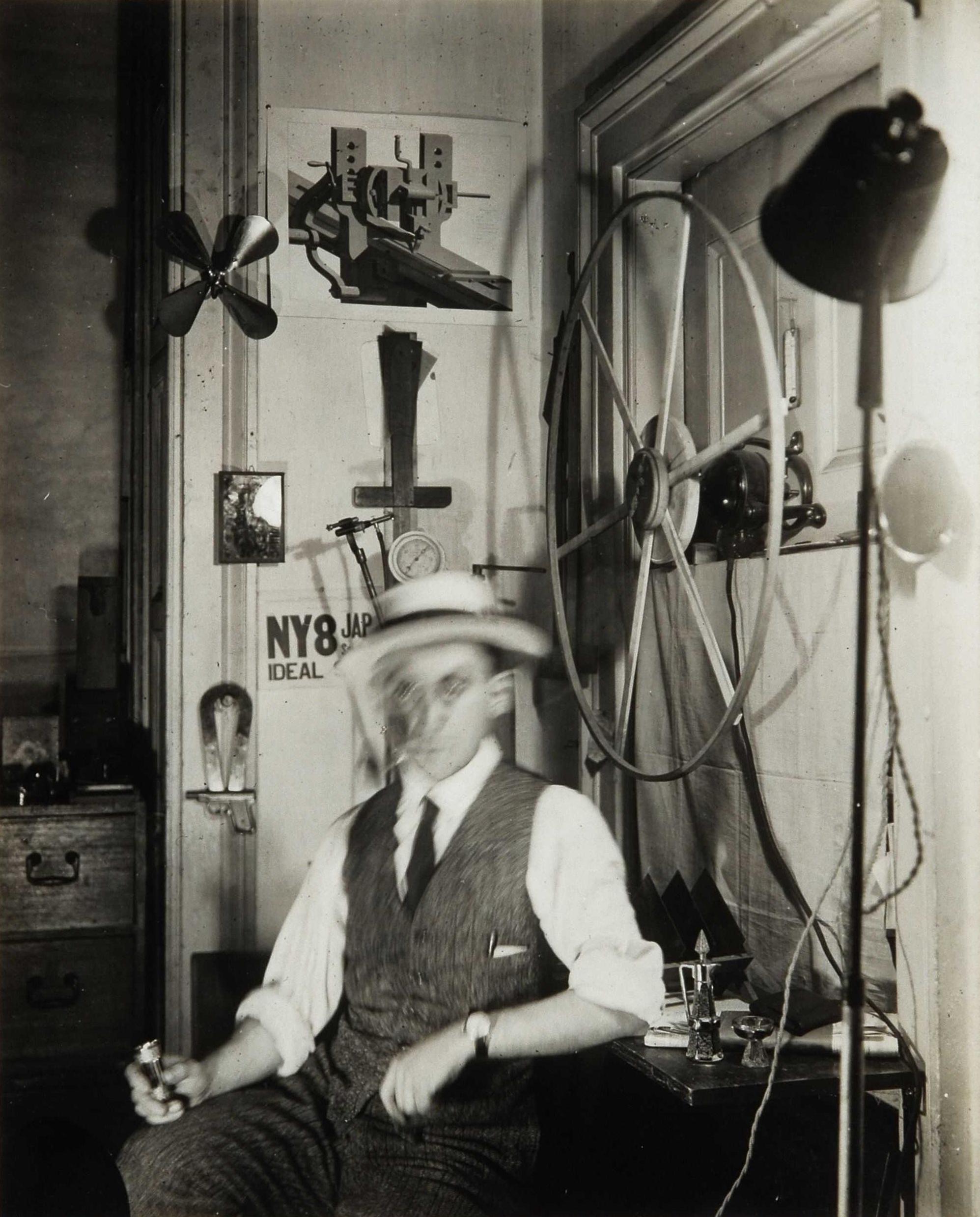
Fig. 1. Man Ray, Self-Portrait, 1920. Gelatin silver print, 4 3/4 x 3 3/4 in. (12 x 9.5 cm). Bibliothèque littéraire Jacques Doucet, Paris, Tristan Tzara Collection (TZR 734 MF-54). © Man Ray Trust / 2026 Artists Rights Society (ARS), New York
Only one early vintage print of the photograph is known to survive today. It is adhered to Man Ray’s 1921 collage Trans Atlantique (fig. 2). Measuring 4 3/4 by 3 3/4 inches, the print’s dimensions are close to those of the other small-scale photographs Man Ray sent for Dadaglobe.[4] It is possible that, following his arrival in Paris in July 1921, Man Ray retrieved the print from Tzara and adhered it to Trans Atlantique, which he displayed in his solo exhibition at Librarie Six in December 1921. The collage appeared at the end of the checklist dated 1921, implying that it was among the first works he executed in Paris.
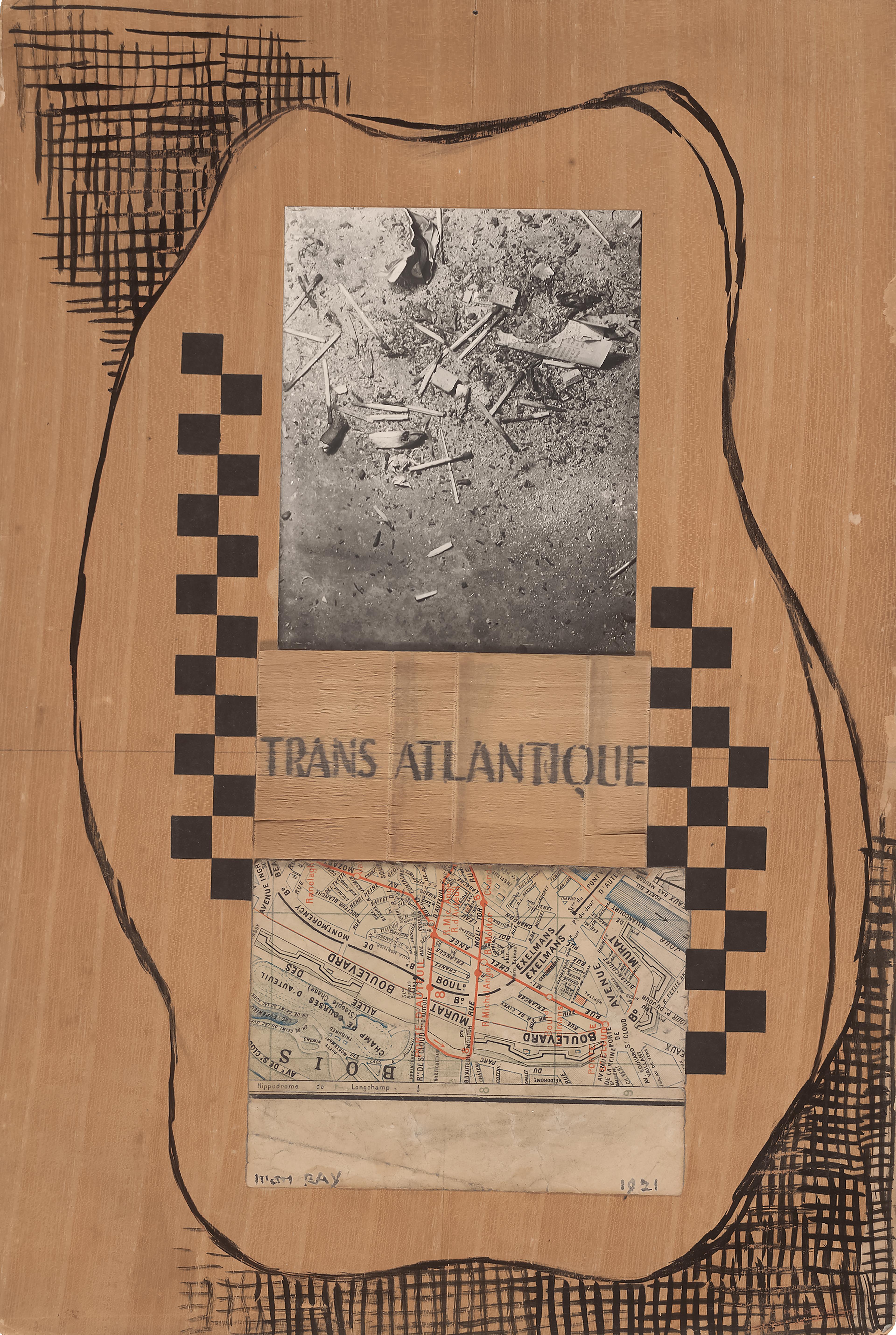
Fig. 2. Man Ray, Trans Atlantique, 1921. Gelatin silver print, ink, and paper on board, 14 1/2 x 9 3/4 in. (36.8 x 24.8 cm). The Metropolitan Museum of Art, New York, The Bluff Collection, Promised Gift of John A. Pritzker. © Man Ray Trust / 2026 Artists Rights Society (ARS), New York
As positioned in Trans Atlantique, the photograph functions as a stand-in for New York. It is placed above a fragment of an inverted map showing Paris’s sixteenth arrondissement, where Man Ray first resided in the city, near Tzara and Picabia. In the collage, the photograph and the map fragment are distanced from one another by means of a spacer, a thick piece of cracked wood veneer, upon which “TRANS ATLANTIQUE” has been neatly inscribed—the word’s prefix and root also divided by a space. The collage is illustrative: Trans Atlantique represents Man Ray’s overseas move in 1921.[5] The “scorched detritus” of an “upturned ashtray,” representing the “cultural wasteland of Manhattan,” as one scholar has described it, has been left behind for a fresh start in Paris.[6] In its most literal sense, the wood veneer connotes the Atlantic, or even an ocean liner used to traverse it.[7] Figuratively, it is a liminal space, a threshold between languages, cultures, and artistic identities.
Trans Atlantique might also articulate radical artistic intent. Using a board with a wood-like surface as his ground, Man Ray literalized the idea of the Cubist tabletop upon which he arranged signifiers charting his overseas move. He outlined the photograph, the map fragment, and the spacer within an undulating oval that might suggest a hyperextended, distorted, even anamorphic painter’s palette. An actual paint-laden palette inscribed with the disparaging phrase “La mer de merde” (the sea of shit) was the subject of one of Man Ray’s other Dadaglobe submissions (fig. 3). As if in dialogue with that image, Trans Atlantique’s schematic palette—if that is what it is—provides a catalogue of alternative modes or strategies available to the artist: the photograph, with its mechanized, chemical processes; the artless, anti-composition of detritus strewn by chance; the ready-made map with its diagrammatic manner of signification; the alternating black-and-white squares of a chessboard, a prompt for play, strategy, and abstract thought; and, of course, collage itself as a process of juxtaposition and chance encounter.[8] For an avant-garde artist intent on redefining his role and overcoming “the sticky medium of paint,” Trans Atlantique offered a menu of potential routes forward.[9]
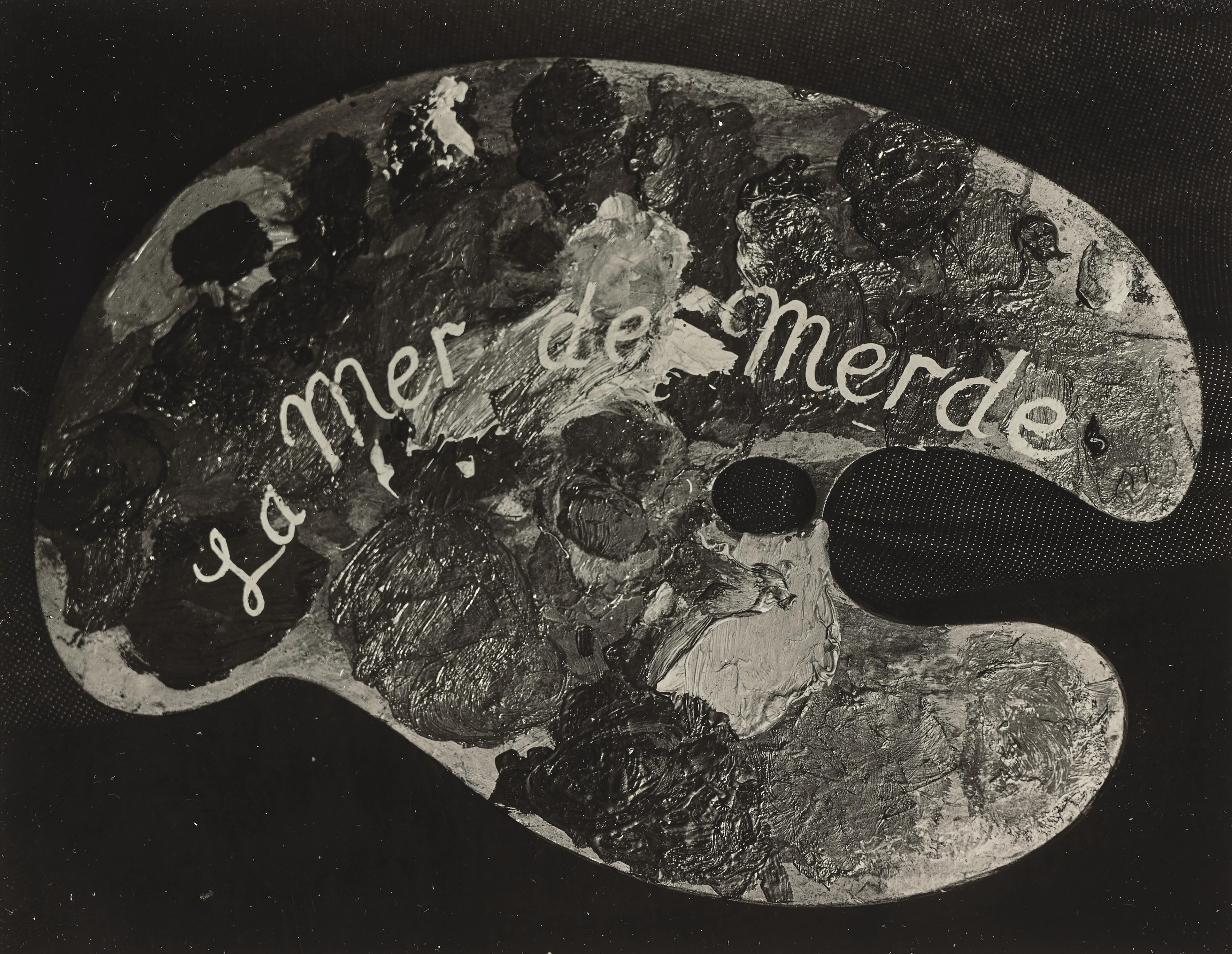
Fig. 3. Man Ray, La mer de merde (The Sea of Shit), 1920. Bromide print, 4 3/4 x 3 3/4 in. (12.2 x 9.6 cm). Museum Boijmans Van Beuningen, Rotterdam (3505 [MK]). © Man Ray Trust / 2026 Artists Rights Society (ARS), New York
Despite its significance as a statement of purpose, Trans Atlantique does not seem to have been exhibited after its December 1921 Paris debut or reproduced in the 1920s and 1930s.[10] Seven years later, in 1928, the photograph of the “upturned ashtray” appeared in the “American Issue” of Eugene Jolas’s Paris-based literary quarterly Transition with the caption “New York: 1920” (fig. 4). Among the other four photographs by Man Ray included in the issue was an image showing his L’impossibilité (Dancer, Danger) and a large wooden winepress set against a screen in Man Ray’s Campagne-Première studio. This image, which is thought to date from about 1926, was captioned “Paris Machine Shop” (fig. 5). On the pages of Transition, the two photographs—one signifying New York, the other Paris—functioned as conceptual counterparts. They represented the same New York–Paris axis as Trans Atlantique, but this time the coordinates on the map were explicitly identified. Although Man Ray would not have been involved in the placement of the images in the journal’s layout (some one hundred pages apart), it is likely that he named the locations pictured, which served as their captions. As the “trans” of the journal’s title implied, Transition concerned itself with making “the literature of other lands” available to American readers through English translation and, more broadly, with probing the question of elective “deracination,” by dictionary definition, “detachment from one’s background (as from homeland, customs, or traditions).”[11] It is within this specific context that Man Ray submitted these polarized images.
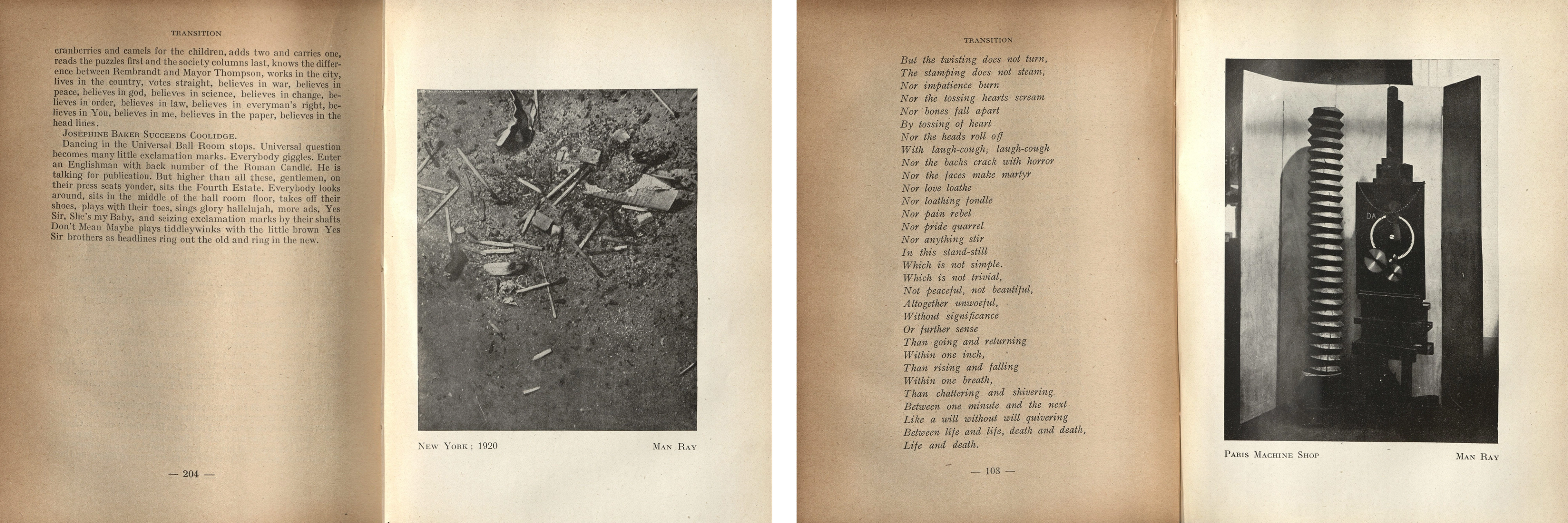
Fig. 4. “Man Ray, New York: 1920,” Transition, no. 13 (Summer 1928): 205. Fig. 5. “Man Ray, Paris Machine Shop,” Transition, no. 13 (Summer 1928): 109
In a questionnaire circulated to its expatriate contributors in the following issue, Transition asked: “Why do you prefer to live outside America?” and “How do you envisage the spiritual future of America in the face of a dying Europe and in the face of a Russia that is adapting the American economic vision?”[12] Man Ray did not give a verbal response, but his pairing of “New York: 1920” and “Paris Machine Shop” seemed to offer a visual one. General consensus among Transition’s contributors held that Europe was “dying,” that it was “finished, decayed, war- and time-worn out,” and that America, by contrast, was new, a country rapidly assimilating the “tremendous industrial innovations of the past fifty years,” for better or for worse.[13] Man Ray simply inverted the terms, presenting images of a “finished, decayed” New York and of a modern, mechanized Paris. Again, he polarized America and Europe, again he contrasted old and new, just as he had done in Trans Atlantique.[14]
If the photograph of the “upturned ashtray” was indeed the one that Man Ray sent to Tzara for Dadaglobe under the title By Products, already, in that early context, it was intended to represent New York. But it takes a magnifying glass to discern that one of the matches is printed with “Hotel Brevoort” (an establishment once located on Fifth Avenue and Eighth Street) and that the charred paper fragment includes English-language text. These details, which were surely illegible in reproduction, hardly declare a clear point of origin, and the title, By Products, is as cryptic as the image itself. Upon sending his provocative contributions to Paris, Man Ray ceded control of them. He sat passively, as it were, in New York, smoking his pipe or cigarette, waiting to see how they would be received. Arranged by Tzara on the pages of Dadaglobe, according to the principles of chance and montage, By Products would have appeared on a spread opposite a photographic portrait of the French poet Benjamin Péret, many pages away from Man Ray’s smoke-filled self-portrait and his other contributions.[15] As originally conceived, it was an open-ended proposition, a prompt to be “completed” by Tzara and by the anticipated readers of Dadaglobe.
In the following year, Man Ray enacted a similar experiment by sending an equally enigmatic close-up photograph of dust accumulating on Marcel Duchamp’s The Bride Stripped Bare by Her Bachelors, Even (The Large Glass) to the editors of the journal Littérature, Louis Aragon, André Breton, and Philippe Soupault. As scholar David Hopkins has poignantly observed, these men belonged to a generation demoralized by a war—only three years past—in which several of their young friends had perished. Hopkins has speculated that it may have been they who perceived the photograph now known as Élevage de poussière (Dust Breeding) (fig. 6) in “elegiac terms” and supplied the caption that likened it to a battlefield as seen from an airplane: “arid / fertile / joyous / sad.”[16] When Man Ray affixed By Products to Trans Atlantique, he literally fixed it in place within an autobiographical narrative, as he would again by pairing it with an image of his Paris studio within the transatlantic parameters of Jolas’s Transition.[17] In doing so, he forfeited an open-ended response to a strange, disturbing image that might have evoked broader associations set free of its identification with New York. The image of formlessness, waste, and destruction might have suggested both an ending and a beginning; destruction and regeneration. On the pages of Dadaglobe, isolated and severed from any specific geographical identification, By Products had the potential to transcend the confines of biography and place, especially for its European readers emerging from the ashes of World War I.
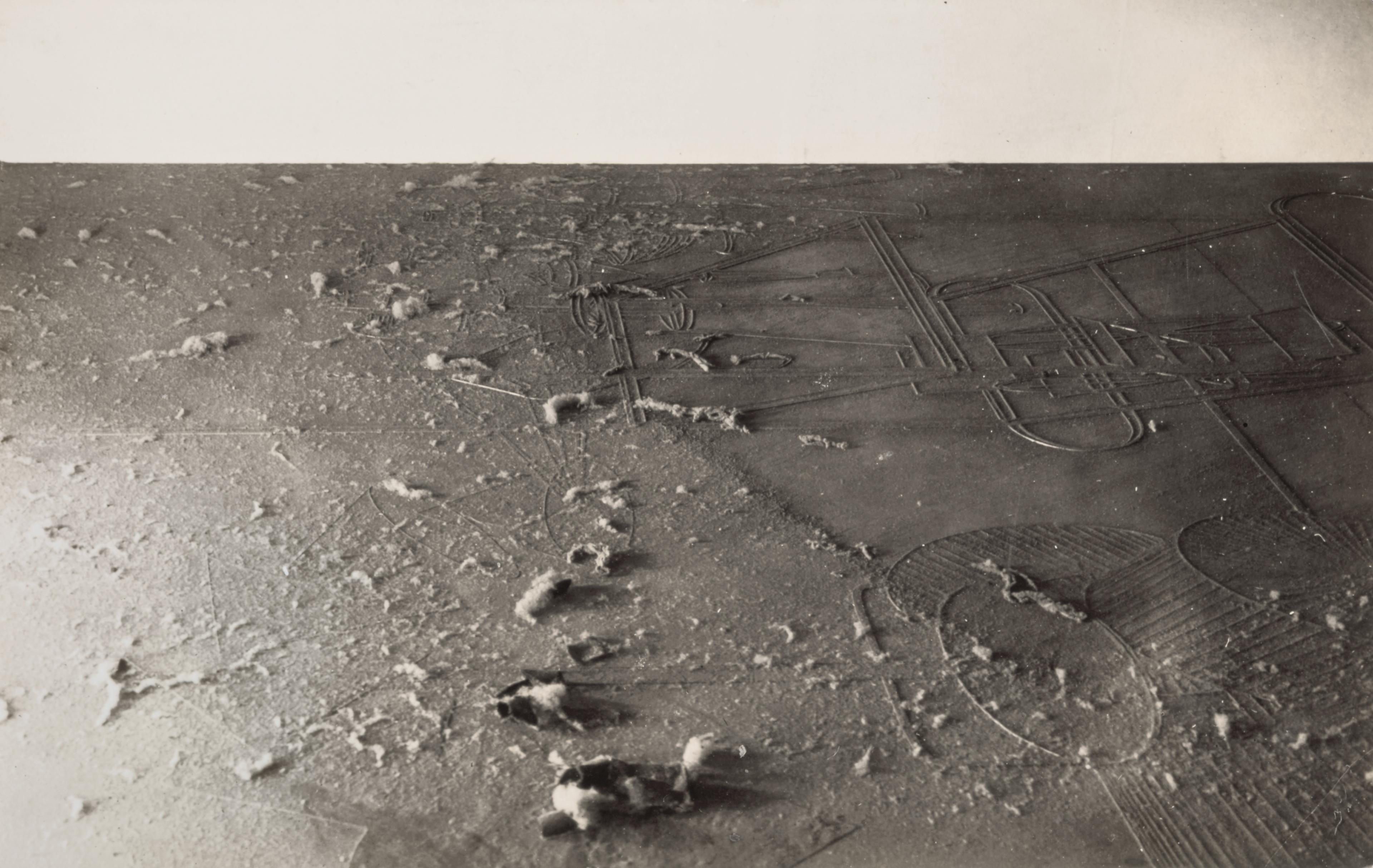
Fig. 6. Man Ray, Élevage de poussière (Dust Breeding), 1920. Gelatin silver print, 2 13/16 x 4 5/16 in. (7.1 x 11 cm). The Metropolitan Museum of Art, New York, The Bluff Collection, Promised Gift of John A. Pritzker. © Man Ray Trust / 2026 Artists Rights Society (ARS), New York
Notes
The journal New York Dada was published in April 1921, bestowing the name. Dadaglobe was slated to appear in March 1921 but ultimately remained unpublished. For my argument that New York Dada may have been prompted by Dadaglobe and represented something akin to a “chapter” or “excerpt” from the larger work rather than an autonomously conceived, stand-alone publication, see Adrian Sudhalter, “R(r)ose Recontextualized: French/American Identity and the Photographic Portraits for Dadaglobe and New York Dada,” in AKA Marcel Duchamp: Meditations on the Identities of an Artist, ed. Anne Collins Goodyear and James W. McManus (Smithsonian Institution Scholarly Press and Random House, 2014), 20–44.
For Man Ray’s full contribution, see Adrian Sudhalter, ed., Dadaglobe Reconstructed, exh. cat. (Kunsthaus Zürich and Scheidegger and Spiess, 2016), 50–52, 120–22.
See “by-product,” The Oxford Pocket Dictionary of Current English, https://www.encyclopedia.com/humanities/dictionaries-thesauruses-pictures-and-press-releases/byproduct/.
These include Self-Portrait (12 x 9.5 cm), La plus belle sculpture d’Amérique (The Most Beautiful Sculpture in America) (11.4 x 8.7 cm), and La mer de merde (Sea of Shit) (12.2 x 9.6 cm). Other known vintage prints of the charred remains are significantly larger (23.5 x 17.5 cm and 28.3 x 22.9 cm), perhaps suggesting that they were printed at a later date, even within the artist’s lifetime.
This is the standard interpretation in the scholarship. See, for example, Francis M. Naumann, New York Dada, 1915–23 (Abrams, 1994), 92, and Stephanie D’Alessandro, “Dangerous Games,” in Stephanie D'Alessandro and Stephen C. Pinson, Man Ray: When Objects Dream, exh. cat. (The Metropolitan Museum of Art, 2025), 163.
Michael R. Taylor, “New York,” in Dada: Zurich, Berlin, Hannover, Cologne, New York, Paris, ed. Leah Dickerman, exh. cat. (National Gallery of Art, 2005), 293–94.
Kim Knowles, “From Studio to Street: The Urban Photography of Man Ray,” History of Photography 34, no. 1 (2010): 31.
See D’Alessandro, “Dangerous Games,” 163.
Man Ray, letter to Ferdinand Howald, April 5, 1922. Ferdinand Howald Correspondence, Rare Books and Manuscripts Library, The Ohio State University, Columbus.
To my knowledge, the collage was not exhibited again or reproduced until its inclusion in the exhibition Dada: Dokumente einer Bewegung, Düsseldorf Kunsthalle (September 5–October 19, 1958), cat. 166, at which time it remained in the artist’s collection.
Unlike the term’s usage at the time of Man Ray’s work, its contemporary reception is informed by the context of critical postcolonial discourse and evokes associations of forcible detachment from one’s homeland. Definition of “deracination”: https://www.merriam-webster.com/dictionary/deracination/. For the original quote, see The Editors, “Introduction,” Transition, no. 1 (April 1927): 135–38.
Transition, no. 14 (Fall 1928): 97.
Transition, no. 14 (Fall 1928): 98 (Robert McAlmon) and 100 (Leigh Hoffmann), respectively.
Serena Trinchero makes the comparison between Man Ray’s photograph in Trans Atlantique and its appearance in Transition in her Ph.D. dissertation, “Per una nuova identita americana. La macchina e il rimitivo nelle riviste americane in Europa 1921–1932,” Università degli Studi Firenze (2019), 78–79.
On how Tzara adapted his linguistic montage practice to the visual layout of Dadaglobe, see Adrian Sudhalter, “Tristan Tzara, Literary Montage, and Dadaglobe,” in Before Publication: Montage in Art, Architecture, and Book Design. A Reader, ed. Nanni Baltzer and Martino Stierli (Park Books, 2016), 44–56.
David Hopkins, “Duchamp’s Metaphysics: Dust Breeding,” in Virgin Microbe: Essays on Dada, ed. David Hopkins and Michael White (Northwestern University Press, 2014), 126.
In the portfolio First Steps in 1920 (Edition Luciano Anselmino, 1972), Man Ray cemented the association of the photograph with the collage by naming the photograph Transatlantique.
