For Fukuko Ando, the body is a catalyst for artistic intuition. A Japanese designer trained in Paris haute couture, Ando has spent over four decades building an inimitable portfolio of thematic dress collections that reflect her dual embrace of the material and spiritual. While committed to the haute couture traditions of handmaking, her designs also demonstrate a deep, sensory inquiry into the inherent qualities of textiles, as well as the body underneath.
In conjunction with Costume Art, The Costume Institute recently acquired three dresses designed by Ando. Below, she discusses her formative years in Japan and France, the enduring inspiration of Madeleine Vionnet, and her insights into the poetics of dressmaking.

Ando at her studio in Japan, 2026. Courtesy Fukuko Ando
Ayaka Iida:
When did you first develop your interest in art and fashion? After studying literature in university, what encouraged you to train in fashion design?
Fukuko Ando:
I’ve had a fascination with art and literature since I was in high school. In old European films and Western paintings considered masterpieces, I found a sublimity of the spirit that I couldn’t experience in my everyday life in Japan.
Around the time I took off my high school uniform and started university, the talents of many designers of a new era had begun to blossom in Japan. Rei Kawakubo, Issey Miyake, and Yohji Yamamoto etc were creating new concepts, silhouettes, and constructions that transcended the traditional Western perspective on clothing. Although I hadn’t been particularly interested in fashion until then, I found that clothing from this new era shone with great vitality.
During this same period, the Paris haute couture collections were also showing the finest beauty and creativity achieved through the art of handcrafting. My particular favorite was Christian Lacroix.
Indeed, a new fashion awakening was taking place from the 1980s through the 1990s, and I began to feel a deep passion in my soul for this power of fashion, although I never imagined I would actually become a designer. However, following a friend’s advice, I enrolled in the evening program at Nagoya Mode Gakuen during my third year of university. I was attending two schools at once—university during the day, and fashion school at night.
Iida:
What was it like to pursue a career as a fashion designer in Japan—at the height of its “bubble economy” in the late 1980s—and what were your motivations in relocating to Paris?
Ando:
After graduating from Mode Gakuen in Nagoya, I first moved to Tokyo and began working as a designer. At that time, the Japanese fashion industry was thriving, and there were many fashion competitions open to students and the general public. I entered a fashion competition proposed by the magazine Ryuko Tsushin, and I won the Gold Prize in the fur category. The prize was a one-week training program at SAGA FURS in Denmark. While I was there, I met designers invited from various countries, including the United States, France, the United Kingdom, and Italy. Through that experience, I sensed the narrowness of Japan’s perspective as an island nation.
At the same time, as I studied fashion history on my own, I came to understand the differences between the kimono and Western clothing and how they respond to the body underneath. I realized that if the body is understood and presented differently, the clothing that wraps around it will also be different.
And it was precisely at that time that I saw the Yves Saint Laurent exhibition (originally organized by The Metropolitan Museum of Art in 1983 and traveled to the Sezon Museum of Art, Tokyo in 1990)—the true haute couture pieces themselves. I felt the sublime soul of clothing that lives through the ages. I felt that I had to go to Paris, the origin of La Mode: Fashion. The desire to discover the true origin of fashion and to create based on that truth was the beginning of my path to Paris.

Fukuko Ando at Christian Dior atelier from Frankfurter Allgemeine Magazin (December 3, 1993). Courtesy Fukuko Ando
Iida:
Could you tell us about your experience working for the House of Dior?
Ando:
It all began at a Parisian haute couture school: École de la Chambre Syndicale de la Couture Parisienne. In France, a “stage” (internship) is mandatory to graduate, requiring a period of practical experience in the workplace. With no leads of my own, I asked the school for help. Fortunately, thanks to their connections with haute couture ateliers, they recommended Christian Dior to me. It was an internship at a haute couture atelier for the fall/winter collection.
I worked under the direction of the ‘Première Main’, the highly-skilled atelier manager, following her instructions. Everything was done by hand. The designer at the time was the Italian Gianfranco Ferré. I remember him speaking to me when I was assisting the Première Main during a toile check. Although I was there as a student intern, they took a liking to me, and I worked there for as long as my residence permit allowed.
Something surprised me when I was altering both haute couture and prêt-à-porter (ready-to-wear) garments. Haute couture garments possess the warmth of meticulous, time-consuming handiwork. In garments made entirely by hand, the vibrations of time permeate the fabric. It is the mystery of craftsmanship.
Iida:
How did your collaboration with Christian Lacroix come about? What was your role in the creation of their collections?
Ando:
Even before moving to Paris, I loved Christian Lacroix’s unique and intricate combinations of colors and materials. After becoming a freelancer in Paris, I started exhibiting at the prêt-à-porter salons there. I compiled a portfolio of photographs of those works and sent it to Lacroix’s Maison. Within two days, I received a call from the Artistic Director, who asked me to create pieces for their haute couture collection. He explained the seasonal concept to me using visual references. Based on that concept image, I created decorative elements—such as crochet, embroidery, and beads—following my own inspiration and making prototypes. Christian Lacroix then used these partial decorative prototypes to complete the entire garment. I have worked at other haute couture ateliers as well, but I had a special affection for Christian Lacroix’s maison, because I felt love was there: AMOUR.
Iida:
After honing your skills at major couture houses, what led you to pursue a unique creative practice that transcends the conventional categories of fashion retail? Did you face challenges as you were carving out your artistic trajectory?
Ando:
It was in Paris that I discovered a major awakening through creation. That’s why I feel as though I was reborn in Paris. The starting point for this was studying draping at the École de la Chambre Syndicale de la Couture Parisienne. Since I had hardly studied draping in Japan, it was a very valuable learning experience. Draping allows me to directly visualize design in three dimensions. Because the human body exists in three dimensions, the essence of the design becomes clearly visible.
At school in Japan, learning was based on textbooks, but this school had no textbooks. Teachers who had retired from haute couture ateliers taught using their own unique methods, drawing on their personal experiences and speaking in their own words. I was able to witness the sensibilities and techniques of those teachers firsthand. It was an invaluable experience.
And then there was Madeleine Vionnet. Betty Kirke’s book, which could be described as an anatomy of Vionnet’s clothing, was my first revelation, while Madeleine Chapsal’s book La chair de la robe presented anecdotes from Madeleine Vionnet’s atelier in Vionnet’s own words. Describing Vionnet’s clothing, Chapsal says “Dresses are living beings. They have a soul and a body as well.” I wanted to create dresses like these. Vionnet herself said:
“What I did wasn’t fashion… I only created harmonies.”
“I made dresses my own way. I was creating a revolution all by myself.”
“The truth isn’t always easy to tell, it isn’t always easy to hear—but it’s worth it!”
I made dresses my way—just like Vionnet. Such a unique approach is difficult in the ready-to-wear market. I have made accessories and taken my work directly to various stores to have them stock it, and there have been many times when I thought about giving up. But in the end, continuing this work is what gives my life meaning, which is probably why I am still doing it today. I believe that always facing myself is the meaning of life. Everything I discover in that process becomes a treasure in my life.

Work in front of a mirror. Photo by Marie Combes. © 2026 Artists Rights Society (ARS), New York / ADAGP, Paris
Iida:
Betty Kirke formerly worked in conservation at The Costume Institute, and it was during her time here, notably through her contribution to the exhibition, The 10’s, the 20’s and 30’s: Inventive Clothes 1909–1939, that she began an extensive study of Vionnet’s designs, meticulously analyzing and recreating her patterns based on extant garments and original toiles. Could you recall your experience of meeting Kirke in 2000?
Ando:
Around the year 2000, I think, I wrote a letter to Betty Kirke. It might have been addressed to the Metropolitan Museum of Art. The internet was not yet widely used back then. I then went to New York to visit her. She invited me to her house, made lunch for me, and we ate together. She showed me Madeleine Vionnet’s anatomical toiles. They were toiles made of cotton fabric, where you could clearly see the seams and patterns. She was most welcoming and treated me with such personal warmth. Here was a Japanese woman who had come all the way from Paris to meet her, inspired by her book. Perhaps she wanted to share her research with me. Given my poor English, I had surprised myself by deciding to make the journey to visit her. But more than 20 years later, seeing Madeleine Vionnet’s dress and my dress displayed side by side is deeply moving. Perhaps it was Betty Kirke’s consciousness that brought us together. The cycles of life are truly mysterious.

House of Vionnet’s Evening dress (left) and Fukuko Ando’s “Wing Y” (right) in Costume Art, 2026.
Iida:
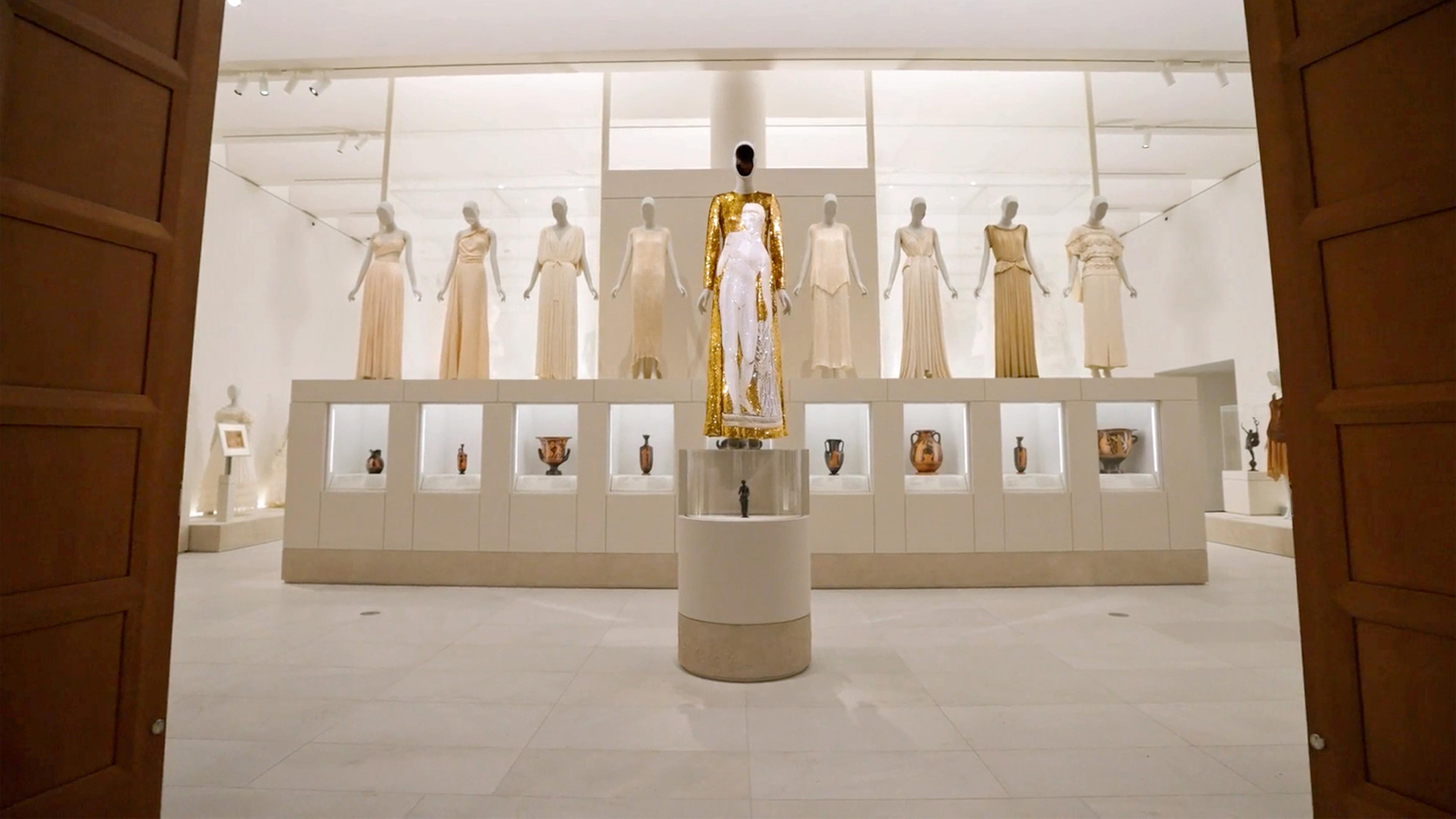
The Costume Institute’s current exhibition, Costume Art, features two of your dresses, “Wing Y” and “Blood”, that demonstrate a three-dimensional awareness of the body through techniques, such as bias-cutting, tucking, pleating, twisting, and knotting. What drew you to this approach of manipulating fabric?
Ando:
As mentioned earlier, Betty Kirke’s book on the anatomical study of Vionnet’s clothing was a real revelation for me. Surprisingly, the first edition was published not in Europe, nor in the United States, but in Japan in 1991. I was already living in Paris at the time, but in my ignorance, I didn’t even know the name of the great designer Madeleine Vionnet, yet I felt compelled to read this book. I had the book sent to me from Japan to Paris. Reading it, I found that therein lay the true creative process. I’d like to quote Issey Miyake’s words from the book’s preface:
“Vionnet’s clothes are based on the dynamics of movement… Each pin-tuck, each embroidery motif, is given an expression, while the fabrics are elastic and flexible and flow about the body of the wearer, creating beauty in harmony with movement.”
It was the bias cut that made this possible. I put this concept into practice when I participated in an international fashion contest in Fujiyoshida, Japan, in November 1992. I was invited from Paris to present an international entry. I used the fabric on the bias and listened to the fabric. The result was a dress completely different from anything I had created before. A dialogue with the fabric—the fabric itself showing its own harmony. This is what I learned from Vionnet: to see harmony within the details of technique.

Fukuko Ando (Japanese, born 1964). "Wing Y", 2006, edition 2026. Silk. The Metropolitan Museum of Art, New York, Gift of Fukuko Ando, 2026 (2026.190.1). Photo by Paul Westlake

Fukuko Ando (Japanese, born 1964). “Blood”, 2005. Silk. The Metropolitan Museum of Art, New York, Gift of Fukuko Ando, 2026 (2026.190.2). Photos by Michael Wayne Plant
Iida:
In addition to these two dresses, we are honored to bring “Red Line X” into The Costume Institute’s permanent collection. This dress utilizes the Japanese dyeing tradition of Arimatsu shibori. Could you elaborate on the concept behind this dress, and what inspired you to adopt this particular technique?
Ando:
This piece is part of my 1996 “Shibori” series. It is one of my early works. The shibori fabric itself is already the result of complex handiwork. Traditionally, this fabric is used to make kimonos with straight-cut seams. I thought that if I cut it on the bias and used pintucks to shape it, I might be able to create a beautiful “music” different from that of a kimono… and I completely ignored the traditional seams that give clothing its shape. Here is a saying by Vionnet that I admire:
“What we know is that there are no seams in the human body.”
It’s a simple yet profound truth that resonates in all my work. At the core of all my creations lies a body that is conscious in every direction—360 degrees.

Fukuko Ando (Japanese, born 1964). "Red Line X", 1995, edition 2026. Cotton, silk. The Metropolitan Museum of Art, New York, Gift of Fukuko Ando, 2026 (2026.190.3)
Iida:
One of the connecting threads between your collections is the dialogue between the body, mind, and dress. How did you develop this relationship with fashion? What does “embodiment” mean to you?
Ando:
Intuition is inspiration. Inspiration is a moment. But to give it form, I must continue to weave that moment within time. In my creative process, I drape the fabric over a mannequin and view the entire piece from all angles in the mirror. While observing the macrocosm of the dress as a whole in the mirror, I look directly at the microcosm of its details. Then I can see the flow of the fabric in the mirror, and within, the fleeting moments of each stitch, one by one. As the silence of my own being deepens and my concentration sharpens, what is the meaning of materializing this invisible inspiration?
“I have created dresses, but what I wish to show you is the miracle of life.
A miracle is the realization and the materialization of that which seems impossible.
The existence of Life from moment to moment, celebrated in each instant.
This is miracle.”
Iida:
Over the course of your career, you have presented your work in various formats, including runway shows, installations, and dance performances. What are your thoughts on displaying fashion in a museum context?
Ando:
I think the concept behind this exhibition is truly remarkable. Cloth holds the breath and energy of beauty from each era. When people wear those clothes, their consciousness changes. Why is that? A person’s consciousness changes depending on what they wear. That is where a feeling is born. Art is imbued with the vibrations of each and every moment in which the artist’s soul is poured into it. “Feeling” is a wonderful human quality. In our materialistic society, where people have come to see only what is visible, I believe the key to the future lies in awakening the ability to sense these invisible vibrations and energies. I hope that this exhibition, which presents the energy of fashion and the power of art from a new perspective, will help reawaken the sensibilities we once had.
This essay is published in conjunction with the exhibition Costume Art, on view through January 10, 2027.
Notes
Young, Lynn. "Body Worship." Newsweek, January 28, 1974.
Translated to English; quoted in Chapsal, Madeleine. La Chair de la Robe. Paris: Fayard, 1989. p. 159.
Translated to English; quoted in Chapsal, Madeleine. La Chair de la Robe. Paris: Fayard, 1989. p. 159.
Foreword by Issey Miyake from Kirke, Betty. Madeleine Vionnet. San Francisco: Chronicle Books, 2012. p. 13
"The miracle of life," Fukuko Ando, December 26, 2013