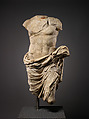
Marble statue of a wounded Amazon
In Greek art, the Amazons, a mythical race of warrior women from Asia Minor, were often depicted battling such heroes as Herakles, Achilles, and Theseus. This statue represents a refugee from battle who has lost her weapons and bleeds from a wound under her right breast. Her chiton is unfastened at one shoulder and belted at the waist with a makeshift bit of bridle from her horse. Despite her plight, her face shows no sign of pain or fatigue. She leans lightly on a pillar at her left and rests her right arm gracefully on her head in a gesture often used to denote sleep or death. Such emotional restraint was characteristic of classical art of the second half of the fifth century B.C.
The original statue probably stood in the precinct of the great temple of Artemis at Ephesos, on the coast of Asia Minor, where the Amazons had legendary and cultic connections with the goddess. The Roman writer Pliny the Elder described a competition held in the mid-fifth century B.C. between five famous sculptors, including Phidias, Polykleitos, and Kresilas, who were to make a statue of an Amazon for the temple. This type of statue is generally associated with that contest.
Artwork Details
- Title: Marble statue of a wounded Amazon
- Period: Imperial
- Date: 1st–2nd century CE
- Culture: Roman
- Medium: Marble
- Dimensions: H. 203.84 cm (80 1/4 in.)
- Classification: Stone Sculpture
- Credit Line: Gift of John D. Rockefeller Jr., 1932
- Object Number: 32.11.4
- Curatorial Department: Greek and Roman Art
Audio
1035. Marble statue of a wounded Amazon
The Amazons were a race of formidable warrior women, noted for their skills in archery and horsemanship. In mythology, the heroes Theseus and Achilles both fought and fell in love with Amazons. This figure is, like their adversaries, a noble and beautiful enemy. She is graceful and composed, leaning lightly on a pillar. Her face shows no sign of emotion, and her tidy hair no evidence of the exertion of battle. The short garment she wears is typical of male horsemen and soldiers, but hers is in disarray, unfastened from her left shoulder, and baring both her breasts. She raises her right arm to rest it on her head in a gesture associated with sleeping and dying in Greek art. Below her right armpit, blood spurts from a wound.
Other subtle details hint at the violence she has known. Stripped of both her horse and her proper belt, she wears a broken bridle around her waist. In mythology, the Amazon Hippolyte lost her belt to Herakles; this could be Hippolyte. A lost belt usually means lost chastity in Greek mythology, and scholars have suggested that the Amazon has been raped as well as wounded.
Like many of the other works in this gallery, the Amazon is an ancient Roman version of an earlier Greek statue. The Roman writer Pliny describes a contest between five famous sculptors who competed to make the best Amazon in the fifth century B.C. This statue probably reproduces one of the Amazons they created for that contest.
More Artwork
Related Content


Research Resources
The Met provides unparalleled resources for research and welcomes an international community of students and scholars. The Met's Open Access API is where creators and researchers can connect to the The Met collection. Open Access data and public domain images are available for unrestricted commercial and noncommercial use without permission or fee.
To request images under copyright and other restrictions, please use this Image Request form.
Feedback
We continue to research and examine historical and cultural context for objects in The Met collection. If you have comments or questions about this object record, please contact us using the form below. The Museum looks forward to receiving your comments.
Content Notice
The Metropolitan Museum of Art presents over 5,000 years of art from around the world, and our online collection reflects ongoing work conducted over the course of our more than 150-year history. You may encounter objects or images that may be inappropriate for some viewers or information that may be outdated.