
Introduction
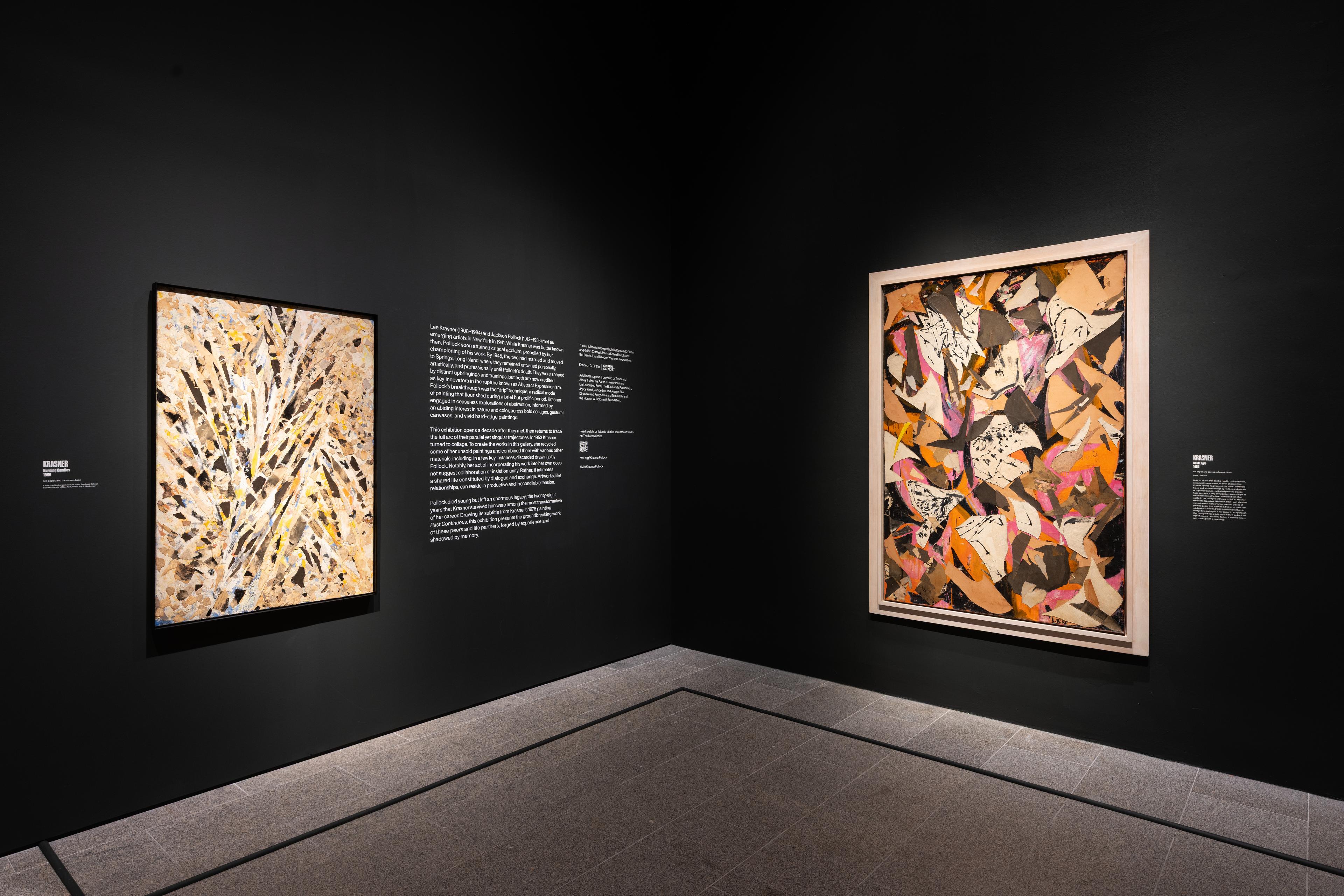
Lee Krasner (1908–1984) and Jackson Pollock (1912–1956) met as emerging artists in New York in 1941. While Krasner was better known then, Pollock soon attained critical acclaim, propelled by her championing of his work. By 1945, the two had married and moved to Springs, Long Island, where they remained entwined personally, artistically, and professionally until Pollock’s death. They were shaped by distinct upbringings and trainings, but both are now credited as key innovators in the rupture known as Abstract Expressionism. Pollock’s breakthrough was the “drip” technique, a radical mode of painting that flourished during a brief but prolific period. Krasner engaged in ceaseless explorations of abstraction, informed by an abiding interest in nature and color, across bold collages, gestural canvases, and vivid hard-edge paintings.
This exhibition opens a decade after they met, then returns to trace the full arc of their parallel yet singular trajectories. In 1953 Krasner turned to collage. To create the works in this gallery, she recycled some of her unsold paintings and combined them with various other materials, including, in a few key instances, discarded drawings by Pollock. Notably, her act of incorporating his work into her own does not suggest collaboration or insist on unity. Rather, it intimates a shared life constituted by dialogue and exchange. Artworks, like relationships, can reside in productive and irreconcilable tension.
Pollock died young but left an enormous legacy; the twenty-eight years that Krasner survived him were among the most transformative of her career. Drawing its subtitle from Krasner’s 1976 painting Past Continuous, this exhibition presents the groundbreaking work of these peers and life partners, forged by experience and shadowed by memory.
Before Krasner, Before Pollock
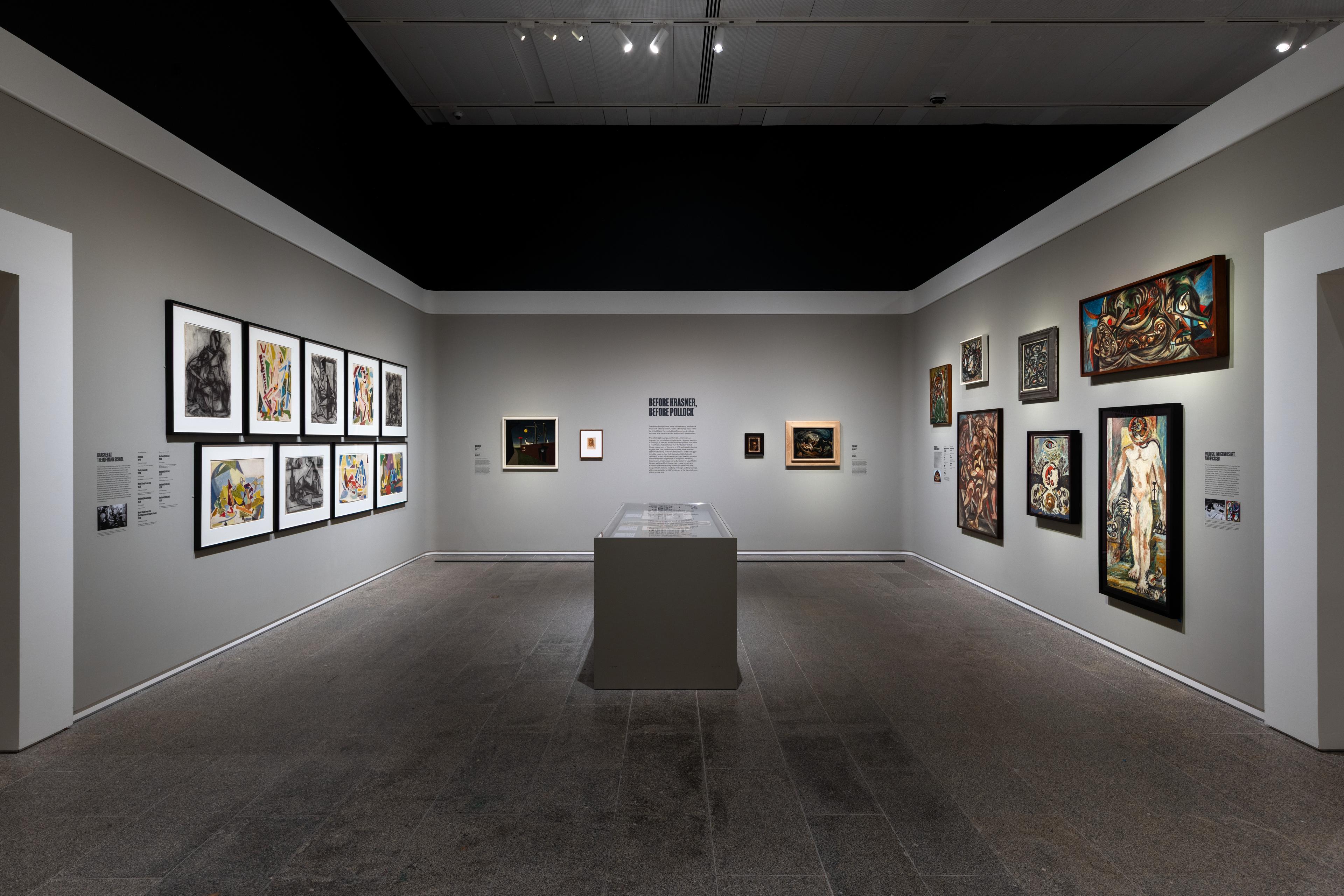
The works displayed here, made before Krasner and Pollock knew each other, reveal two parallel art-historical tracks within the United States that needed to collide and cross-pollinate to create what became known as Abstract Expressionism.
The artists’ upbringings and formative interests were divergent but nonetheless complementary. Krasner was born in Brooklyn, in 1908, to Jewish immigrant parents from what is now Ukraine. Pollock hailed from the Western United States; he was born in Wyoming, in 1912, and raised in the Los Angeles area. Their professional paths took shape amid the economic hardship of the Great Depression and the struggle to build a career in New York during the 1930s. Pollock’s patchwork of early influences ranged from Mexican muralism and United States Regionalism to Indigenous American, Oceanic, and African art, as well as Surrealism by way of Pablo Picasso and Joan Miró. Krasner had a more formal—and European-directed—training at New York institutions (the Cooper Union, National Academy of Design, and City College), which culminated in her 1937 enrollment at the Hans Hofmann School of Fine Arts.
Krasner at the Hofmann School
The teaching of German-born artist Hans Hofmann (1880–1966) connected a new generation of artists in New York, including Lee Krasner, to modernist breakthroughs happening in Paris. Hofmann spent his formative years between Munich and Paris, in the orbit of avant-garde artists such as Henri Matisse, Pablo Picasso, Georges Braque, and Vasily Kandinsky. After immigrating to the United States, he became an influential progressive teacher. In 1933 he established the Hans Hofmann School of Fine Arts, which prioritized drawing from live models. Numerous studies Krasner created during her time there (1937–40) betray Hofmann’s emphasis on articulating the human figure in space through shapes, lines, and textures (a tenet of Analytic Cubism). Krasner’s still-life compositions, meanwhile, illustrate Hofmann’s “push-and-pull” theory that color and forms could be placed in specific ways to suggest dimension and dynamism.
Pollock and Mexican Muralism
Of the celebrated Mexican muralists who worked in the United States between 1927 and 1940—including José Clemente Orozco, Diego Rivera, and David Alfaro Siqueiros—Pollock was most influenced by Orozco. Even before moving to New York, Pollock traveled to Pomona College in California to see Orozco’s recently completed mural Prometheus (1930), which he called “the greatest painting done in modern times.” Orozco’s muscular figures and painterly approach permeate many of Pollock’s works from this era. In compositions such as Figure Kneeling Before Arch with Skulls and Naked Man with Knife, Pollock melds Orozco’s themes of foreboding, conflict, and human struggle with his own emerging symbolic language. Later, as Pollock underwent psychoanalysis, these influences merged with his exploration of the unconscious, giving rise to anguished hybrid figures and animal forms—seen in the donkey head of Untitled and the bull horns of Head.
Pollock, Indigenous Art, and Picasso
Pollock’s lifelong affinity for Indigenous American art led him to visit and study collections and exhibitions across the city, including Indian Art of the United States (1941) at the Museum of Modern Art. Aspects of the works he encountered, including masks, totems, and chimeric figures, filtered into paintings such as Naked Man and Bird. At the same time, Pablo Picasso loomed large for New York artists in the 1930s, and Pollock was no exception. Through the writings of John Graham (see adjacent gallery), Pollock came to understand Picasso’s modernism as linked to Indigenous African, Oceanic, and American art through a shared expression of the unconscious via abstract forms. As Pollock absorbed and reinterpreted these intertwined influences, he created works such as Mask, which draws as much from Picasso’s Girl before a Mirror as from Indigenous traditions.
John Graham’s American and French Paintings
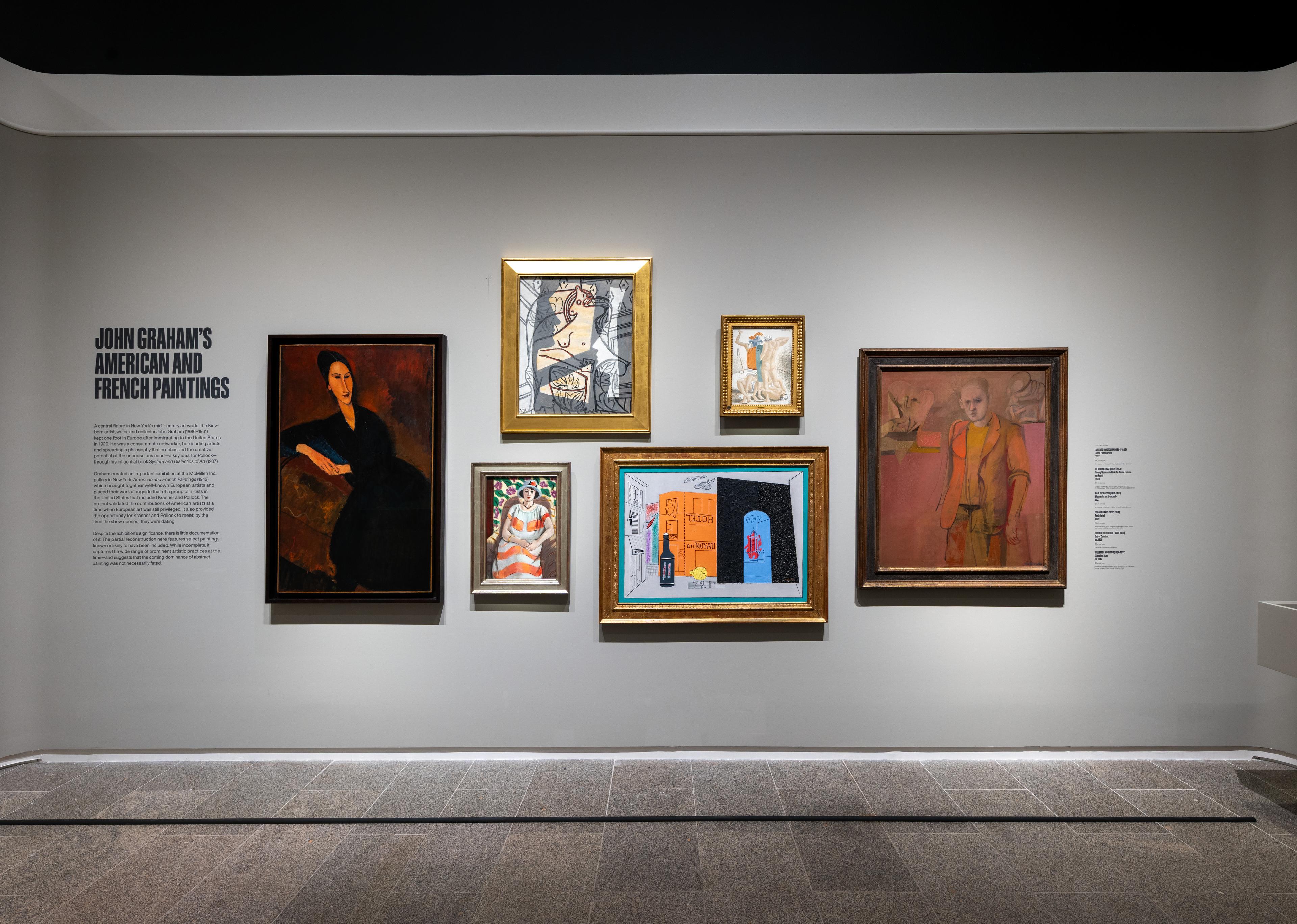
A central figure in New York’s mid-century art world, the Kiev-born artist, writer, and collector John Graham (1886–1961) kept one foot in Europe after immigrating to the United States in 1920. He was a consummate networker, befriending artists and spreading a philosophy that emphasized the creative potential of the unconscious mind—a key idea for Pollock—through his influential book System and Dialectics of Art (1937).
Graham curated an important exhibition at the McMillen Inc. gallery in New York, American and French Paintings (1942), which brought together well-known European artists and placed their work alongside that of a group of artists in the United States that included Krasner and Pollock. The project validatedthe contributions of American artists at a time when European art was still privileged. It also provided the opportunity for Krasner and Pollock to meet; by the time the show opened, they were dating.
Despite the exhibition’s significance, there is little documentation of it. The partial reconstruction here features select paintings known or likely to have been included. While incomplete, it captures the wide range of prominent artistic practices at the time—and suggests that the coming dominance of abstract painting was not necessarily fated.
Image Surfacing
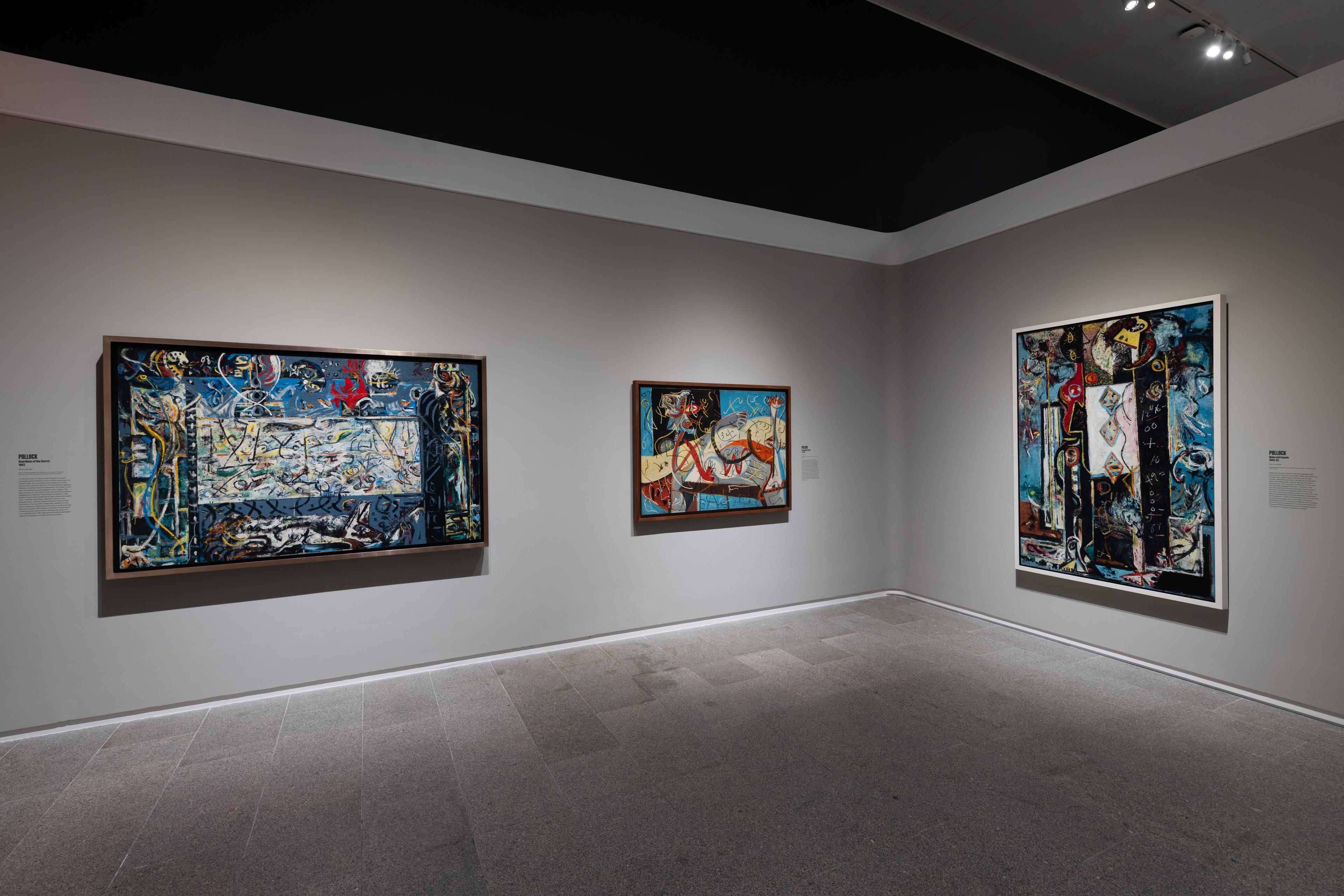
The advent of Krasner and Pollock’s relationship in 1942 also marked a crossroads in each of their artistic practices. For Krasner, the path ahead looked almost like a dead end; for Pollock, a limitless horizon. By her own admission, Krasner’s initial encounters with Pollock’s work occasioned a creative block, and she tarried over a series of false starts. The paintings she later called her “gray slabs” were so layered and built up that they dissolved into something resembling mud, and she destroyed them all, scraping down and recycling the canvases. At the same point, Pollock’s career was on the rise—due in no small part to Krasner, who acted as de facto publicist, handler, interlocutor, and caretaker for her notoriously talented yet troubled partner. He came into the fold of the collector Peggy Guggenheim and her gallery Art of This Century. Pollock’s Surrealist-inflected imagery betrays an artist smuggling in personal narrative through an infrastructure of mythology and symbols. Krasner’s new presence in his life can be obliquely felt in paintings that take on coupling, gender, and sexuality.
The one painting by Krasner in this gallery, Image Surfacing (ca. 1945), sees her finally finding a way out of the dark.
Springs, Long Island
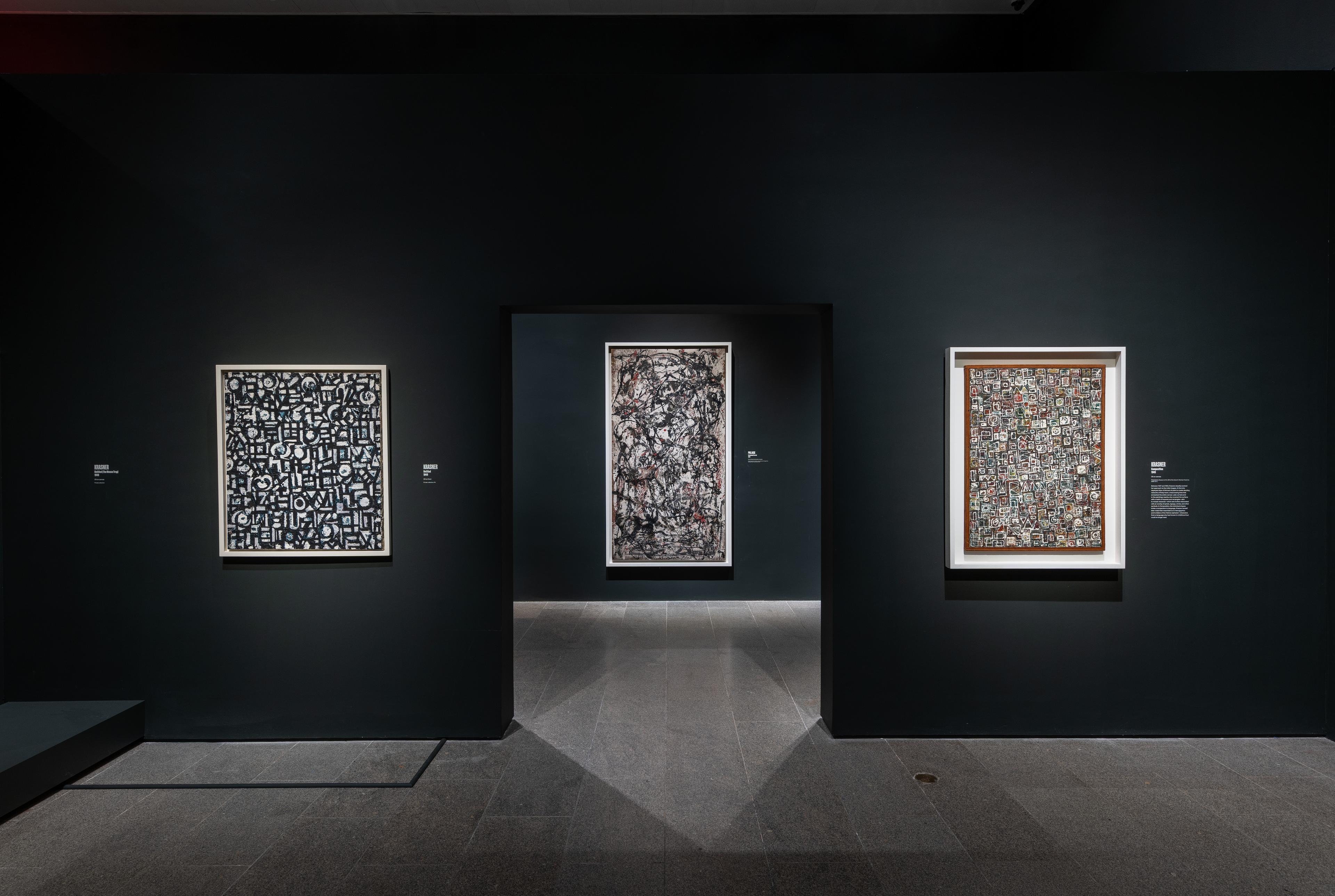
Shortly after they married, Krasner and Pollock moved to the rural town of Springs in East Hampton, Long Island. Instigated by Krasner, the November 1945 departure from New York withdrew Pollock from a scene that fed them both artistically yet enabled his alcoholism too readily. They set to work making a home out of the farmhouse and grounds. With an exhibition fast approaching, Pollock worked in an upstairs bedroom, while Krasner made do with the kitchen below. When he cleared the barn for himself in the summer of 1946, Krasner took over the bedroom workspace. The nested galleries here approximate the relative scale of their respective studios.
Both artists began experimenting with all-over abstract compositions: covering every square inch of the surface through combinations of pouring, dripping, and manipulating paint, often without direct touch. Krasner’s intimate, elaborate canvases pulsed with vibrancy; Pollock’s dramatic, expansive drip works radically reimagined what a painting could be. They visited each other’s studios regularly, but only by invitation. During one visit, Pollock posed a question he could only ask someone he trusted: “Is this a painting?” In 1949 Life magazine posed another: “Jackson Pollock: Is he the greatest living painter in the United States?”
Convergence
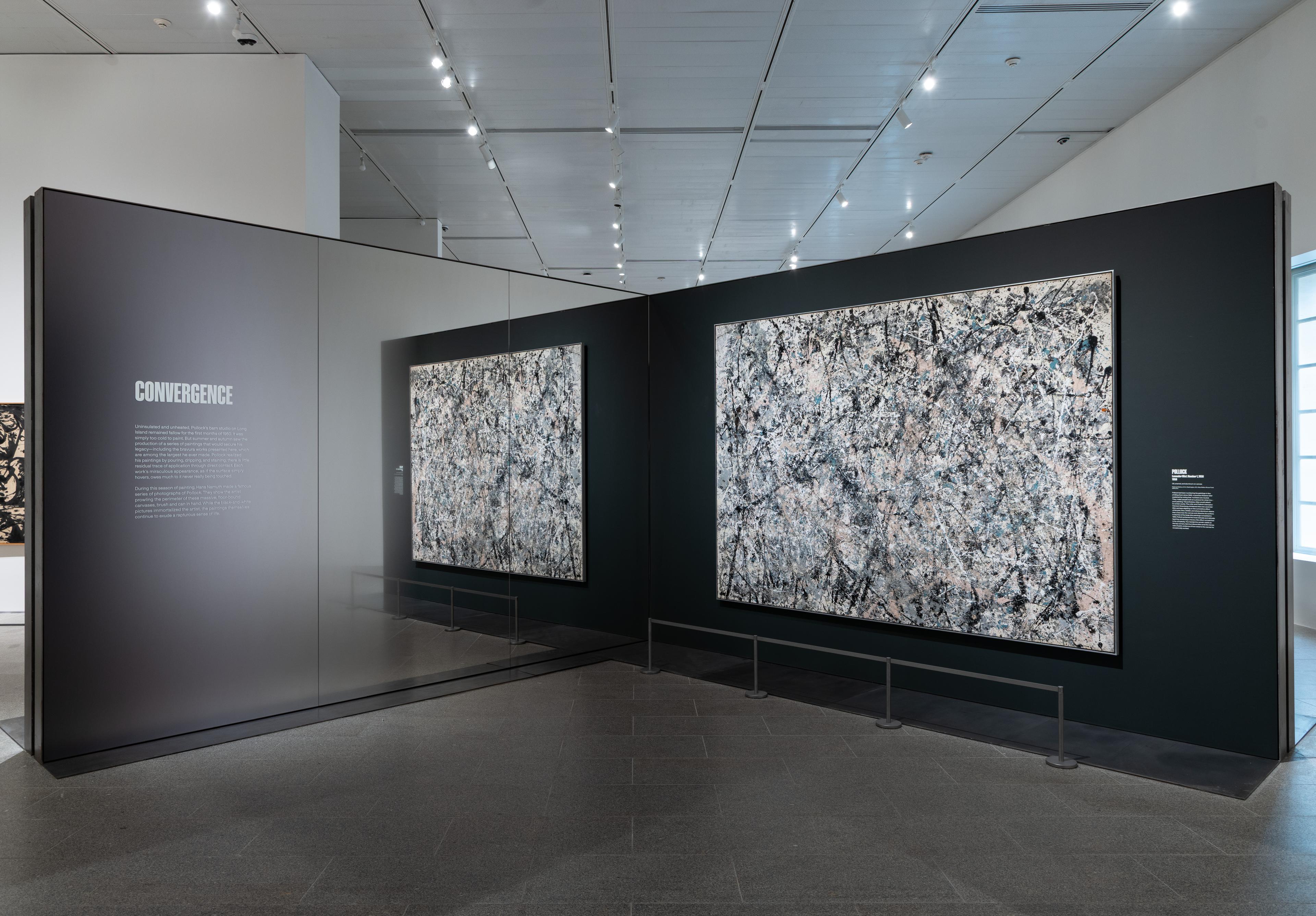
Uninsulated and unheated, Pollock’s barn studio on Long Island remained fallow for the first months of 1950. It was simply too cold to paint. But summer and autumn saw the production of a series of paintings that would secure his legacy—including the bravura works presented here, which are among the largest he ever made. Pollock realized his paintings by pouring, dripping, and staining; there is little residual trace of application through direct contact. Each work’s miraculous appearance, as if the surface simply hovers, owes much to it never really being touched.
During this season of painting, Hans Namuth made a famous series of photographs of Pollock. They show the artist prowling the perimeter of these massive, floor-bound canvases, brush and can in hand. While the black-and-white pictures immortalized the artist, the paintings themselves continue to exude a rapturous sense of life.
Black Pourings
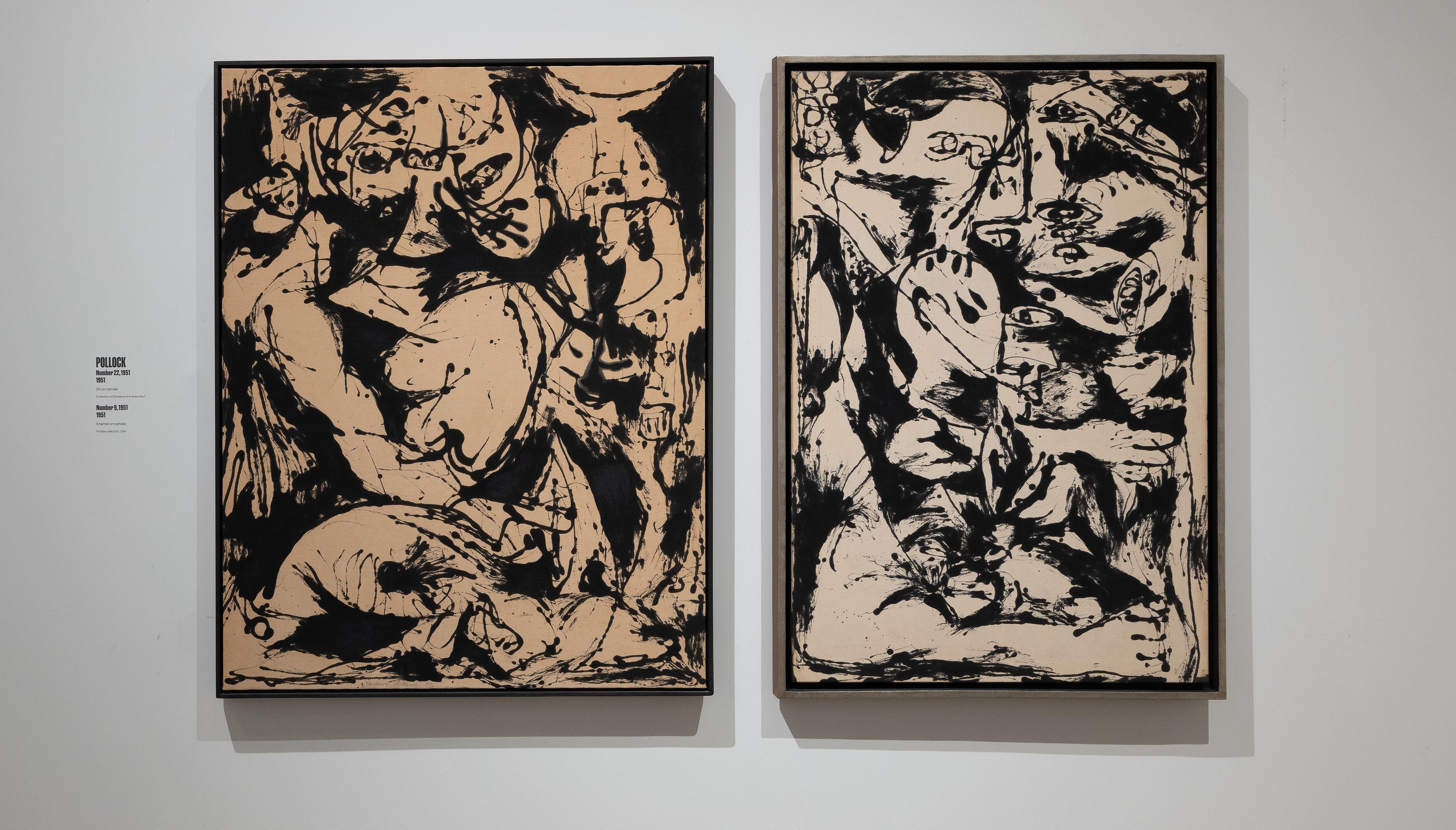
What does an artist do after a breakthrough? This question haunted Pollock as he became renowned yet typecast for his all-over drip paintings. His response was one of restraint, return, and reimagining. In works that came to be known as his “black pourings” (1951–53), Pollock relied solely on black commercial paint and unprimed canvas to revisit the biomorphic and figurative forms of his drawings and paintings from a decade earlier. Alongside his now-famous dripped lines, he leaned more intentionally into pooled passages of black and contours achieved through the controlled pours of a basting syringe. With their pared-back palette, these works were also in dialogue with the monochrome paintings of artists such as Willem de Kooning, Robert Motherwell, Barnett Newman, and Franz Kline. The magnetic charge of Pollock’s line—as it became pattern, figure, and form—elicited mixed responses from critics and audiences when he exhibited these paintings in 1951 and 1952. Nevertheless, the productive explorations in this short chapter mark a turning point in Pollock’s career as he cast about for a way through—and past—the drip.
Stable Gallery, 1955
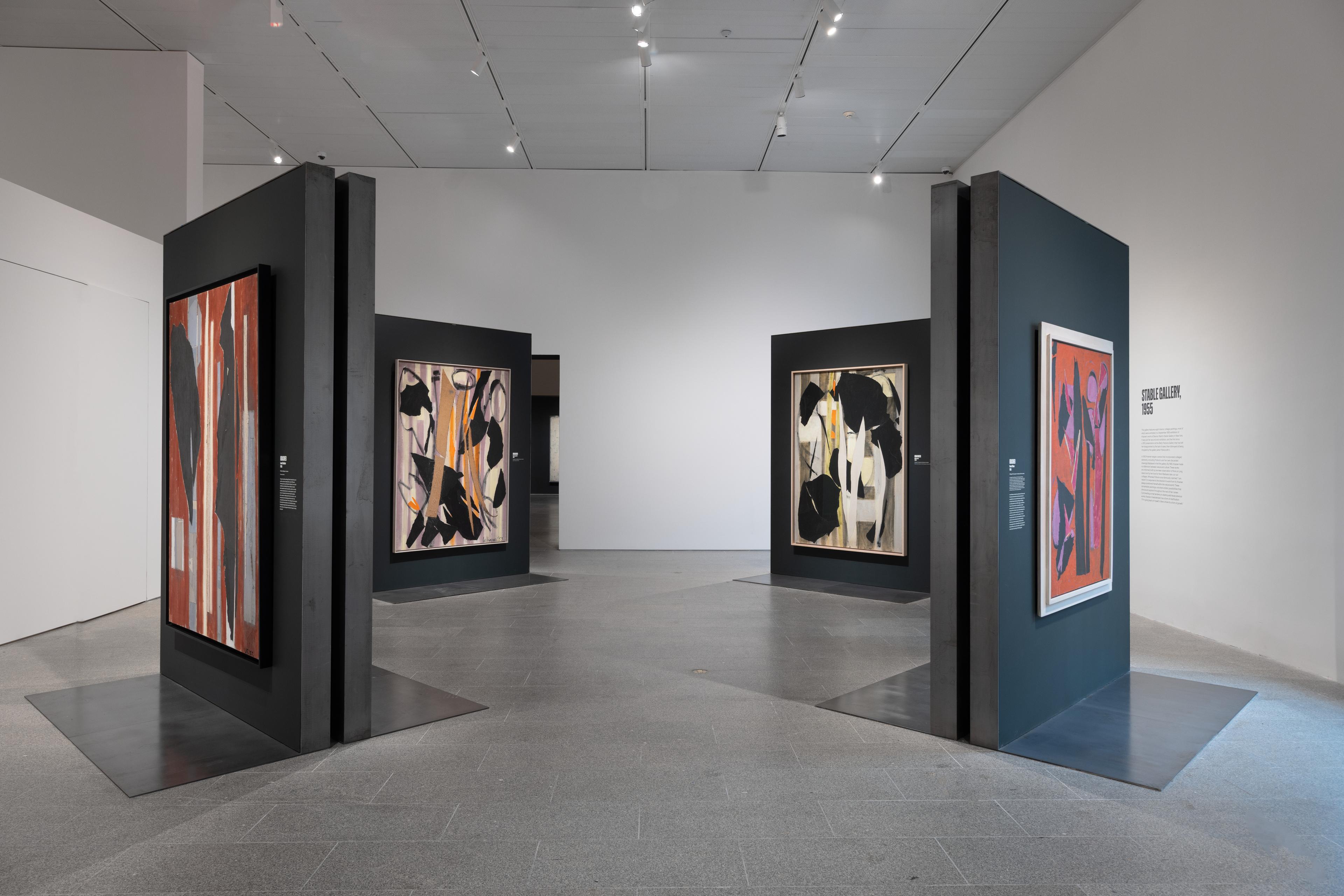
This gallery features eight totemic collage paintings, most of which were exhibited in a September 1955 exhibition of Krasner’s work at Eleonor Ward’s Stable Gallery in New York. It was just her second solo exhibition, and the first since a 1951 presentation at the Betty Parsons Gallery that had left her disappointed by the lack of sales, then dismayed at being dropped by the gallery when Pollock left it.
In 1953 Krasner began a series that incorporated collaged elements, including Pollock’s and her own discarded drawings (displayed in the first gallery). By 1955, Krasner made no distinction between nature and culture. These works are informed both by her keen observation of flora on Long Island and by her love for Henri Matisse’s late cut-out collages. Whereas Pollock once famously claimed “I am nature” (in response to the direction to work from it), Krasner always positioned herself within the natural world. These remarkable paintings unlocked artistic possibilities that she would explore throughout the rest of hercareer. Commenting on her tendency to destroy and reuse previous works, Krasner characterized it as a form of clarification: “If I’m going back on myself, I’d like to think it’s a form of growth.”
Re-echo
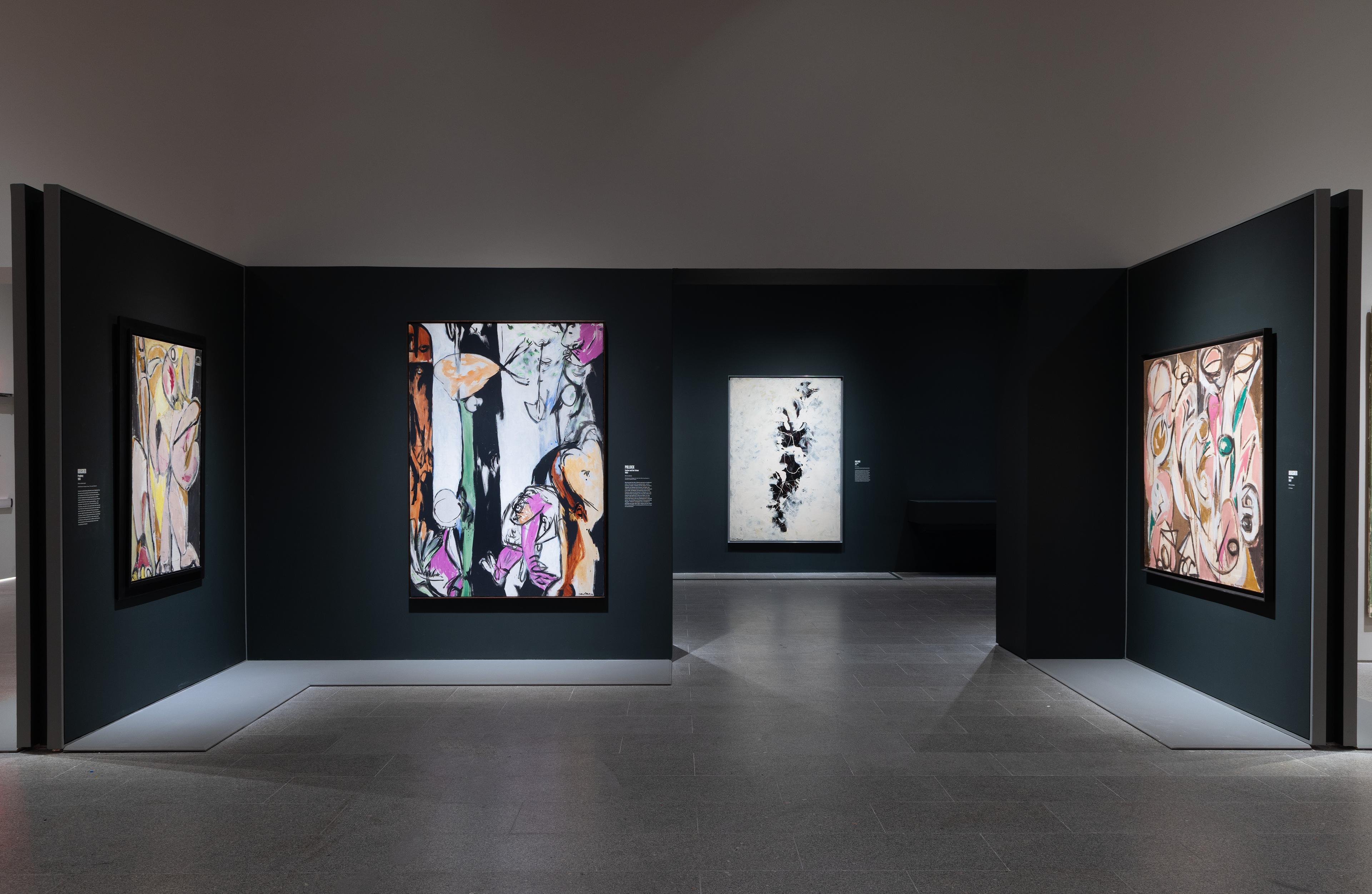
Krasner unapologetically and brilliantly swerved between—and away from—styles across her entire career. Pollock was the opposite. While the limited aesthetic moves that followed his radical forays into drip painting could be inventive, they also look like studied refinements of his earlier style. Nevertheless, at a dizzying intersection between the early 1950s and his death in 1956, Pollock and Krasner created bodies of work that share more visual DNA than at any other time in their lives together. Ironically, this is also the moment their personal relationship was nearest collapse, with Pollock’s alcoholism, infidelity, and precarious mental health making daily life untenable for Krasner.
Vivid palettes and sinuous, arabesque lines suggest their shared debt to the art of Henri Matisse, which Krasner had introduced to Pollock early in their relationship. While the vertical segmentation and Surrealist imagery of certain Pollock paintings are echoed in later ones by Krasner, the question of influence is never straightforward. The earliest paintings here are by Krasner, and their fractured geometries and implied body parts populate Pollock’s late production. As with any echo, the location of the original source is easy to lose in the reverberating present.
The Seasons
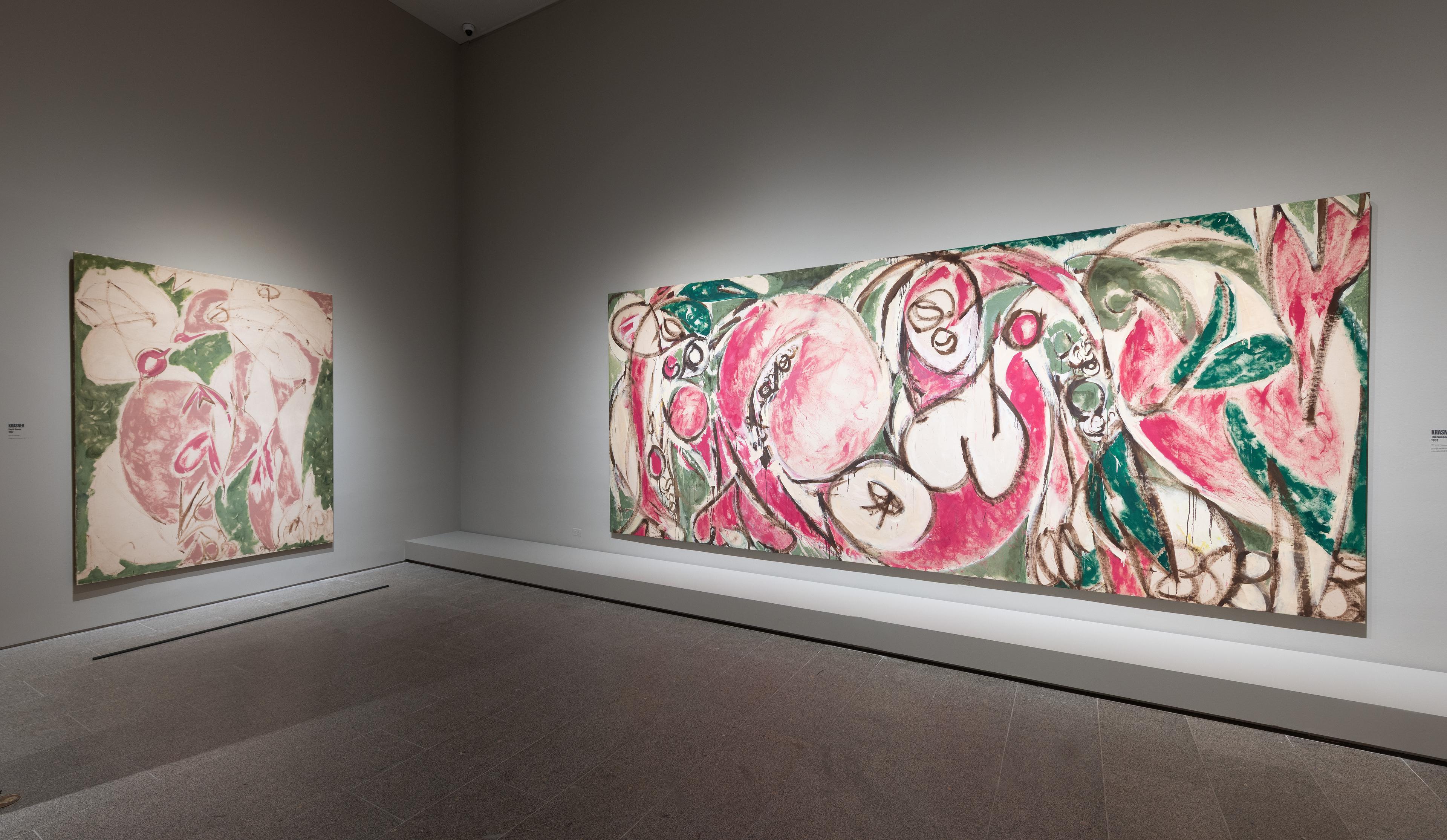
A year after Pollock’s 1956 death, Krasner moved her brushes, paints, and tools into the barn at Springs and made it her studio. Claiming this space was practical, if emotionally fraught. She could now work on a massive scale that had been impossible in the kitchen or bedroom.
The Seasons, at seventeen feet wide, stands as vibrant evidence of Krasner immediately reckoning with Pollock’s legacy. Marrying the scale of his defining canvases with the organic shapes, patterns, and curves found in the art of Henri Matisse, Krasner expanded her practice in still new directions. With their lush chroma and sinuous bodily forms, the paintings here sing of cycles, like seasons, that push fresh feelings out of known forms. The sense of freedom and lightness stands in stark contrast to much of what came before and what would follow. If they signal a release from the burdens of the past, Krasner’s pulsing paintings also suggest that time never stands still.
Night Journeys
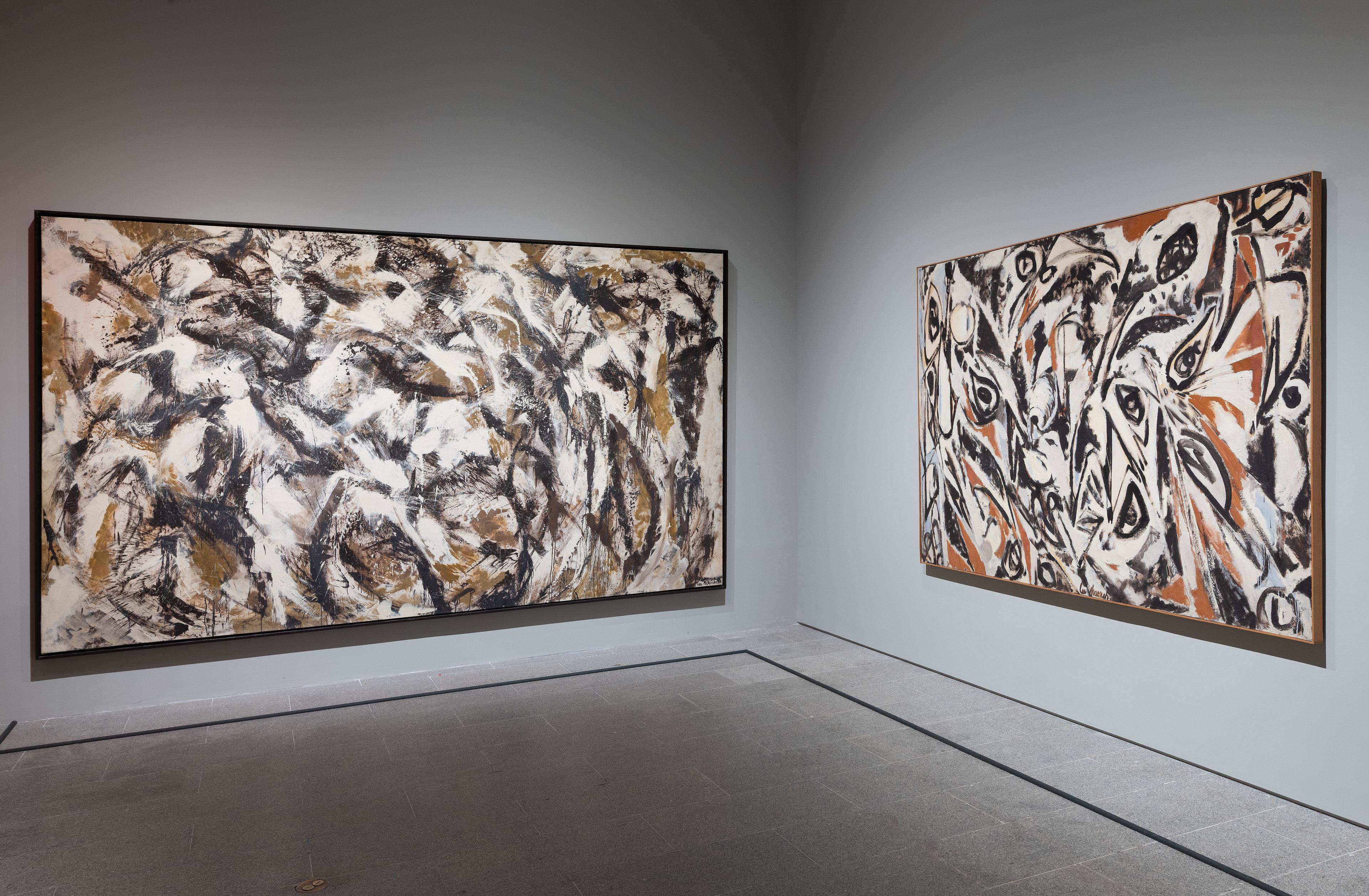
Mourning does not operate on a schedule. After the initial eruption of color and optimism that made its way into Krasner’s production shortly after Pollock died, the lights went out. In the early 1960s, following the 1959 death of her mother, Krasner experienced chronic insomnia and worked at night. Not trusting the interaction of color and artificial light in the barn studio, she leached her palette to white and umber, both raw and burnt. The resulting works teem with emphatic and energetic swarms of paint. The poet Richard Howard called them “Night Journeys,” but Krasner’s choice of Polar Stampede for one title suggests the chaos she meant to simultaneously harness and unleash in these aesthetic acts. The artist later said of this period: “My mother died shortly before. . . . I didn’t know how to deal with Pollock. It was a rough life.” In her retreat from color, Krasner committed fully to gesture, perhaps as a way of inhabiting the loss she felt and working through it in the only way she knew how—in paint.
Through Blue
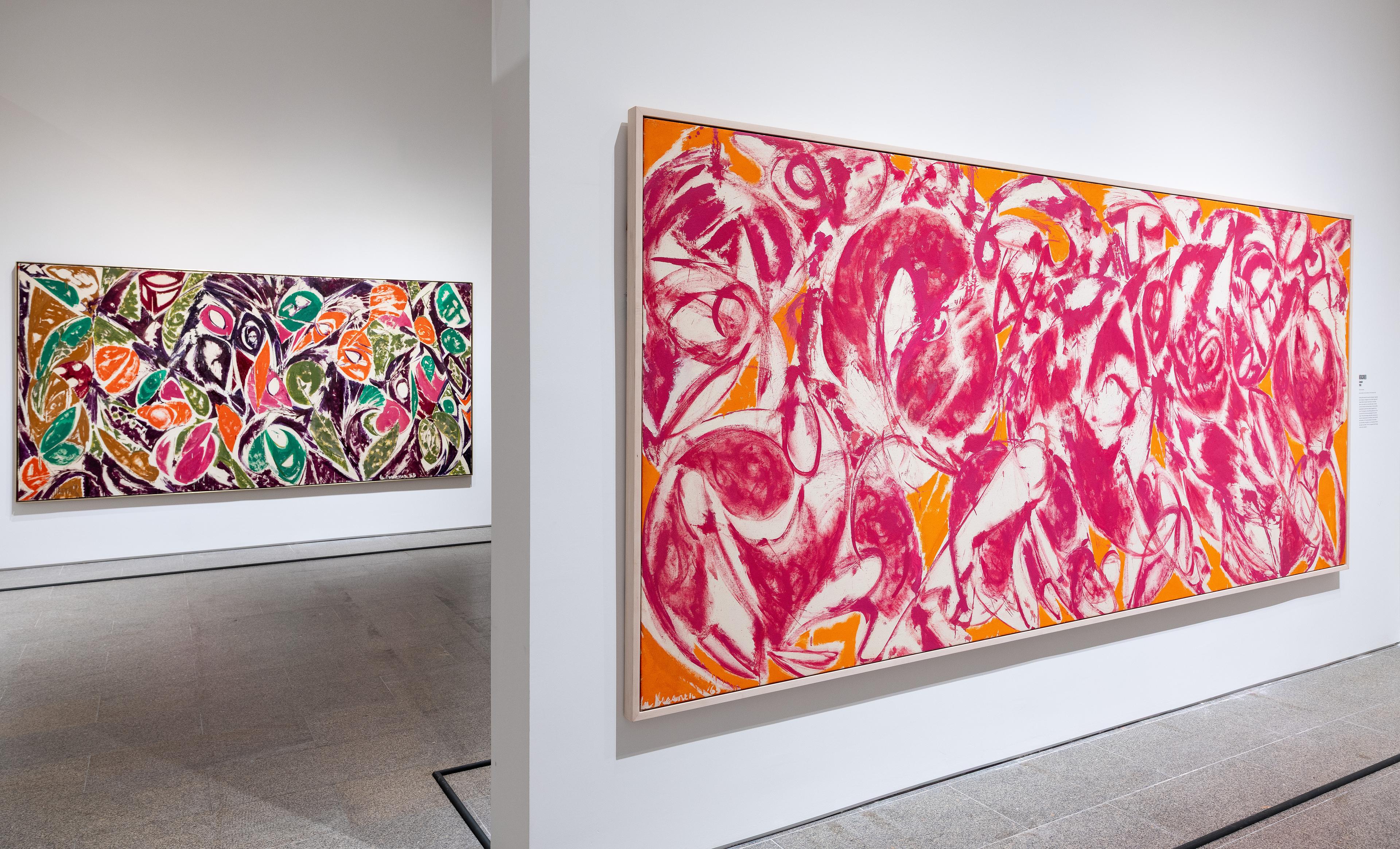
As the 1960s progressed, Krasner followed the monochromatic Night Journeys, and the emotional darkness that attended them, with a rapturous reengagement with color. Through Blue, in this gallery, painted after Krasner broke her right arm and taught herself to work with her left, embodies its irrepressible and determined maker. Krasner always trafficked in cycles, and paintings from this decade show her preference for returns and revisions over linearity and progression. By 1965, rhythmic arabesque lines and fecund biomorphic forms once again gave structure to a riot of aggressive color combinations. Yet even within a single year, Krasner swerved, deploying on bare canvas a poignant, curved painted line like a dancer still moving long after the music fades. It would be an important time for Krasner—a 1965 retrospective at the Whitechapel Gallery in London proved a triumph. By 1967 Krasner had relocated her principal studio to Manhattan, yet nature continued to unfold in her work into the following decade as she embarked on further chapters of renewal.
Past Continuous
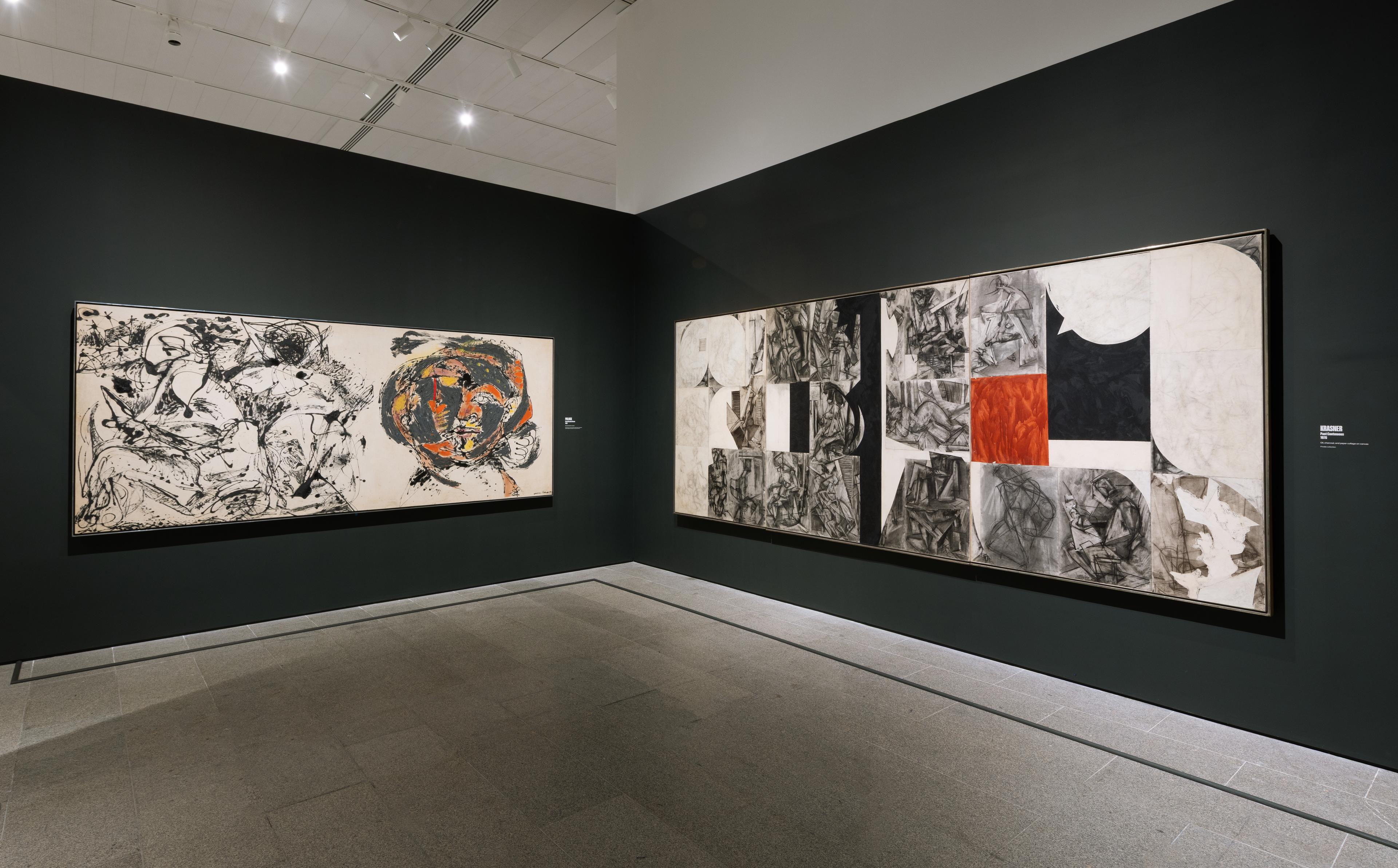
“I believe in continuity. . . . The past is part of the present which becomes part of the future.”
—Lee Krasner, 1977
In 1974 the rediscovery of a cache of drawings from the 1930s gave Krasner a chance to take stock. She framed some of these Cubist life studies and initially intended to trash the others. However, as with Pollock’s discarded drawings decades earlier, Krasner ultimately found in them the materials for new work: a series titled Eleven Ways to Use the Words to See, each painting named after a different verb form. She sliced selected drawings into vectors and shards, then reconstituted them on canvas with slight glitches in alignment and a new incorporation of color. These paintings are both old and new—revealing an established artist reckoning with her past and a younger artist willing herself into the future.
Paired with them here is one of Pollock’s largest late works, Portrait and a Dream (1953). Its two halves—an abstraction akin to paintings of the 1950s and a face that recalls a self-portrait from the 1930s—seem to attract and resist each other’s pull. These visions of the past, intentionally unreconciled, express Krasner and Pollock’s shared desire to keep time and history in productive suspension.