At the age of twenty-seven, on horseback, in full armor resplendent with oak leaves to catch the eye of a young lady he had met in the shadow of an oak tree, Federico da Montefeltro charged an opponent in a mock battle at a tournament in Urbino, only to have his opponent’s lance strike his visor, destroy the bridge of his nose, and pierce his right eye. Later, as a fabulously successful leader of a mercenary armed force, the duke of Montefeltro accumulated enormous wealth, a vast library, and an art collection befitting his status in Renaissance society. He also developed a passion for the new science of depicting linear perspective that flourished in Italy at the time. Given that one perceives spatial depth stereoscopically, it is perhaps surprising that a man with vision in only one eye would commission the Gubbio Studiolo, a complex representation of perspective and trompe l’oeil illusionism.
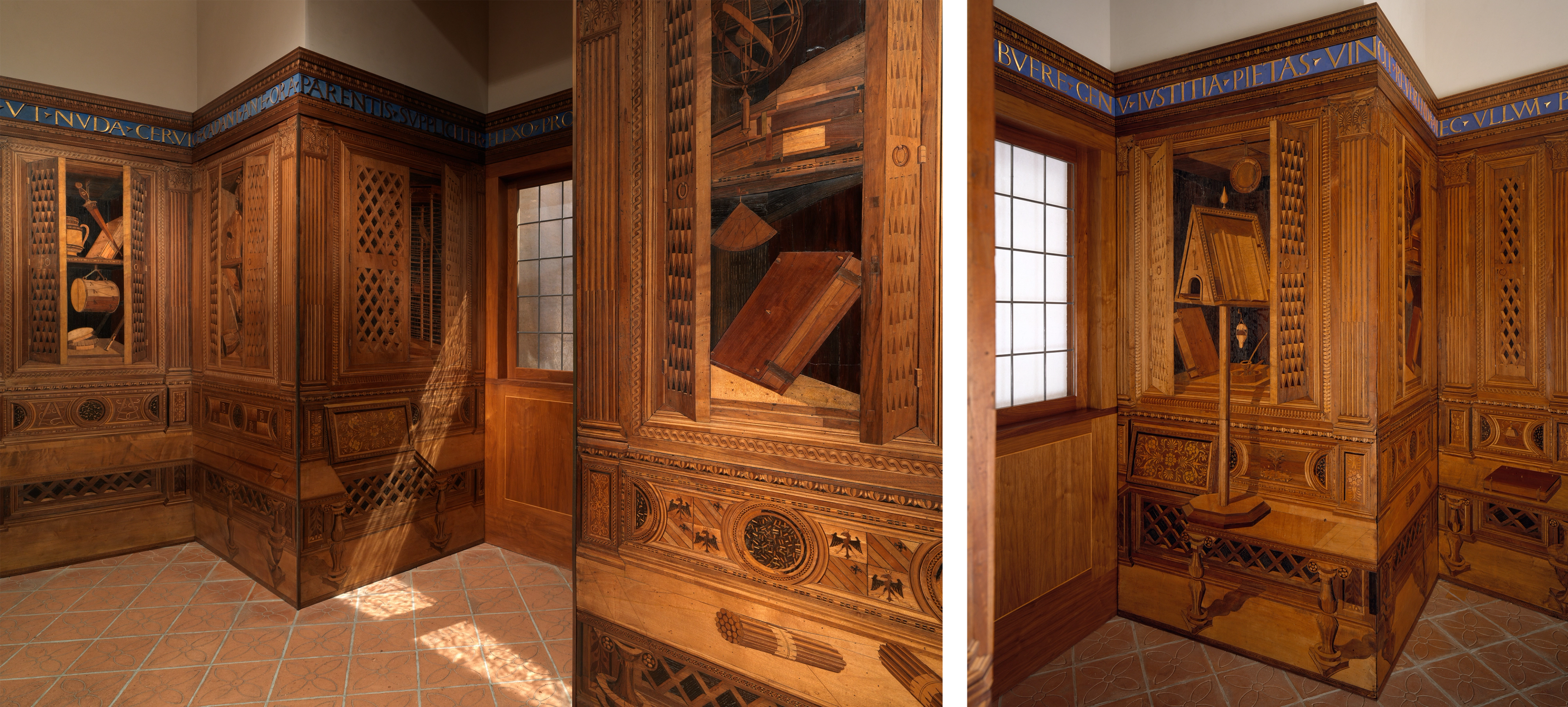
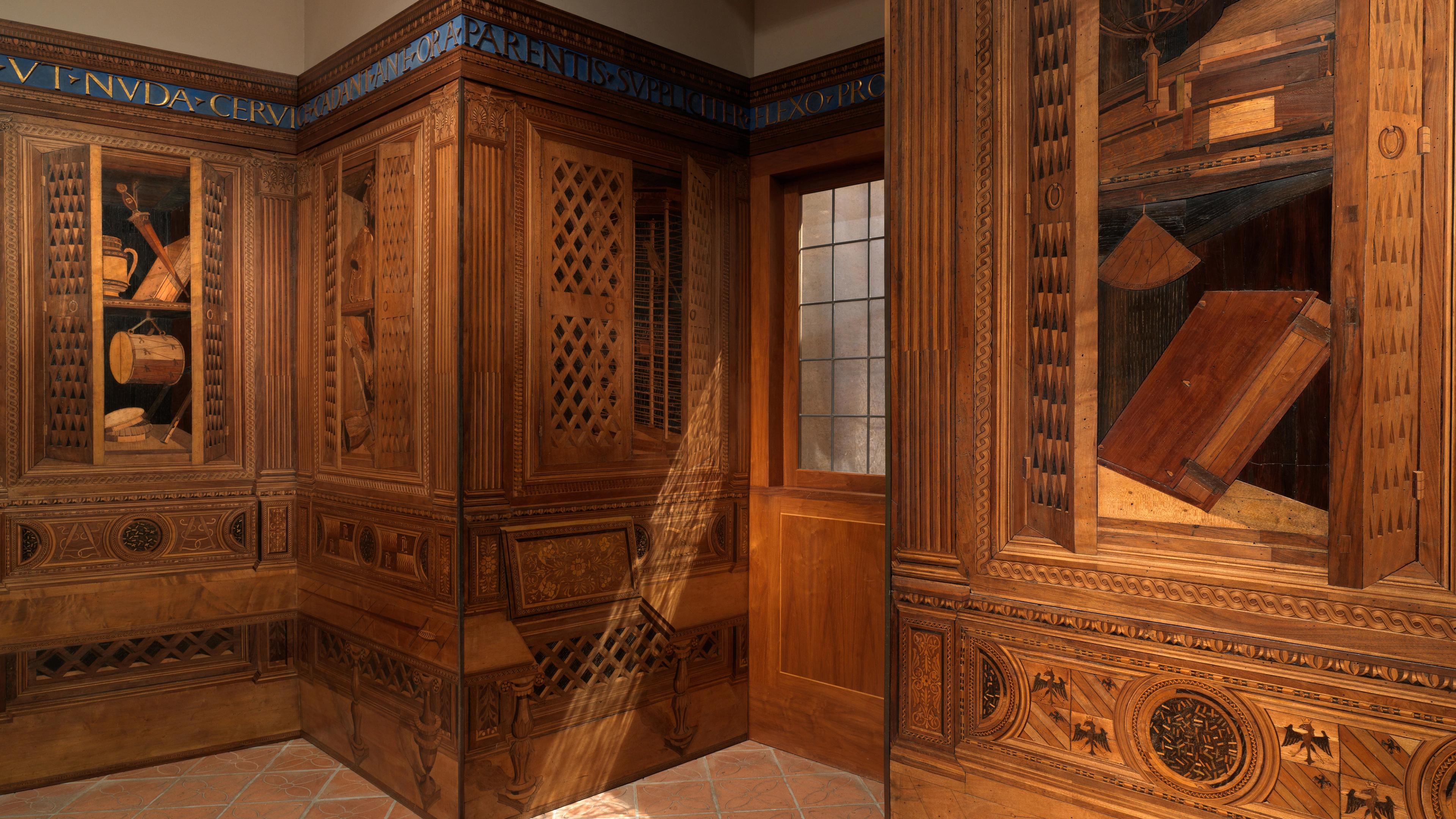
Designed by Francesco di Giorgio Martini (Italian, 1439–1501). Studiolo from the Ducal Palace in Gubbio (details), ca. 1478–82. Walnut, beech, rosewood, oak and fruitwoods in walnut base, 15 ft. 11 in. x 17 ft. x 12 ft. 7 1/4 in. (485 x 518 x 384 cm). The Metropolitan Museum of Art, New York, Rogers Fund, 1939 (39.153)
Built as a reflection of its patron’s intellectual and moral aspirations, the duke’s studiolo, or private study, for his palace in Gubbio provided a carefully edited autobiography. Federico’s competitive nature compelled him to reach beyond the sophistication of antiquity but also to outshine contemporary Florence in an artful imitation of reality. This was a snug, irregular space, a room for reading and writing, but also a VIP lounge, the most private of public rooms. A sixty-six-inch horizon is set for a five-foot-six-inch-tall viewer. Architect Francesco di Giorgio and master woodworker Giuliano da Maiano carefully considered the geometry of the fixed distance and ideal center point from which the trompe l’oeil furnishings and objects are meant to be seen. Olga Raggio, the former chair of The Met’s Department of European Sculpture and Decorative Arts, explained to me her opinion that this measurement must correspond to the height of the duke, not the woodworker. The room’s physical dimensions are thus a mathematical embodiment of the man.
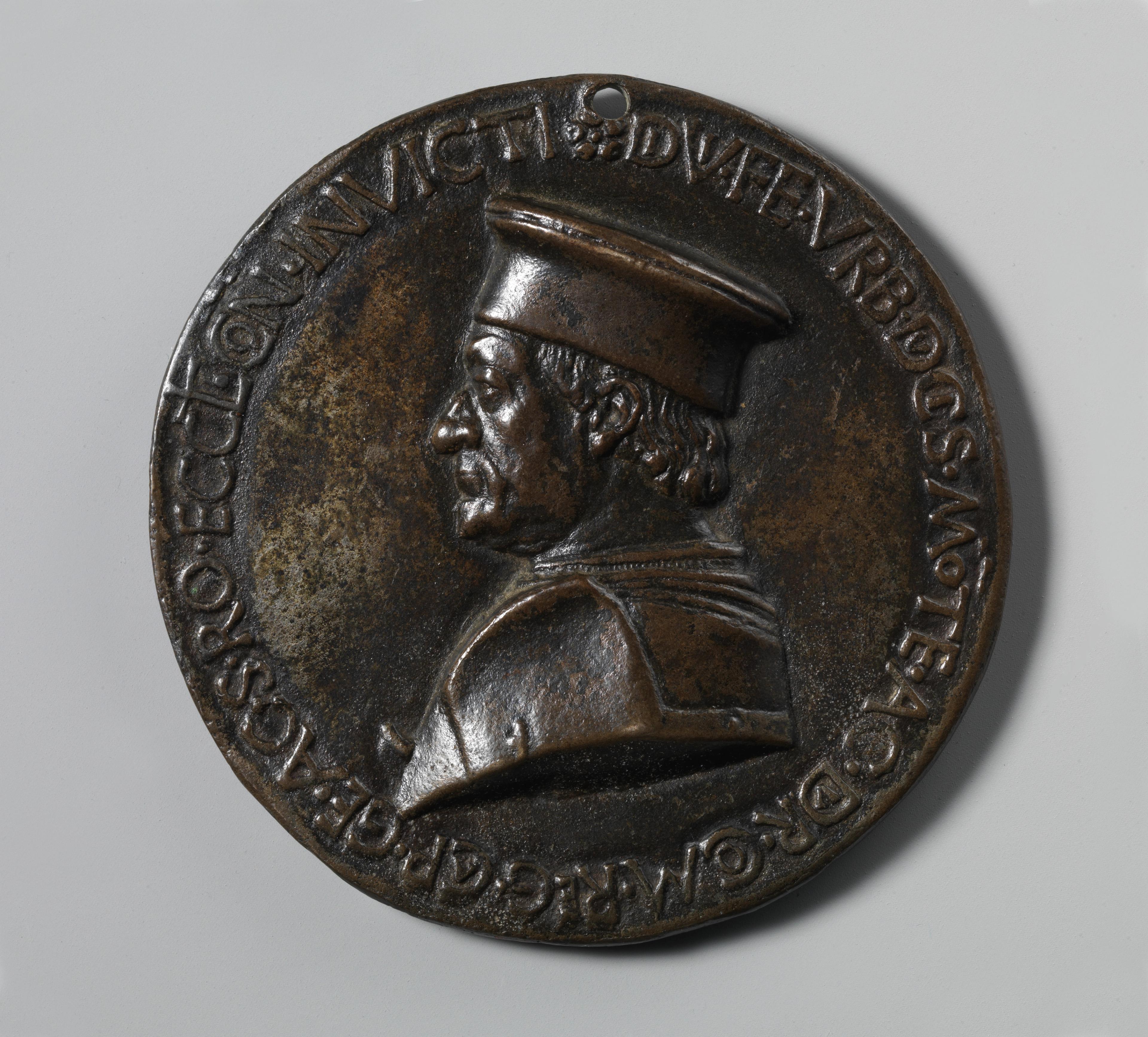
Savelli Sperandio (Italian, ca. 1425–1504). Federigo da Montefeltro, Duke of Urbino, ca. 1474–82. Bronze, 3 1/2 in. (8.9 cm). The Metropolitan Museum of Art, New York, Bequest of Anne D. Thomson, 1923 (23.280.28)
An illusionistic long bench with sections flipped up extends below cabinets with diamond-latticed doors that reveal shelves spilling with books, musical instruments, armor, scientific equipment, and an astronomer’s armillary sphere. The neck of a lute seems to prop open a cupboard above the front door, casting rippling shadows of bog oak simultaneously over the pretend moldings below and the lattice of the door above. Federico’s sword rests on the bench below his velvet-covered, eagle-topped parade helmet. A parakeet perches in a delicate cage. Moldings of astonishingly realistic threaded disks, each tilted and shadowed in inlaid wood, are seen in perfect perspective, with bottoms and tops of disks revealed according to their height above and below the viewer’s eye.
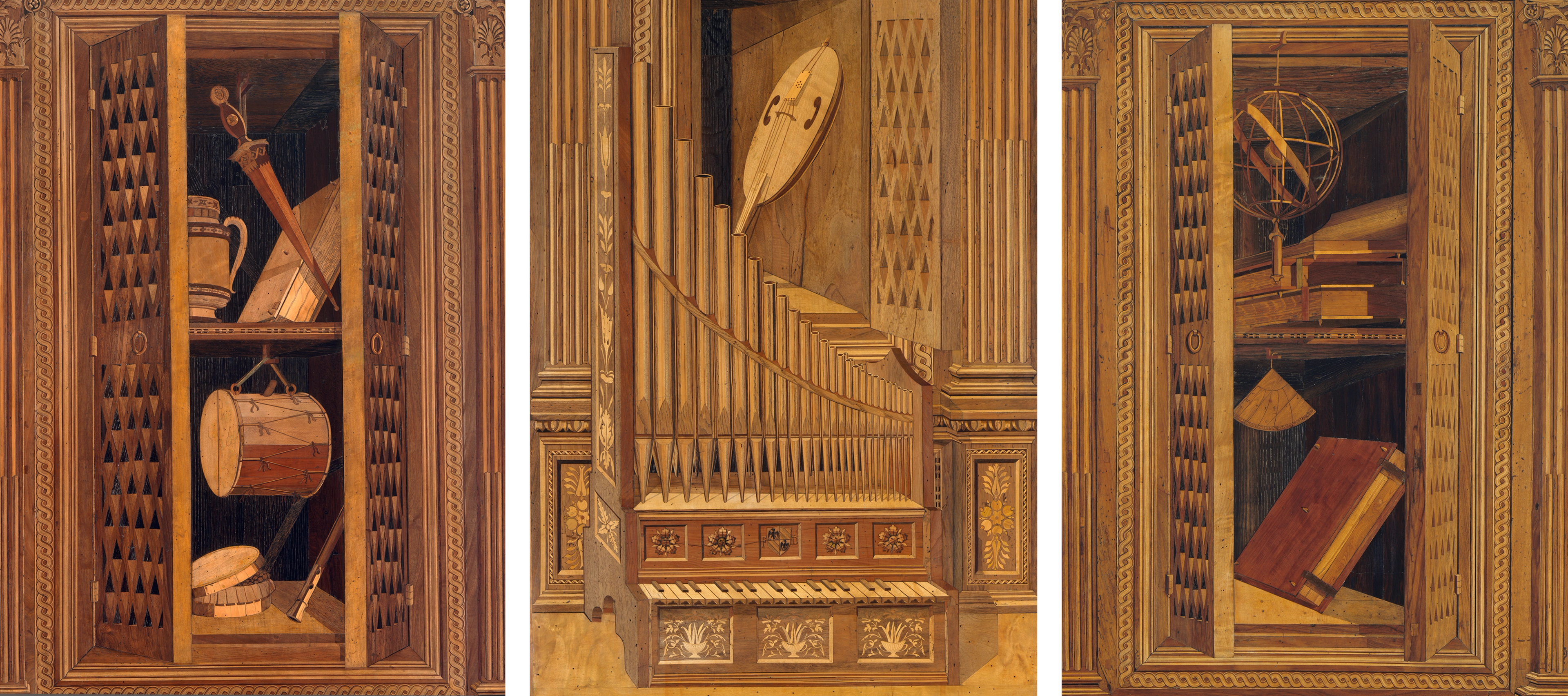
Details from the studiolo.
As the room was moved from Gubbio to Rome, then Venice, and finally New York, areas damaged by water, insects, and time were subject to multiple restorations over the centuries. In a hollow space behind one section, restored in September 1877, a woodworker named Luigi Rizzo left a secret note as well as his bet for the Italian game of numbers. The room was acquired by The Met in 1939, shown from 1941 to 1967, then disassembled and put back in storage, and finally fully restored in 1996. The meticulous process of properly reassembling the walls of this tiny room was an epic undertaking. Raggio and the brilliant wood conservators Antoine Wilmering and Mecka Baumeister had big sections of the room propped up like stage backdrops in the depths of the Museum’s subterranean workrooms. They asked if I could provide detailed explanatory drawings (exploded perspectives, cut-through studies, multiple vanishing-point overlays) to aid in the reconstruction.
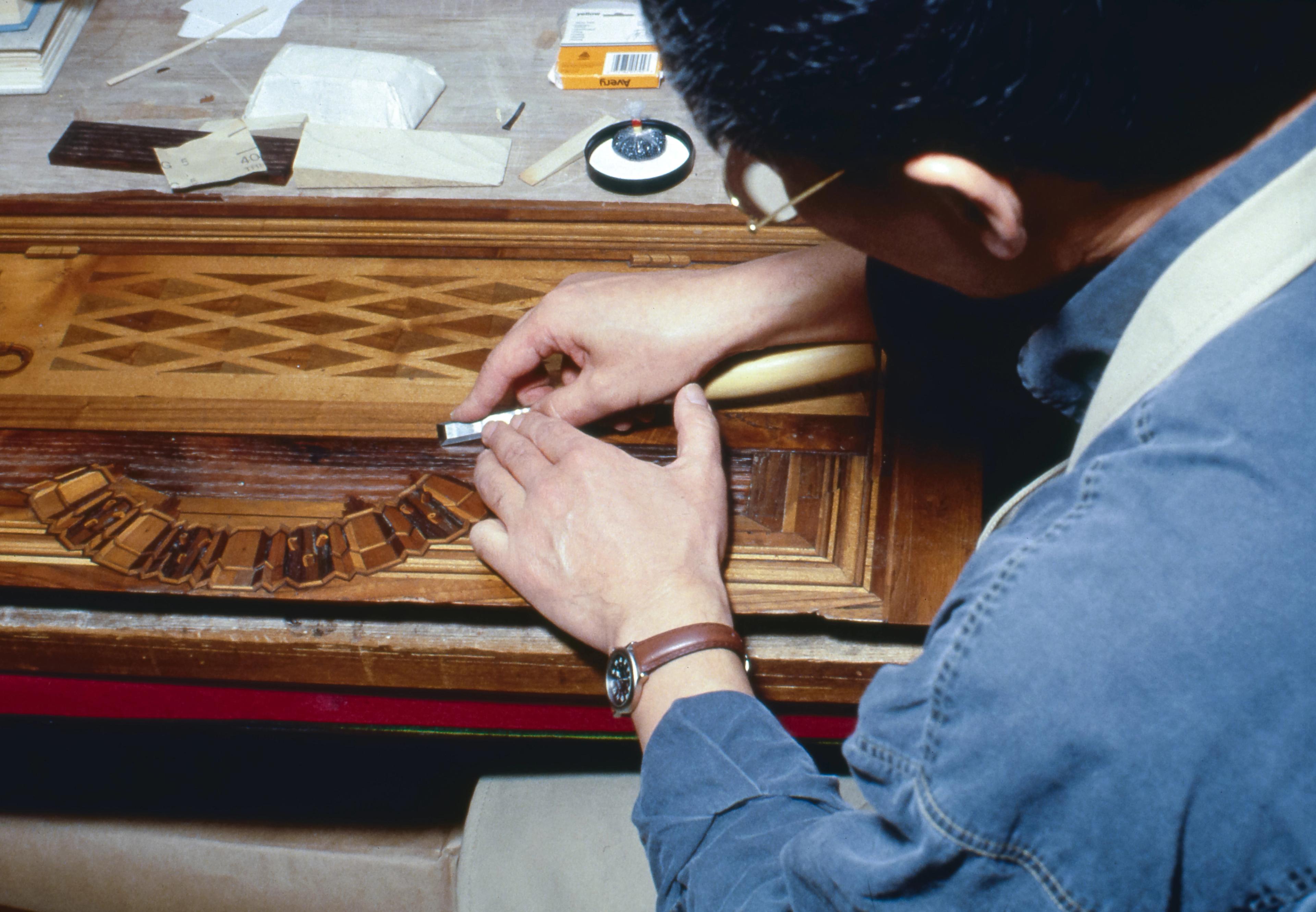
Restoration of the studiolo in 1995.
Fifteen types of wood were inlaid to form the mosaic of colors, textures, and patterns, ranging from inky dark bog oak for deep shadows to nearly white spindlewood and boxwood for highlights. The woodworker deftly used a shoulder knife, pulled toward the body with a long handle braced against a shoulder, along with wood planes and fretsaws to inlay intarsia in a process developed only one hundred years before the studiolo was built.
Despite the intent of the room, to overwhelm and impress the visitor with the duke’s impeccably crafted tribute to Renaissance humanism, what strikes me most is the physicality of the constructed illusion. Drafting those drawings revealed to me the labors of dealers in treasured timber, intarsia cutters, toolmakers. Close looking just makes me want to explore the room even more intimately. Its mathematical logic is overpowered by the beauty of the natural materials and the virtuosity of the human hand.
This essay is adapted from Points of View: 100 Connections to Art, a book that brings together voices from across The Met to consider how art inspires us to connect to the world and to each other.