
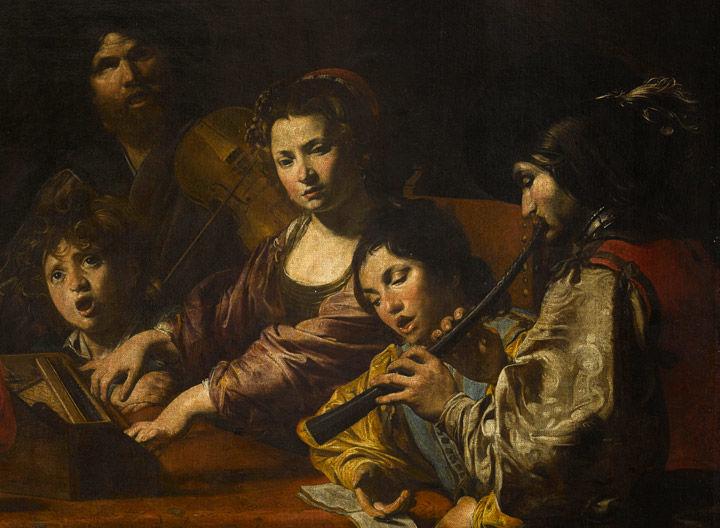
Detail view of musicians singing and playing various instruments in Valentin de Boulogne's Concert with Eight Figures
From Keith Christiansen, John Pope-Hennessy Chairman of the Department of European Paintings:
«Each of these three scenes depicts a group most likely playing secular music—a sonata with accompaniment or a madrigal. This means there's a looseness to the instrumentation, with the collections of continuo instruments (harp, guitar, lute, theorbo, virginal, bass violin) freely accompanying what are probably interchangeable treble parts played by the violin, cornetto, or singers.»
The combinations represented are fairly progressive—fewer voices and richer continuo groupings—and look toward the last stages of the madrigal's evolution as it transformed into the cantata by the mid-17th century.
Concert with a Bas-Relief
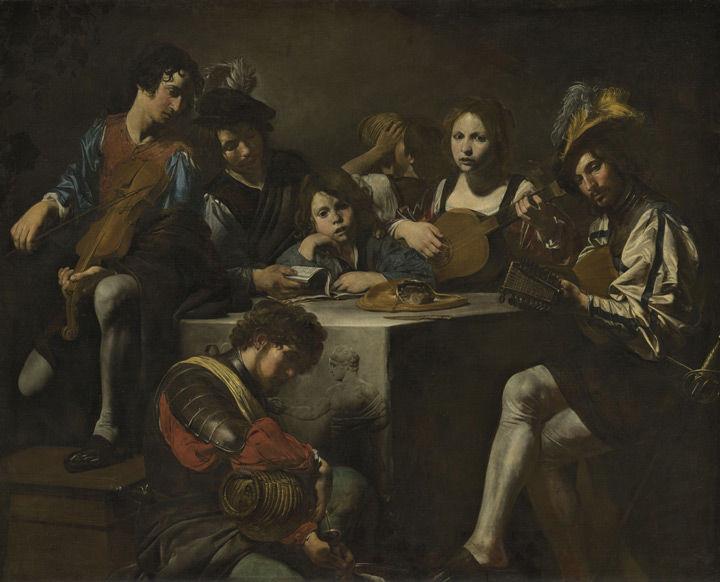
Valentin de Boulogne (French, 1591–1632). Concert with a Bas-Relief, ca. 1624–26. Oil on canvas, 68 1/8 x 84 1/4 in. (173 x 214 cm). Musée du Louvre, Paris (Inv. 8253)
Concert with a Bas-Relief includes a guitarist, a lutenist, and a violinist presumably playing a violin sonata or, if the book on the table isn't music, improvising on a popular bass line. It may have sounded something like this sonata by Dario Castello:
Concert with Eight Figures
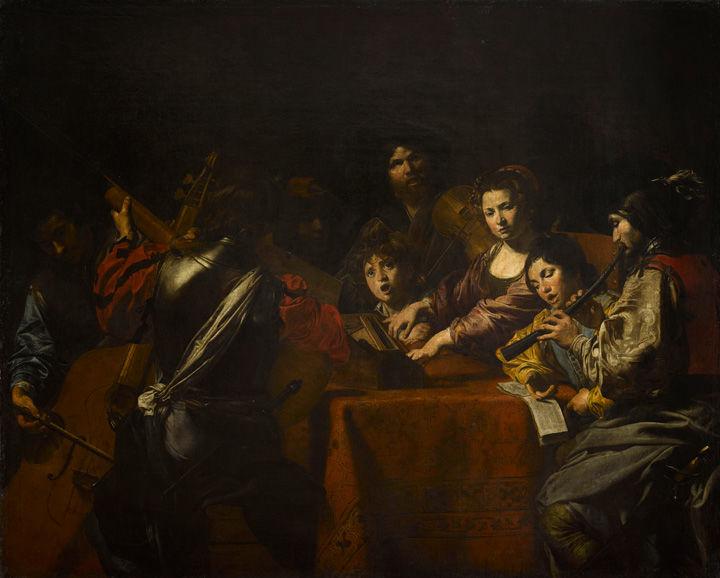
Valentin de Boulogne (French, 1591–1632). Concert with Eight Figures (also called Concert in an Interior), ca. 1628–30. Oil on canvas, 68 7/8 x 85 1/16 in. (175 x 216 cm). Musée du Louvre, Paris (Inv. 8252)
Concert with Eight Figures shows the busiest group, with a bass violin, theorbo, and virginal supporting a violin, a cornetto, and two singers. They are playing an instrumental madrigal, maybe something like Monteverdi's Chiome d'Oro. The cornetto, with its singular sound, is used with great caution at concerts today, but here is one of the few recorded examples I know of, arecording of Tarquinio Merula's Ciaccona:
Fortune-Teller
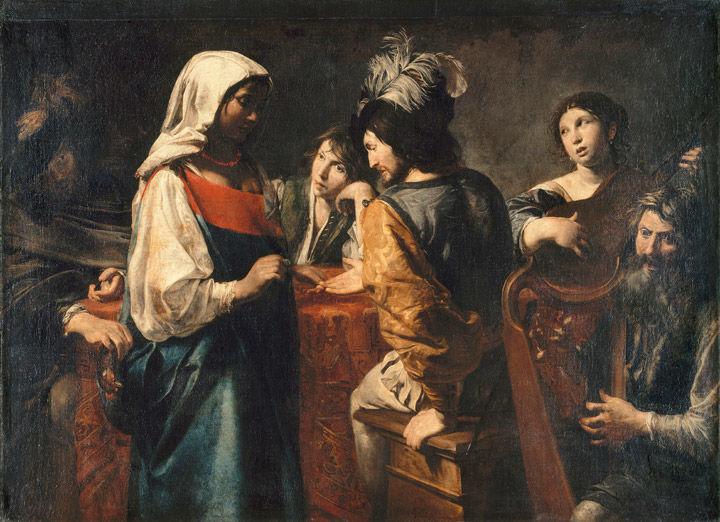
Valentin de Boulogne (French, 1591–1632). Fortune-Teller, ca. 1626–28. Oil on canvas, 49 3/16 x 68 7/8 in. (125 x 175 cm). Musée du Louvre, Paris (Inv. 8254)
I'm not sure what to make of the scene in Fortune-Teller: the man on the right is playing the harp backwards, and the combination of guitar and harp is rather odd, as both lack the strong bass presence that is essential in a continuo group. Given what seems to be a somewhat perverse subject, I hope you'll indulge me offering a perverse example without perfectly aligning the instruments involved. It's an anonymous piece from early 17th-century Naples in which an angel and devil share their respective thoughts about Paradise and Hell:
Related Links
Valentin de Boulogne: Beyond Caravaggio, on view at The Met Fifth Avenue from October 7, 2016, through January 16, 2017