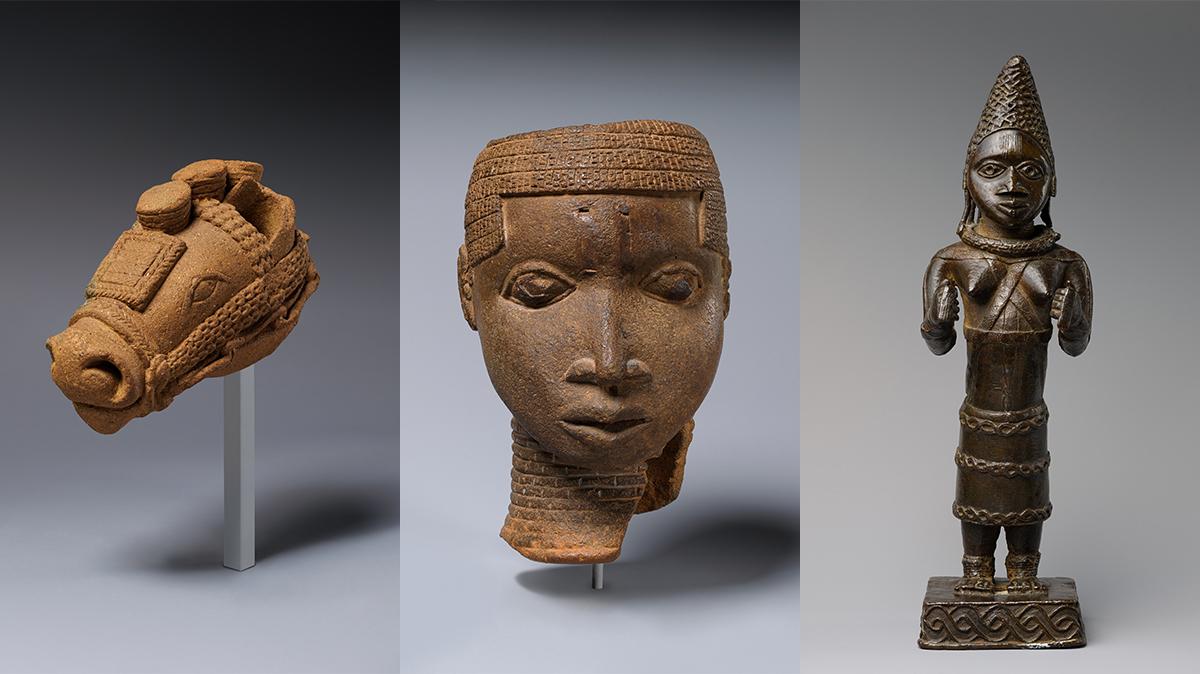
Image Captions (L-R): Yoruba artist, Horse head, Yoruba peoples, 12th–15th century, Terracotta. L. 7 1/2 inches. Loan from Friends of Nigeria's Cultural Heritage, Myriad USA, Gift of Ceil Pulitzer; artists, Ùhúnmwèlaò (commemorative portrait), Edo peoples, ca. 16th century, Terracotta. H. 9 1/2 inches. Loan from Friends of Nigeria's Cultural Heritage, Myriad USA, Gift of Ceil Pulitzer; Ìgùn Ẹ́rọ̀nwwọ̀n (brass-casting guild) artists, Iyọ́bà (queen mother) figure, Edo peoples, ca. 18th century. Brass. H. 13 inches, Loan from Friends of Nigeria's Cultural Heritage, Myriad USA, Gift of Ceil Pulitzer
(New York, September 21, 2026)—The Metropolitan Museum of Art and the Nigerian National Commission for Museums and Monuments (NCMM) today announced the landmark agreement for the long-term loan of three masterpieces of Nigerian art to The Met. The sculptures will be installed this September in The Met’s Michael C. Rockefeller Wing, where they will be displayed for the Museum’s 6.3 million yearly visitors and contribute to ongoing scholarship. The works will be on loan to The Met for a 25-year period, with the opportunity for extension.
These three exceptional works of art, which range in date from the 12th to the 18th century, were gifted from the private collection of Ceil Pulitzer, a noted philanthropist, collector of African art and a long-time supporter of African art at The Met. The Met facilitated the gift to the Friends of Nigeria’s Cultural Heritage, established by the NCMM and hosted at Myriad USA, which enables international philanthropic giving to the NCMM to advance the preservation, study and accessibility of its collections. This innovative three-way collaboration helps to bring once privately held works to international audiences and scholars, supports NCMM’s mission, and expands appreciation of Nigerian cultural heritage globally. Ceil Pulitzer’s visionary act of generosity at once marks a significant investment in the future of Nigerian museums and contributes to the collaboration between The Met and its partner institutions in Nigeria.
Max Hollein, The Met’s Marina Kellen French Director and CEO, said: “The Met’s mission is to bring outstanding works of art to the public in compelling and scholarly displays that reach to the widest possible audiences, and this agreement successfully builds on the Museum's ambitious advancement of this work in a highly impactful way. We greatly value our partnership with the National Commission for Museums and Monuments, which continues to deepen. Historical and contemporary Nigerian art holds a place of distinction within The Met’s collection and has gained renewed significance following last year’s reopening of the Michael C. Rockefeller Wing. It was a pleasure to welcome NCMM Director General Olugbile Holloway to the Wing’s opening, reaffirming the close alignment between our institutions. This innovative collaboration will help to expand global appreciation of Nigerian art and further our understanding of Nigeria’s extraordinary cultural heritage, while supporting the goals of the NCMM. We are deeply grateful to Mrs. Pulitzer and Mr. Holloway for making this presentation possible.”
Olugbile Holloway, Director General of the National Commission for Museums and Monuments, said: “This initiative is very important to us because it enables Nigerian antiquities in private collections to be displayed at The Met and seen by a wide and diverse audience. Our partnership with The Met is of tremendous value, and we look forward to even more opportunities to deepen and strengthen the relationship between our two institutions.”
The works are exceptional examples of sculpture from the ancient Ife civilization and Court of Benin. While at The Met, they will be displayed in the Museum’s Arts of Africa galleries in the newly transformed Michael C. Rockefeller Wing and will be made available for research. Their inclusion will expand The Met’s presentation of one of the world’s greatest artistic traditions that flourished in Ife from the 9th through 16th centuries.
This agreement builds on a long-standing, active history of collaboration between The Met and Nigeria, including a multi-year initiative to develop digital documentation of the NCMM’s collections. Beginning with a pilot project to document 100 works of art, the initiative has included a residency at The Met for curatorial staff from the National Museum in Lagos (NML), as well as a series of reciprocal meetings and workshops in New York and Lagos focused on cataloguing standards, photography, and visitor engagement. The collaboration has also supported the installation of a new photography studio and digital storage infrastructure at the NML to enable state-of-the-art imaging of the collection and the development of an online educational asset. The project remains ongoing, with teams from both institutions continuing to expand documentation and collections management efforts, along with capacity building and exchange.
Recently, The Met was awarded the U.S. Department of State Ambassadors Fund for Cultural Preservation (AFCP) grant for a second time to support the next phase of this work.
About the Works
The three works being transferred highlight the achievements of the Ife and Benin artistic traditions, and will contribute significantly to The Met’s display of Nigerian art:
- A Yoruba terracotta, Head of a Horse, 12th to 15th century, representing a rare sculptural work from the Ife Kingdom: Framed by a delicately molded bridle, elaborate coiffure, and ridged forehead plate, the elegant forms of this horse head convey a regal solemnity. That arresting visual power is a hallmark of terracotta and brass sculptures produced by artists at Ile-Ife, a medieval city-state credited with the foundations of both Yoruba and Edo divine kingship. Ile-Ife ceramicists were responsible for producing hundreds of human, animal, and otherworldly subjects between the twelfth and fifteenth centuries honoring and augmenting the authority of royal figures. The horse served as a mount for warriors and rulers, a role underscored in this example through the depiction of an intricate halter and tufted mane;
- An Edo terracotta, Commemorative Portrait from the Benin Kingdom, circa 16th century, which embodies the courtly practices of memorializing figures of status: Idealized terracotta portraits are hand modelled by members of the royal brass casters guild Ìgùn Ẹ́rọ̀nwwọ̀n for display on altars to commemorate deceased leaders of the guild. Historically, such evocations were also created to honor the guildsmen responsible for purifying the earth, as well as the first ọ́bàs (kings) of Benin reigning prior to the fourteenth century;
- An Edo copper alloy Figure Representing a Queen Mother from the Benin Kingdom, circa 18th century, constituting a rare portrait of a historical woman at the Court of Benin: Freestanding iyọ́bà figures like this are exceedingly rare. Most queen mother castings featured as the focal point of larger ensembles within an ùrhọ̀tọ̀ (altar tableau). The unique nature of this figure may indicate that it commemorated an especially prominent iyọ́bà who held the title sometime between the late 17th and 18th centuries. That period spans the reigns of five queen mothers: Imarhiaede (ca. 1689–1701), Ewebonoza (ca. 1701–12), Ihasogie (ca. 1713-35), Ede (ca. 1735–50), and Oloi Ohogha II (ca. 1750–1804). Of these, Ihasogie and Oloi Ohogha II were among the most influential. Oral histories recount that Ihasogie commanded both physical and supernatural powers to install her son, Ọ́bà Ákẹ́nzùa I, on the throne. Oloi Ohogha II is recognized as one of the wealthiest iyọ́bà whose son, Ọ́bà Akẹngbẹdo, was responsible for a long and peaceful reign.
Collaboration between The Met and Nigeria
The Met has a longstanding partnership with Nigeria, going as far back as 1980, when The Met hosted the exhibition Treasures of Ancient Nigeria, a landmark presentation of 100 of Nigeria's artistic treasures that was among the earliest presentations of these ancient traditions to US audiences. That relationship has continued to evolve over the years as part of The Met’s ongoing commitment to the shared stewardship of global cultural heritage.
In 2021, The Met and the NCMM signed a Memorandum of Understanding formalizing a shared commitment to future exchanges of expertise and art, including reciprocal loans. The agreement was established in conjunction with the transfer of three works from The Met to the NCMM, following joint provenance research.
Nigerian art features prominently in The Met’s recently reopened Michael C. Rockefeller Wing. Works by master sculptors created in present-day Nigeria, including outstanding exemplars from the Kingdom of Benin and the Yoruba and Igbo cultures, constitute a key part of the reimagined display and reflect the rich diversity of cultural traditions that have historically flourished within Nigeria and their importance to the history of art. Additionally, a digital initiative of 12 short films introduces Africa’s distinctive cultural landmarks, undertaken in partnership with the World Monuments Fund, features two from Nigeria, showcasing the bronze casters on Igun Street in Benin City and the Ọṣun-Òṣogbo Sacred Grove. The films share informed perspectives from artists and experts, including Adebisi Nurudeen Adisa, the son of sculptor Adebisi Akanji. Works by Nigerian artists are also found in collections across the museum.
Under the MOU, the digitization of NCMM’s collections began as a pilot to document 100 works of art over several phases. The first phase was a month-long Residency at The Met for Ms. Chizoba Joy Ephraim, Assistant Curator for Collections at the National Museum in Lagos (NML). During her time at The Met, Ms. Ephraim consulted with teams from Digital, Imaging and Education to help the Met staff better understand cataloguing practices underway at the NML. Following the Residency, three workshops by Met staff were held in 2023, 2024 and 2025 at the National Museum in Lagos. They covered establishing protocols for documentation with suitable metadata fields, training on new photography of works in the NML collection and developing a new Visitor Guide that connects objects in the collection to larger educational narratives across the museum. The Met team also acquired imaging and digital storage equipment based on the special considerations at the NML and installed a new photo studio that has been in use to document the collection. This project is ongoing and core teams from the Met and NML continue to meet regularly and scale the documentation project to include objects histories, photographic details of artworks and workflows for data storage and safety.
About NCMM
The National Commission for Museums and Monuments (NCMM) is an offshoot of a department of the then Federal Ministry of Works, established in 1943. It was transferred to the Federal Ministry of Information as the Department of Antiquities by ordinance 17 of the Colonial Government of 1953. The NCMM is currently under the Federal Ministry of Arts, Culture, Tourism, and the Creative Economy.
Presently, the National Commission for Museums and Monuments manages and oversees 53 museums and outlets across the country, 65 national monuments, and 2 world heritage sites. The museums are primarily ethnographic and archaeological. Some are specialized, such as the Museum of Traditional Nigerian Architecture (MOTNA) and Zoological Garden in Jos, while others are localized with collections from the immediate environments, for example, Igbo-Ukwu, Ile-Ife, Nok, and Benin.
The Commission, as it is currently constituted, is made up of six departments, namely the Departments of Museum, Research, Planning and Publications, Educational Services and Training, Monuments, Heritage and Sites; Finance and Accounts, and Administration and Supplies. www.museum.ng
About The Met
The Metropolitan Museum of Art was founded in 1870 by a group of American citizens—businessmen and financiers as well as leading artists and thinkers of the day—who wanted to create a museum to bring art and art education to the American people. Today, The Met displays tens of thousands of objects covering 5,000 years of art from around the world for everyone to experience and enjoy. The Museum lives in two iconic sites in New York City—The Met Fifth Avenue and The Met Cloisters. Millions of people also take part in The Met experience online. Since its founding, The Met has always aspired to be more than a treasury of rare and beautiful objects. Every day, art comes alive in the Museum’s galleries and through its exhibitions and events, revealing both new ideas and unexpected connections across time and across cultures.
The Met is currently ushering the Museum into the future by renovating one-quarter of its two-million-square-foot building on Fifth Avenue galleries. These reimagined spaces will tell new stories through the breadth of the collection, while improving visitor experience, infrastructure, and sustainability. This remarkable $1.5 billion capital campaign includes: the acclaimed Michael C. Rockefeller Wing for the arts of Africa, Oceania and the Ancient Americas (opened summer 2025); the new Condé M. Nast Galleries (opened May 10, 2026, with the inaugural exhibition Costume Art); new galleries for the Arts of Ancient West Asia and Ancient Cyprus (opening 2027); reimagined spaces for dining and retail inside a newly reactivated entrance off The Met's plaza (opening 2027); and the transformative Tang Wing for Modern and Contemporary Art (opening 2030).
###
September 21, 2026