Bourguignotte à l'antique
Artwork Details
- Titre: Bourguignotte à l'antique
- Artiste: Filippo Negroli, Italien, v. 1510–1579
- Date: 1543
- Technique: Acier et or
- Dimensions: H. 24,1 cm
- Crédits: Don de J. Pierpont Morgan, 1917
- Accession Number: 17.190.1720
- Curatorial Department: Arms and Armor
Audio
4407. Burgonet
NARRATOR: Donald Larocca.
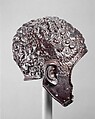
DONALD LAROCCA: This helmet by Fillipo Negroli, signed and dated 1543, is probably the single most artistic piece of armor in the Museum, and one of the most beautifully made examples anywhere in the world. It looks like it’s cast out of bronze and that’s intentional; it’s made to look as if it were a piece of sculpture, but it’s all made out of iron that’s been decorated also with gold, a technique known as embossing or repoussé. The designs are worked up from the inside, but the finishing work, the real detail, is done on the outside—chasing and chiseling in steel; it’s not a soft iron, it’s actually a steel; and then the coloration of it, the patination is done intentionally to give it the appearance of bronze.
NARRATOR: Stuart Pyhrr.
STUART PYHRR: The inspiration comes from Roman decoration. The comb, or the top of the helmet, worked up into an imaginative creature, a siren or mermaid whose body stretches over the top, her hands reaching forward to hold at the front to hold the legendary gorgon, Medusa, whose look would turn one to stone. Gorgons heads on shields and in front of helmets was a playful conceit of the Renaissance, with the thought that would turn one’s enemies into stone.
At the very back of the helmet, over the nape, of the neck is a grimacing satyr head, and out of his lips come two tendrils that curl around the side of the helmet. The cheekpieces, which would have covered the side of the head are now missing. At the front of the helmet is an added plate below the brow. If you bend down, you’ll see a plate over the forehead, which is difficult to read but is in fact inscribed in gold with the name of the armorer, Fillipo Negroli of Milan, and the date 1543.
More Artwork
Related Content
Research Resources
The Met provides unparalleled resources for research and welcomes an international community of students and scholars. The Met's Open Access API is where creators and researchers can connect to the The Met collection. Open Access data and public domain images are available for unrestricted commercial and noncommercial use without permission or fee.
To request images under copyright and other restrictions, please use this Image Request form.
Feedback
We continue to research and examine historical and cultural context for objects in The Met collection. If you have comments or questions about this object record, please contact us using the form below. The Museum looks forward to receiving your comments.
Content Notice
The Metropolitan Museum of Art presents over 5,000 years of art from around the world, and our online collection reflects ongoing work conducted over the course of our more than 150-year history. You may encounter objects or images that may be inappropriate for some viewers or information that may be outdated.