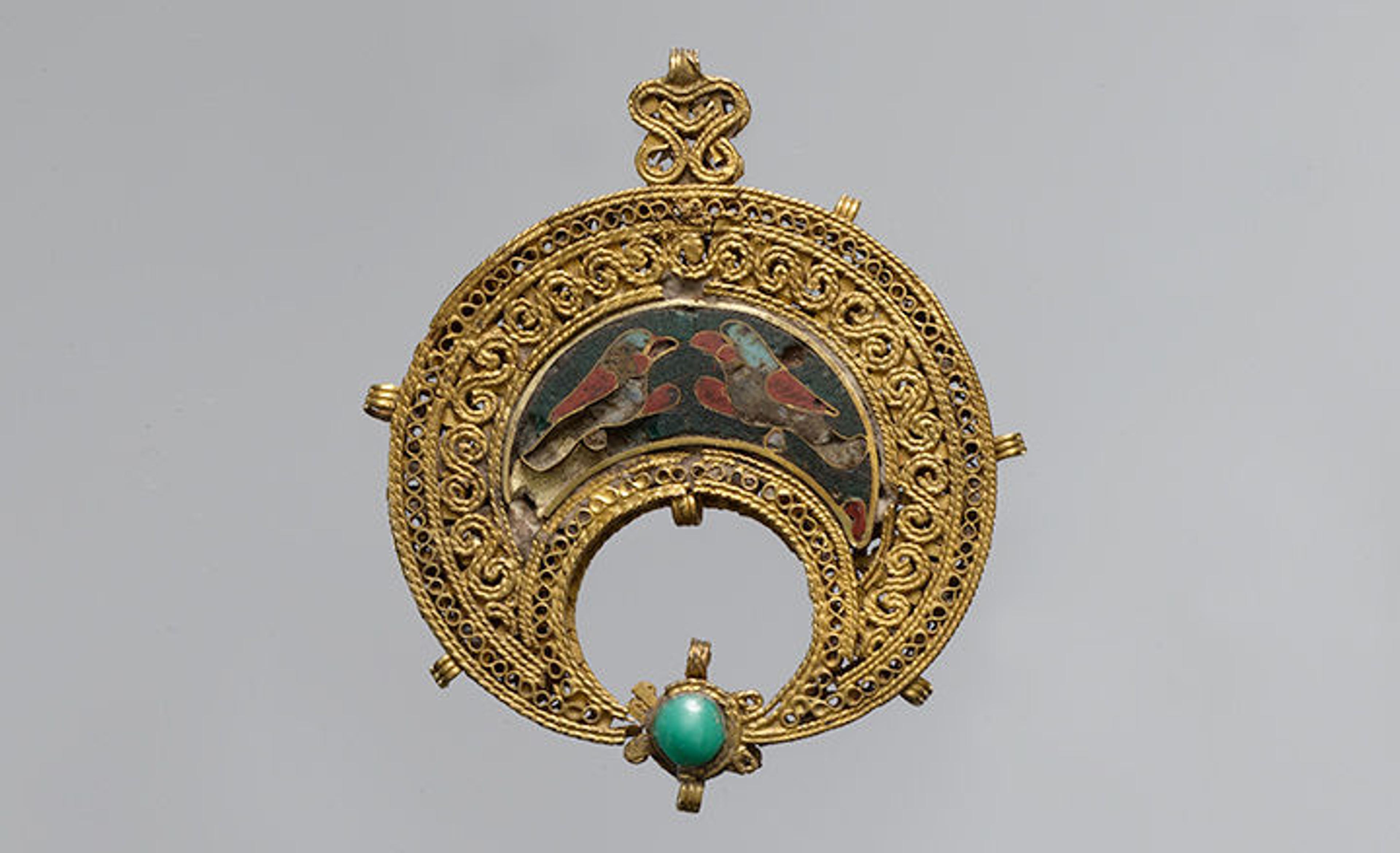
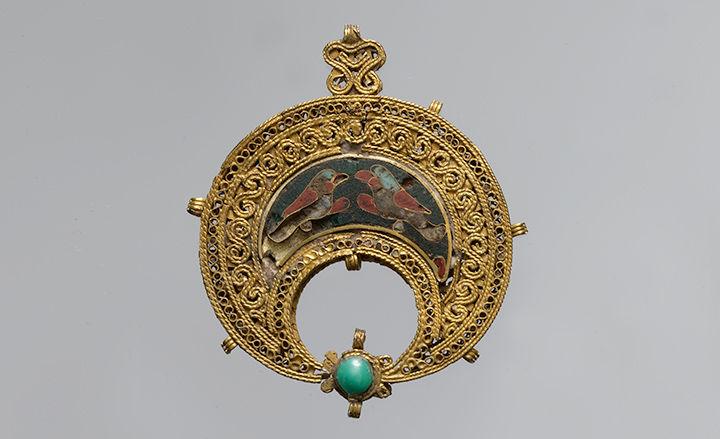
Crescent-shaped pendant with confronted birds, 11th century. Made in Egypt. Gold, cloisonné enamel, turquoise; filigree, 1 3/4 x 1 3/8 in. (4.5 x 3.5 cm). The Metropolitan Museum of Art, New York, Theodore M. Davis Collection, Bequest of Theodore M. Davis, 1915 (30.95.37)
«The crescent-shaped pendant from the 11th century pictured above entered The Met collection in 1915 through a bequest by the American lawyer and Egyptologist Theodore M. Davis. At the time, it was believed to be a Byzantine object and was labeled a work of "European decorative art" in a Metropolitan Museum of Art Bulletin supplement dedicated to Davis's collection, published in 1931.»[1]
That designation changed in 1983 with new scholarship by Marilyn Jenkins, then an associate curator of Islamic Art at the Museum, and Manuel Keene, formerly a research associate in the same department. That year, they published a catalogue of The Met's Islamic jewelry—"a little-studied subject," they acknowledged—in which the pendant, now recognized to be from Fatimid Egypt (909–1171), was prominently shown in full color against a striking red background.[2]
Why objects such as these had survived mostly intact for more than 800 years was largely a mystery to Jenkins and Keene, as it is for us today. "Jewelry was frequently made from the melted-down metals of outmoded jewelry, coins, or the spoils of war," writes Courtney Stewart, senior research assistant in the Department of Islamic Art at The Met, in a new Timeline of Art History essay on Fatimid jewelry. "Considering the inherent value of the raw materials, it is remarkable that any jewelry survives from the medieval period." Several works that do survive are the focus of her essay, which looks at the defining characteristics of Fatimid jewelry, how the objects were made, and what their purposes may have been.
The entirety of Stewart's essay, along with more than 1,000 others spanning the full range of the Museum's collection, is available on our Heilbrunn Timeline of Art History.
Notes
[1] James J. Rorimer, "The European Decorative Arts," The Metropolitan Museum of Art Bulletin 26, no. 3, part 2 (March 1931): 24.
[2] Marilyn Jenkins-Madina and Manuel Keene, Islamic Jewelry in the Metropolitan Museum of Art(New York: The Metropolitan Museum of Art, 1983), 7.


