
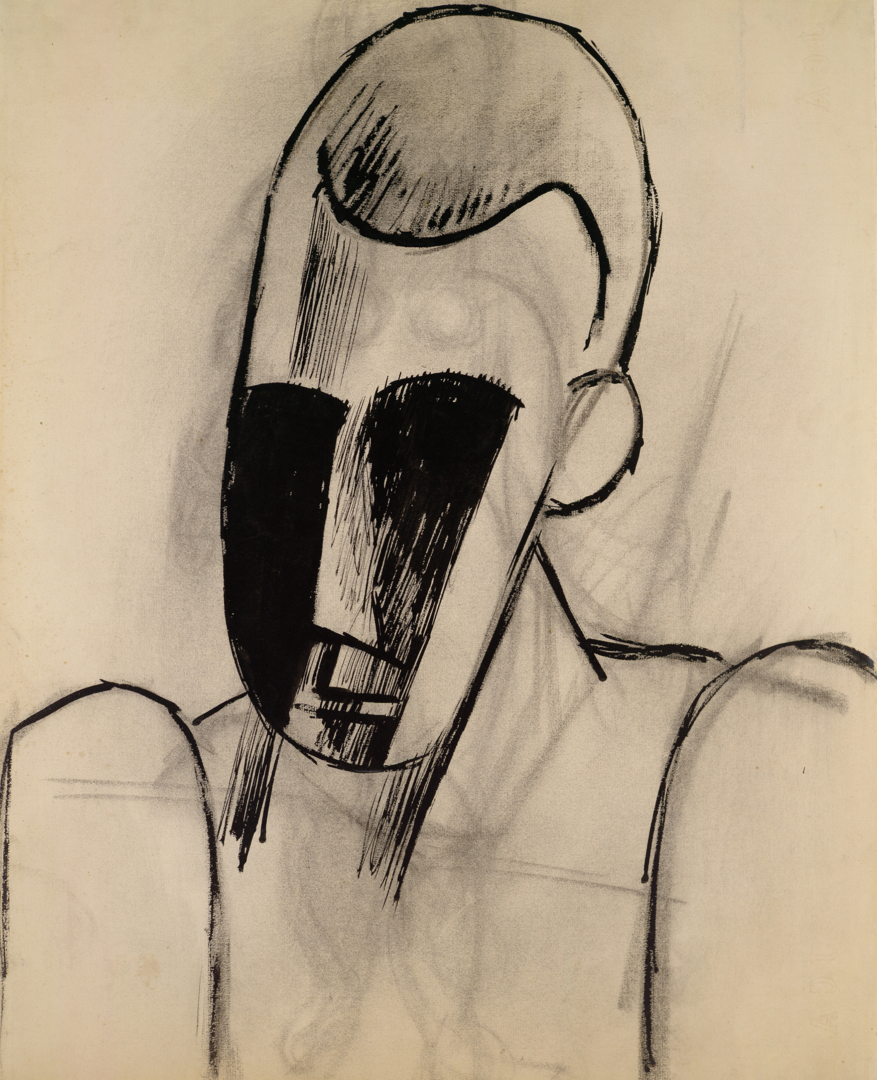
Pablo Picasso (Spanish, 1881–1973). Head of a Man, 1908. Ink and charcoal on white laid paper, 23 7/8 x 18 1/2 in. (60.5 x 47 cm). The Metropolitan Museum of Art, New York, Leonard A. Lauder Cubist Collection, Gift of Leonard A. Lauder, 2016 (2016.237.11) © 2026 Estate of Pablo Picasso / Artists Rights Society (ARS), New York
In the early years of his career, Picasso tended to reuse high-quality artist’s paper. In this 1908 drawing, a faint charcoal image of a standing female nude is visible under the final image of the man’s head. Picasso used short, quick strokes to develop the woman’s posture and reworked her legs and the oval that defines her head. The artist clearly was comfortable using charcoal; he smudged and softened forms and lines to create modulated tones behind the figure, giving the impression of three-dimensional space, with light and shadow. In the early twentieth century, there were multiple types of charcoal available, and Picasso often used more than one in any given work. Here, however, he used the exact same type of charcoal to draw both the nude and the large male head. He brushed deep black India ink over almost all of the broad, choppy charcoal strokes of the head and shoulders. Picasso applied this shellac-based ink in straight, dense strokes that shadow the face at a steep angle. The ink's density and slight sheen accentuate the color and hardness of its surface.
An examination with raking light provided the first indication that Picasso had initially drawn his figure with open eyes. When the sheet was viewed with transmitted light—in this case, a blue-tinted light source was placed behind it—the original contours of the eyes were not clearly visible; however, the lines were revealed when false color was added through computer manipulation.
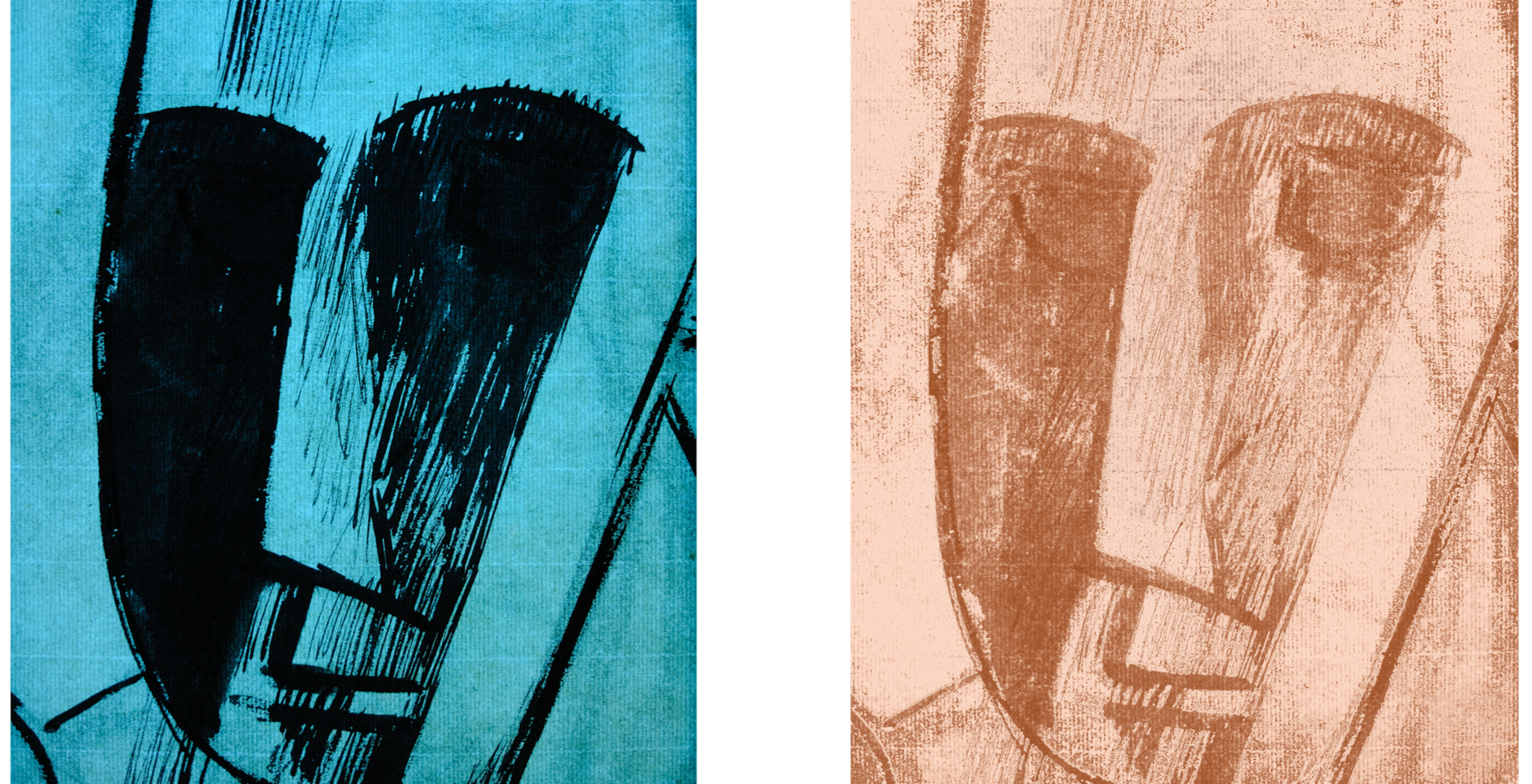
Left: Detail of Picasso’s Head of a Man as seen under a blue-tinted transmitted light. The prominent horizontal chain lines are typical of the paper Picasso favored. Right: Detail of Picasso’s Head of a Man as seen with false color transmitted light. Note that the open eyes are now visible.


