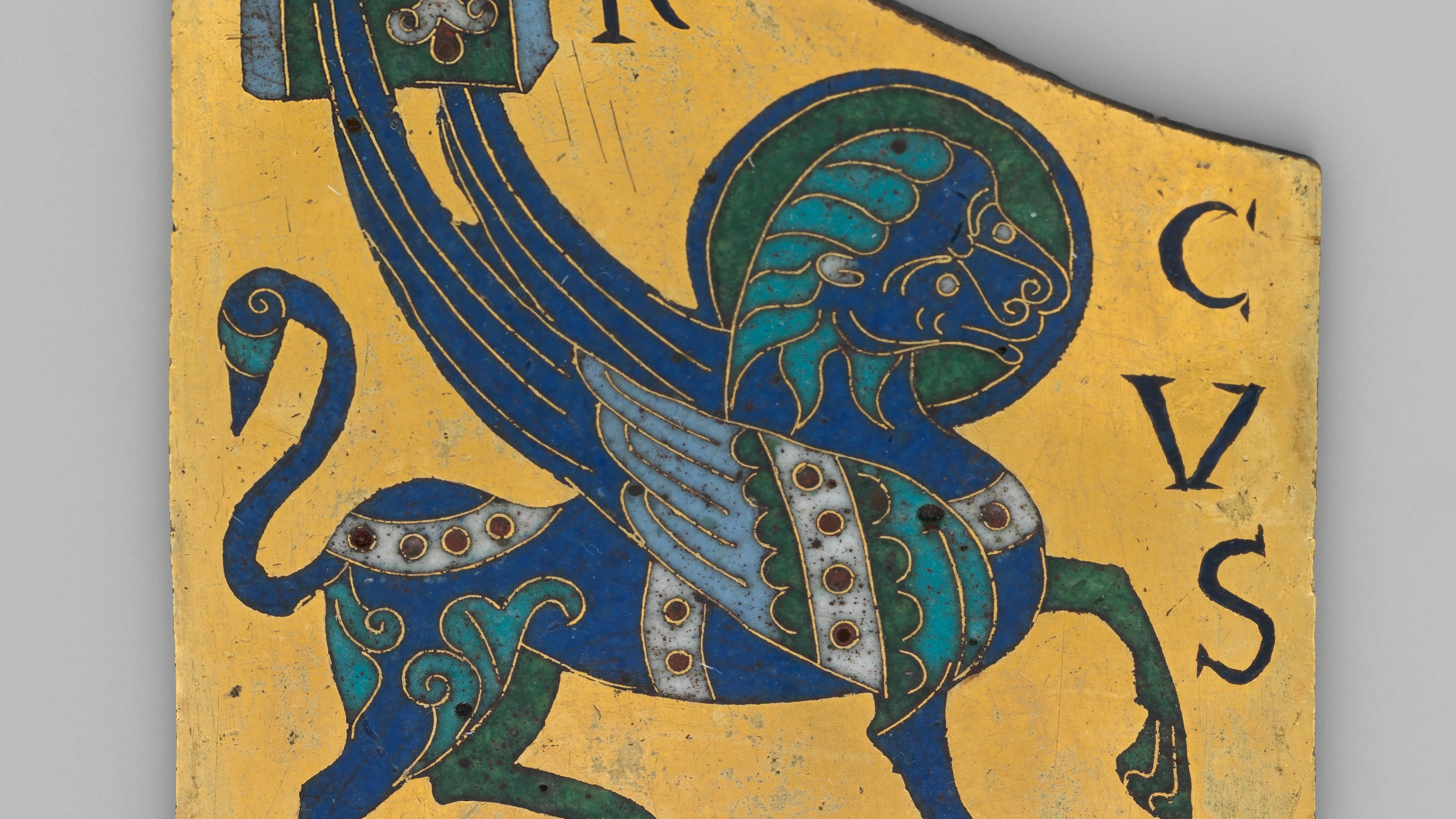
This small plaque of Mark the Evangelist, represented by a lion holding a book between its wings, stands for many stories that illustrate facets of medieval Christian faith. At a time when inexplicable phenomenon could be hailed as a miracle if it proved beneficial, or bemoaned as divine punishment, religion and its mysteries held tremendous sway over social conduct in Europe. Created around 1100 CE at an abbey in Conques, southern France, this piece for me represents the magical aspect of Christianity.
The winged lion on the plaque was not unusual in medieval times, when bestiaries described both real and imaginary animals: unicorns, dragons, and all sorts of hybrid creatures, such as centaurs, sirens, and basilisks. Some of these chimeras became Christian allegories. The griffin, for example, part lion and part eagle, symbolized Christ’s dual nature as both human and divine. A winged lion with a book anywhere on its body represented Saint Mark, the first evangelist.
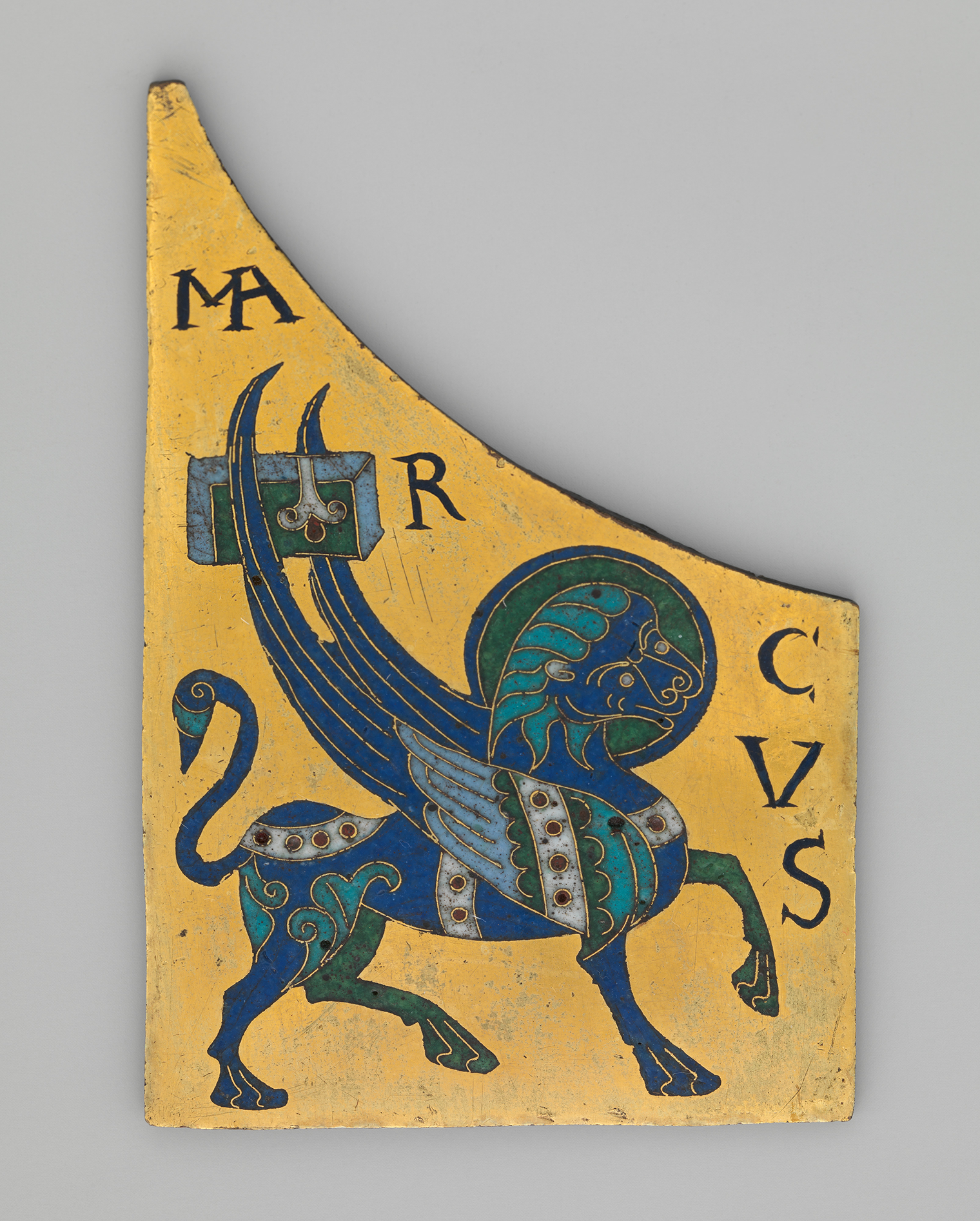
Plaque with the Symbol of the Evangelist Mark, ca. 1100. Made in Conques, France. Champlevé and cloisonné enamel on gilded copper, 4 in. × 2 7/16 in. × 1/8 in. (10.1 × 6.2 × 0.3 cm). The Metropolitan Museum of Art, New York, Gift of J. Pierpont Morgan, 1917 (17.190.426)
Although not an apostle, Mark may have met Jesus at his parents’ house in Jerusalem and seen him there with his disciples more than once. He was the first to write about the incipient Christian religion. He served as Peter’s scribe and Greek and Latin interpreter, and he was the first to write down Jesus’s story as Peter told it to him. Unlike Matthew and Luke, Mark focused on Jesus’s humanity, describing him as an earthly man who felt anger, weariness, and sorrow. Mark wrote his gospel for Christians persecuted and martyred in Rome, knowing that the Christ they needed was not some divine, distant figure but a real, down-to-earth human being. The saint’s “grounded” temperament and style contrast with how he was later portrayed.
In the fourth century CE, when the Catholic church consolidated its power in Europe. Christians were no longer persecuted as they once had been. Churches were filled with gold, priests were showered with privileges, and the artists they sponsored sometimes depicted saints as more than ordinary humans, making them celestial and distinctive, associated with fantastic animals. According to tradition, Mark was the first bishop of Alexandria, where he performed several miracles and founded the Coptic Orthodox Church. After his death, his relics, the sacred remains, stayed in that city for nearly seven centuries.
In April 828, two Venetian merchants, named Malamocco and Torcello, smuggled his remains onto their ship, concealing them in a huge basket of pork to avoid Muslim guards inspecting their cargo too closely. According to legend, Saint Mark appeared to the sailors during their voyage to warn them of a perilous storm, saving their lives. Mark’s body was taken to the floating city, and he became its patron saint, legitimizing and boosting Venice’s position in its power struggles with Rome and Byzantium. Ever since, the winged lion has also been the official symbol of La Serenissima, appearing on its coat of arms, flag, and all official documents.
This act of furta sacra (holy theft in Latin) is one of the most fascinating medieval religious phenomena. Stealing relics from one shrine and taking them to another was usually done to increase the prestige or wealth of their new home. Medieval logic dictated that saints could not be stolen without their consent; in other words, they were fully cognizant of and even facilitated the relocation of their remains. Any miracles that occurred in their new place of residence were considered irrefutable proof of divine approval.
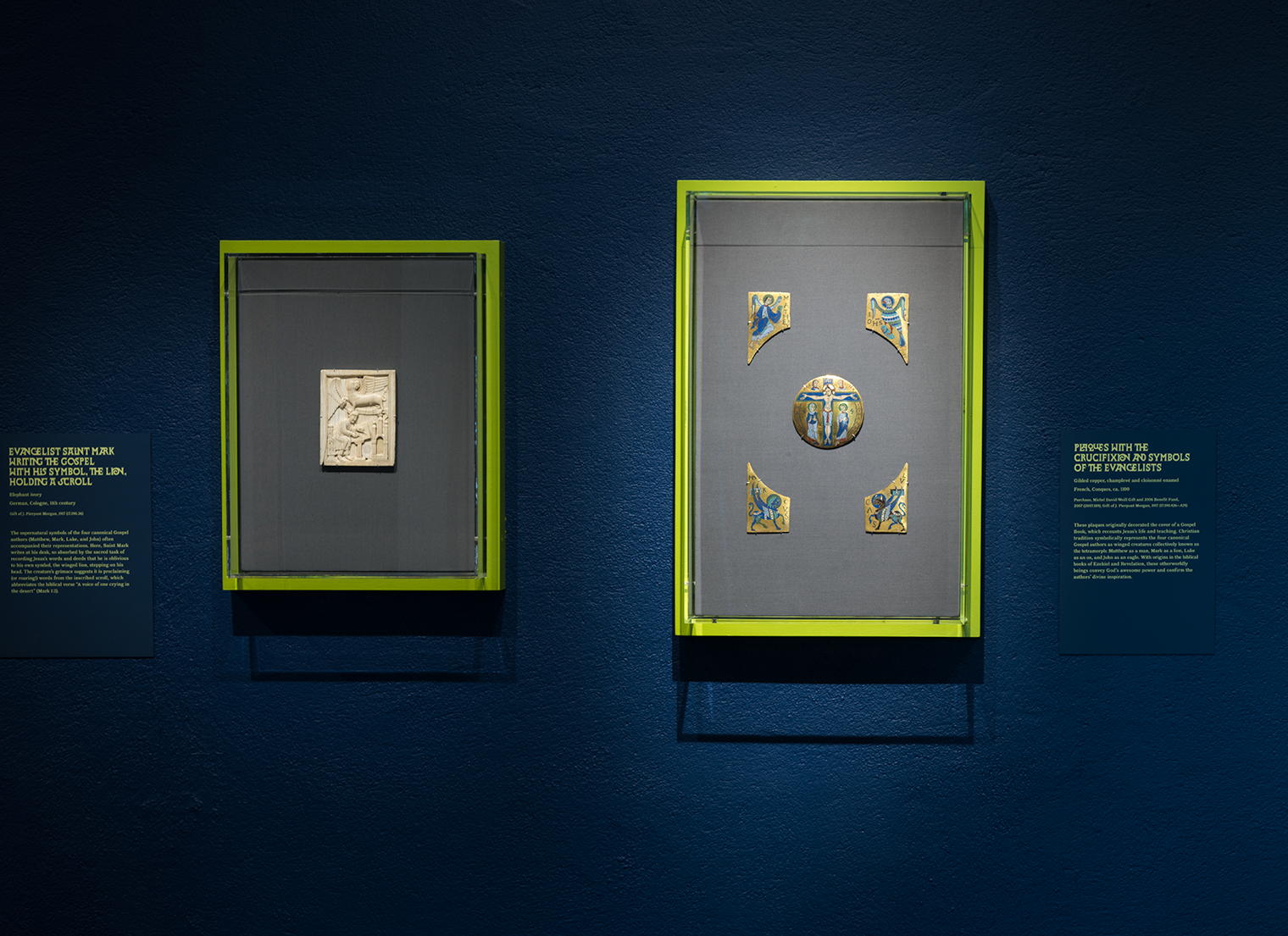
Plaque with the Symbol of the Evangelist Mark, ca. 1100 on view in Creatures of Myth and Imagination: Europe and the Americas
The abbey at Conques, where this plaque was created, had its own case of furta sacra involving the remains of Sainte Foy or Saint Faith, a twelve-year-old girl who was martyred during the Roman persecution of Christians. The relics were kept in her hometown of Agen in southwestern France for several centuries until a monk from Conques was assigned to watch over them. As soon as the opportunity presented itself, he spirited them away to his hometown. The cult of Saint Faith surged dramatically after numerous favors were granted (prisoners freed, sight restored to the blind), and the saint’s new home became a mandatory stop for pilgrims on the Camino de Santiago.
The traveler’s donations funded the abbey workshop where goldsmiths crafted exquisite pieces like the one you see here. Cases of furta sacra—such as the two mentioned—were so common at the time that they fired people’s imaginations and eventually evolved into a genre of religious literature. To my mind, these exquisite works, steeped in symbolism, stories, and delicacy, are the greatest wonders of this era.
This essay is published in conjunction with the exhibition Creatures of Myth and Imagination: Europe and the Americas, on view through October 18, 2026.


