Audioguida
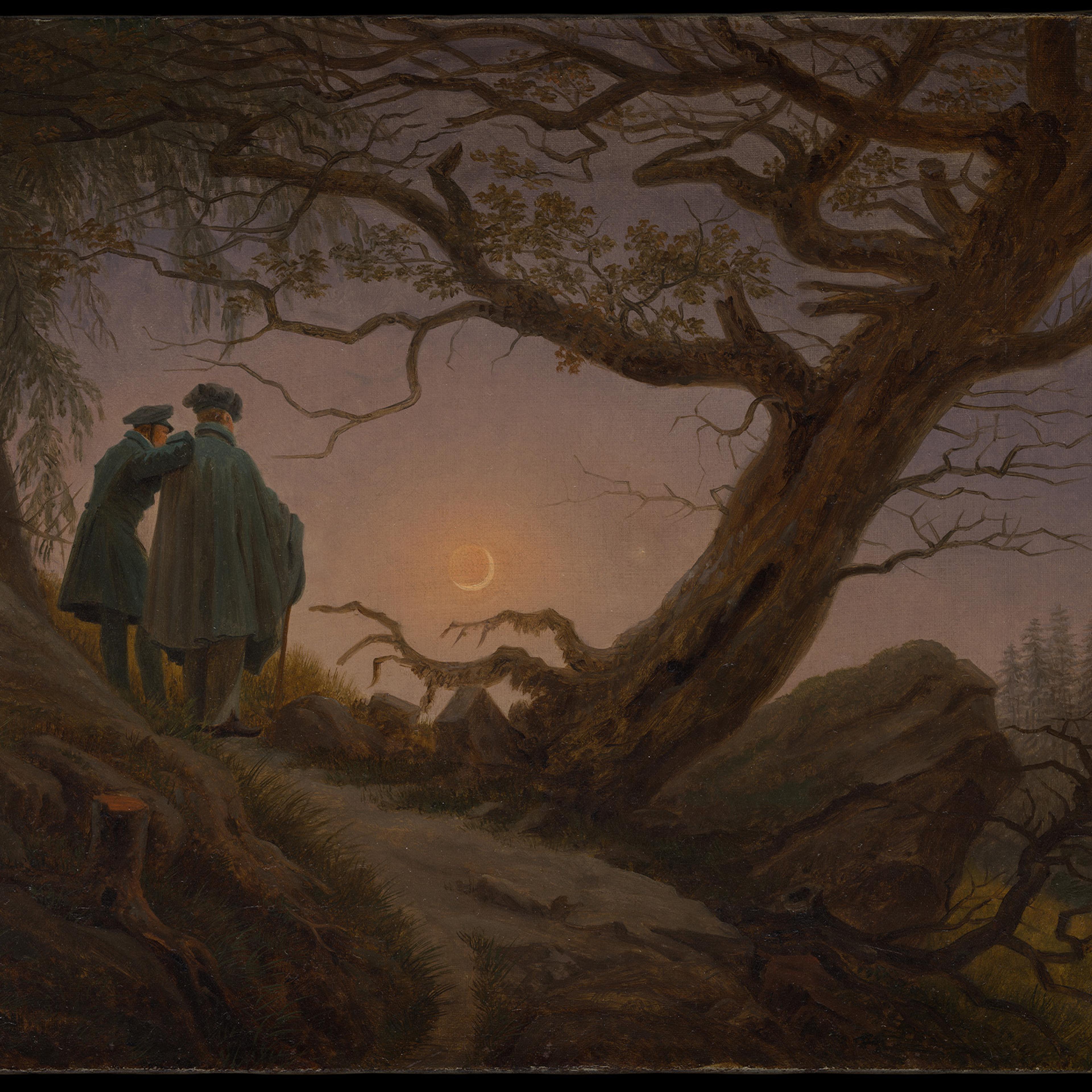
374. Alone Together (Two Men Contemplating the Moon, ca. 1825–30)
“In some ways his pictures are about looking together.”
ALISON HOKANSON: This is Two Men Contemplating the Moon, and they’ve hiked partway up this hill. They have their backs to us. They’re called in German rückenfiguren, so literally figures seen from the back, which were a trademark of Friedrich’s.
NARRATOR: Co-curator, Alison Hokanson.
HOKANSON: He didn't invent the rückenfigur but he explored that motif in a new way. They invite our identification and our engagement with the scenes.
JOANNA SHEERS SEIDENSTEIN: You don’t usually see the person's face, you don’t have any sense of what their expression is. The body language is also often somewhat ambiguous.
NARRATOR: Co-curator, Joanna Sheers Seidenstein.
SHEERS SEIDENSTEIN: That I think encourages the viewer to ask themselves, what would my experience be if I were the one standing here? What would I feel in this situation?
HOKANSON: They’re modeling the contemplation of nature that is at the core of Friedrich’s art. They're modeling for us how we might engage both with nature and with the painting that we see before us.
NARRATOR: Look around and you’ll see examples of Friedrich’s rückenfiguren, alongside drawings he made while out in nature—often when in the company of fellow artists and friends.
HOKANSON: From what I had read about Friedrich, I had the sense that his works do emphasize isolation or, in a more positive sense, solitude in nature.
But in fact, what I came away with was a sense of companionship in nature. And what he depicts is people experiencing nature together. And I think that he hit on this experience, which we now call being alone together, he captures that in a really wonderful way.
KIM STANLEY ROBINSON: I have rarely backpacked by myself, I like my friends up there.
NARRATOR: Kim Stanley Robinson is a science fiction author, avid backpacker and writer of The High Sierra: A Love Story.
ROBINSON: I've had some solitary experiences where after the fact, looking backwards, it seems dreamy. I have to wonder, God, did that really happen?
So, there’s an elusive, slippery feeling to solitary memories that being with someone else solidifies because you can talk about it afterwards. And we are intensely social, and we do like to talk about the past with each other. It reshapes the memories, it reaffirms the reality of our lives.
HOKANSON: In some ways, his pictures are about looking together. And of course, if you want to be clever about it, the figures within the paintings are looking together at nature. And then we as viewers are looking together at the painting.
###
Music: Schubert, Minuet in A major, D. 334, performed by Gerhard Oppitz. Courtesy of Naxos of America, Inc.