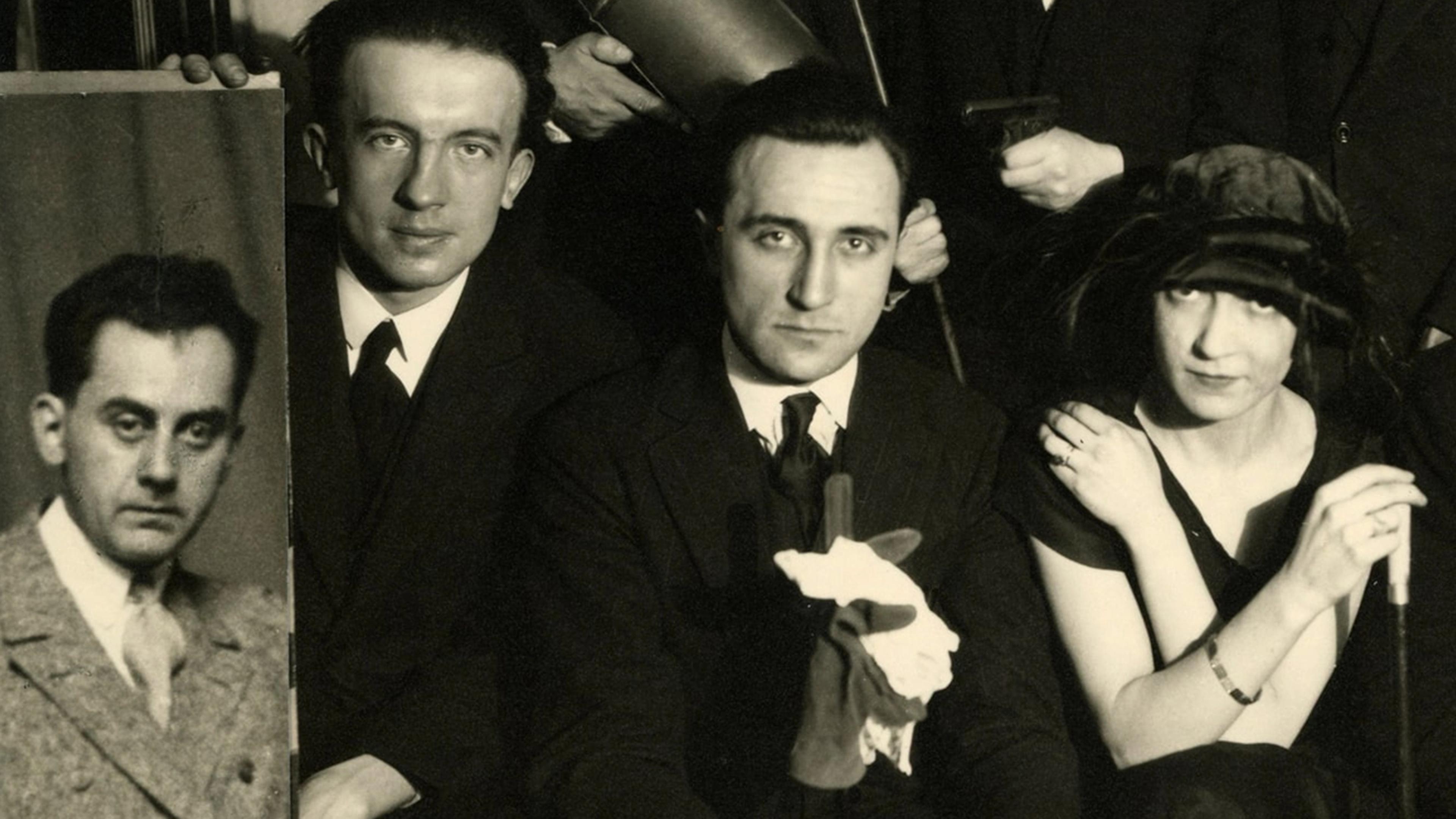
How serious these ladies and gentlemen are, staring gravely at us! And how soberly dressed: the twelve men uniformly in suits and ties; one of only two women with what looks like a leopard-skin coat draped over her shoulder (fig. 1). For a group of self-styled revolutionaries—who in fact reproduced this photo on the inaugural cover of their magazine, boldly and baldly titled La révolution surréaliste, in December 1924—they could practically pass for bankers or young executives, were it not for the decidedly noncorporate artwork hanging behind them.[1] The photograph was made by Man Ray, and it depicts the members of the Paris Surrealist group in their newly minted office-cum-gathering space, the Bureau of Surrealist Research, also known as the “Surrealist Central,” at 15 rue de Grenelle.
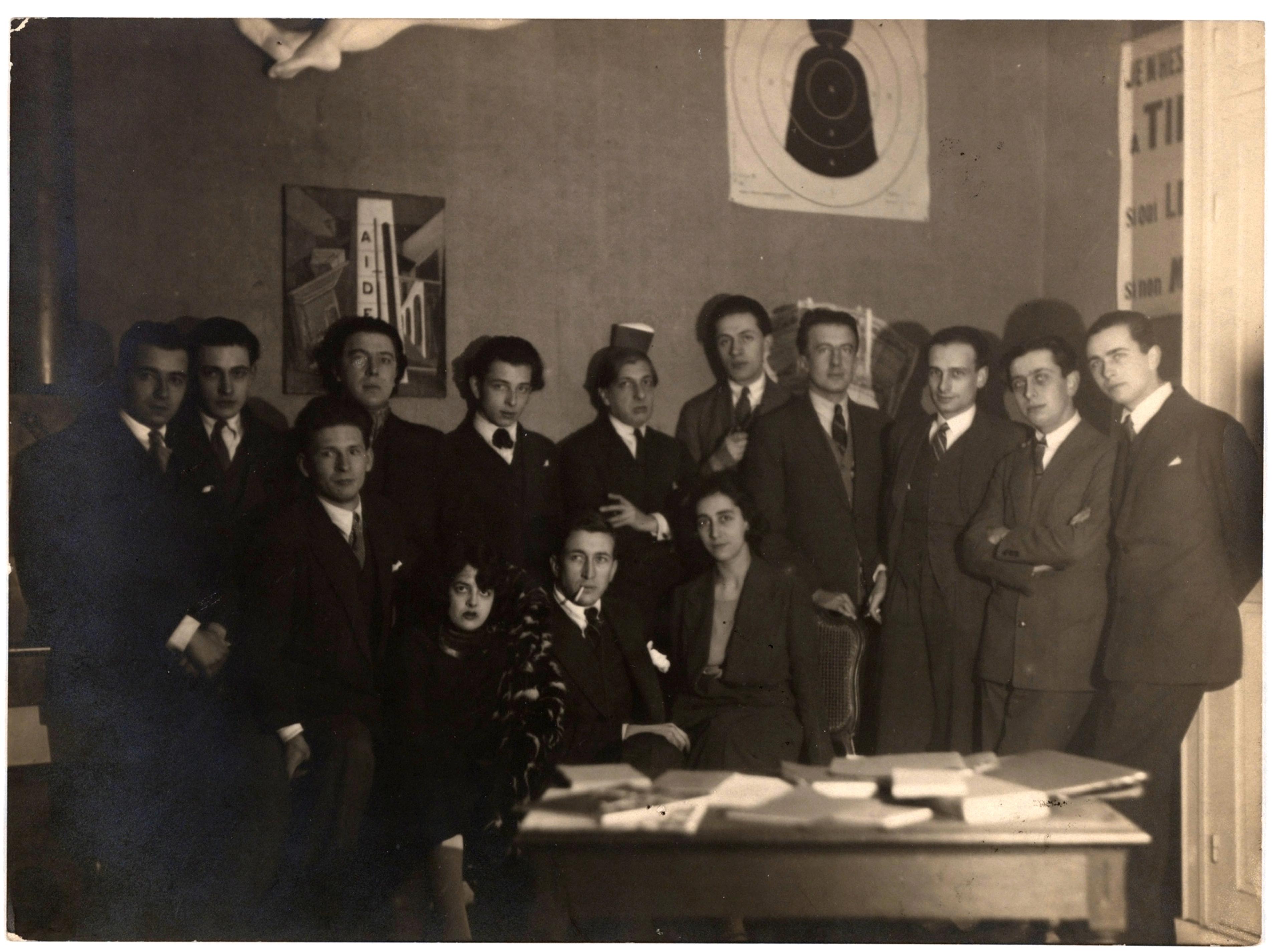
Fig. 1. Man Ray, La centrale surréaliste, 1924. Gelatin silver print, 6 11/16 x 9 1/16 in. (17 x 23 cm). Courtesy of Association Atelier André Breton, Paris. Originally published on the cover of La révolution surréaliste 1 (December 1924). The back carries an annotation in an unknown hand listing the people depicted, along with Man Ray’s stamp. © Man Ray Trust / 2026 Artists Rights Society (ARS), New York
Who are these gravid young firebrands? Starting at left, someone often misidentified as the teenage poet Jacques Baron but who is in fact his older brother, Charles; we know this not only because the fellow gazing at us is manifestly not a teenager, but also because a print of the photograph annotated on the back in André Breton’s hand lists the dramatis personae (though Breton misdated the photo to 1925). Next to him stands Raymond Queneau, future author of the popular novel Zazie in the Metro, among many others, and cofounder of the experimental literary workshop Ouvroir de Littérature Potentielle, known as Oulipo. After Queneau comes Breton, the only one to affect a certain sartorial flair, with his monocle and lively patterned shirt. Then Jacques-André Boiffard, Man Ray’s assistant, who would later make the haunting landscapes for Breton’s Nadja—which Breton, as he would go out of his way in the book to say, found disappointing. Giorgio de Chirico, on loan to the Surrealist Central from his Italian homeland, looking either annoyed or bored. Roger Vitrac, playwright and, less than a year later, the first victim of Breton’s periodic purges of the Surrealist circle. Paul Éluard, consummate poet, mediocre family man, future political toady. Philippe Soupault, coauthor with Breton of the first Surrealist text, Les champs magnétiques (The Magnetic Fields, 1919), who, a year after Vitrac, would also find himself on the chopping block. Robert Desnos and Louis Aragon, looking nearly indistinguishable in face and posture, except that Aragon looks directly at the camera and Desnos, the star of the group’s sleeping trances, looks like a zombie.
Seated in front of them are Pierre Naville, who would irritate Breton a few months later for decreeing in La révolution surréaliste that there was “no such thing as Surrealist painting” (prompting Breton to rebut with what became Le surréalisme et la peinture [Surrealism and Painting]), and again in 1926 for questioning the group’s commitment to Communist politics (prompting Breton to rebut with the pamphlet “Légitime défense”); the future gallerist Simone Kahn Breton, to whom we owe much of what we know about the early days of the Surrealist movement; Max Morise, desultory writer, who always seems to be next to Simone in group photos; and finally, Marie-Louise “Mick” Soupault, wife of Philippe, looking vaguely out of place.
A variant image (fig. 2), evidently taken just before or after, shows the gang in slightly more relaxed, or unprepared, stances: Baron, Morise, and Mick Soupault looking elsewhere, Vitrac dragging on his pipe, Simone slouching . . . only Breton and de Chirico look virtually identical in both photos, rigid as if this were their natural state.
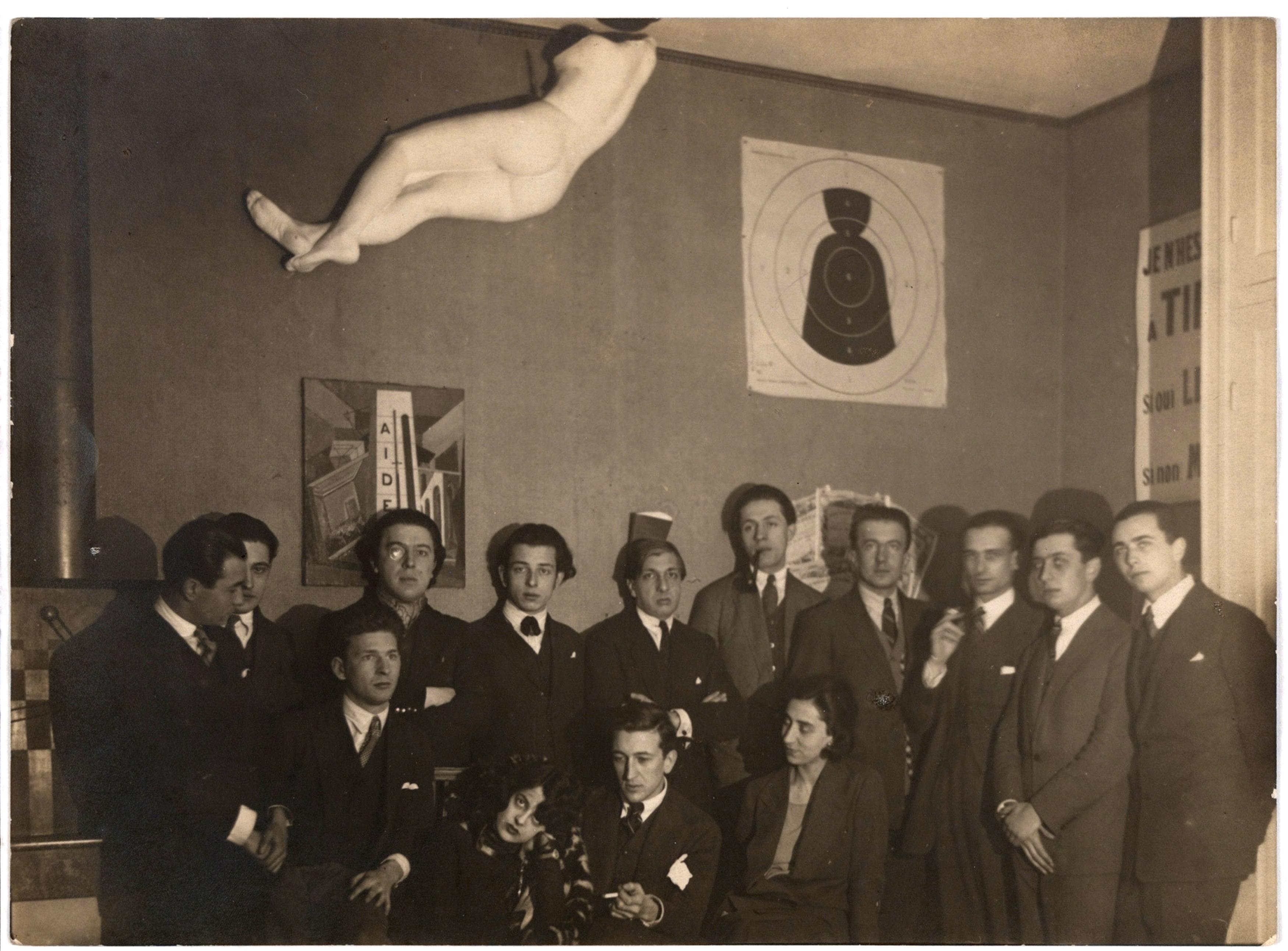
Fig. 2. Man Ray, La centrale surréaliste [alternate, unpublished version], 1924. Gelatin silver print, 6 11/16 x 9 1/16 in. (17 x 23 cm). The back carries an annotation in Breton’s hand listing the people depicted and misdating the photo to 1925. © Man Ray Trust / 2026 Artists Rights Society (ARS), New York
The photographer of both images, of course, is nowhere to be seen. Or isn’t he? At far left, largely obscured behind Charles Baron in the published version, but more visible in the outtake, we can identify Man Ray’s 1917 assemblage Boardwalk (Staatsgalerie Stuttgart). The artist is there and not there, inside and outside at the same time. All the more so, in that this alternate image is virtually unknown, meaning that viewers of the version published in La révolution surréaliste would have had no chance, given the picture’s diminutive size on the magazine’s cover and the muddy printing quality, of detecting the little scrap of Man Ray’s presence.
There and not there: This had been Man Ray’s modus operandi since his first contacts with the group. Arriving in Paris in 1921, tail-winded by a warm recommendation from Marcel Duchamp, he had immediately been embraced by the Paris Dadaists, including many of the future first-generation Surrealists. He nonetheless maintained his independence, seldom taking part in the Dada performances, becoming more a fellow traveler than an adherent: an expatriate by nature as well as nationality, as neutral as Switzerland. When Breton and Tristan Tzara, Dada’s impresario-in-chief, spectacularly parted ways, Man Ray remained friends with both.
After Surrealism’s official launch in October 1924, Man Ray continued to associate with the group, becoming its de facto portraitist, exhibiting in its collective shows, and publishing work in its magazines. Still, he rarely attended the daily café meetings that Breton imposed on his comrades and almost never signed the movement’s political broadsides. In part, this might be due to his status as a foreigner, someone who could not afford to engage in activities that might get him deported. In part as well we could chalk this up to his nearly nonexistent French—there was a lot of talk at the café sessions, not easily understood even by native speakers—which led him to prefer American expat bars over the Surrealists’ favored Café Cyrano. And just as he avoided taking part in French politics, so too he circumvented the internal politics with which Surrealism was rife.
It was no doubt this ability to stay outside the fray that helped ensure Man Ray’s longevity as an insider, a status accorded to few who passed through the Surrealist ranks. While inner-circle stalwarts like Desnos were eventually expelled for frittering away their talent on menial tasks like journalism (needing to make a living was no excuse), Man Ray’s work as a fashion photographer for upscale periodicals like Vogue and Vanity Fair, or his film commissions for wealthy clients, went relatively unpenalized. Never coming truly inside, he couldn’t be drummed out.
Two years before the Surrealist Central portrait, Man Ray tried out a less subtle variation on simultaneous presence and absence. A group photo of the Paris Dadaists from about 1922 (fig. 3) shows Éluard, Tzara, Philippe and Mick Soupault, Georges Ribemont-Dessaignes, Jacques Rigaut, and some lesser lights hunkered together, while Éluard apparently holds a mirror in which the photographer seems to be reflected. A closer look, however, reveals that the object Éluard is holding in fact reflects something else, and that Man Ray slapped a self-portrait on top of it, cropped to fit the surface of the glass.
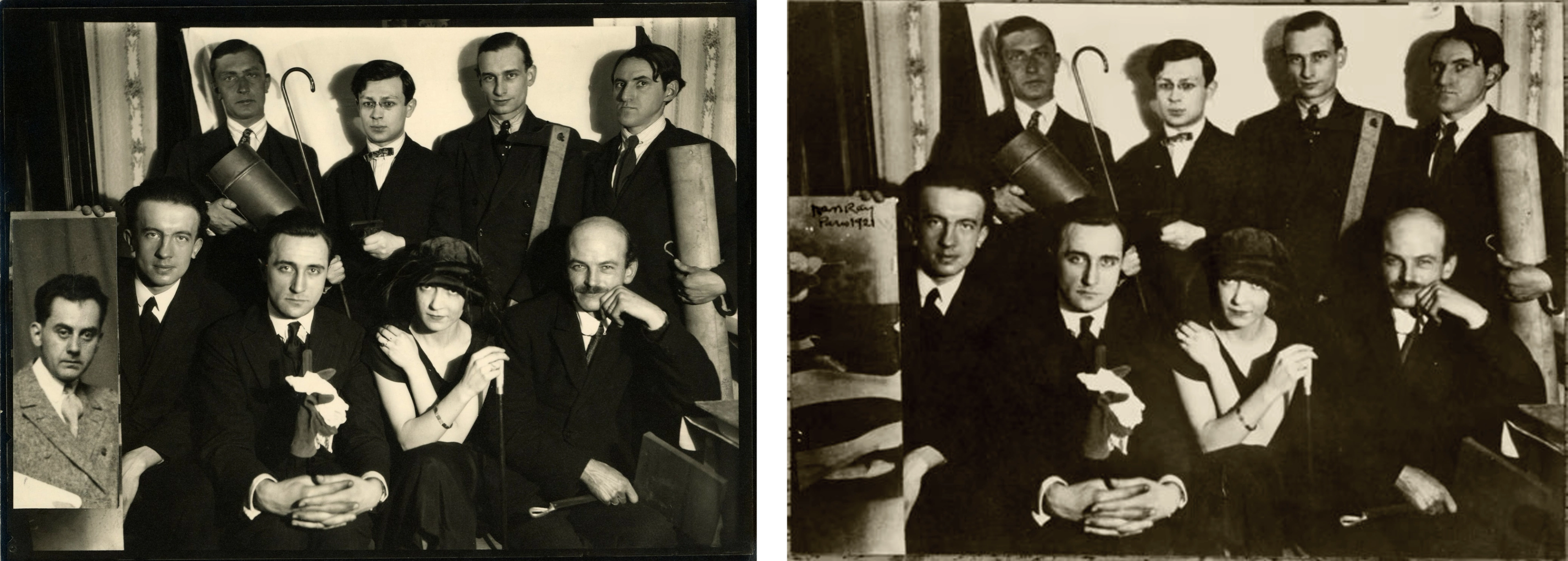
Fig. 3. Man Ray, The Dada Group, ca. 1922. Photomontage, 7 x 9 1/2 in. (17.8 x 24.1 cm). © Man Ray Trust / 2026 Artists Rights Society (ARS), New York. Fig. 4. Man Ray, The Dada Group [unretouched version], ca. 1922 (signed “Man Ray Paris 1921”). Photomontage, 7 x 9 1/2 in. (17.8 x 24.1 cm). © Man Ray Trust / 2026 Artists Rights Society (ARS), New York
What was reflected in that mirror, assuming it is one? An unretouched version of the same photo (fig. 4) shows that it is a snippet of what appears to be a painting or photograph, with a partial inscription visible at top right—as well as, in at least one version, Man Ray’s own signature and the mention “Paris 1921.” Moreover, what is shown suggests that the reflected work might be one of Man Ray’s, with flat, vaguely anthropomorphic shapes reminiscent of his 1916 canvas Promenade (private collection), and cloudlike masses and a horizon line not unlike those in mid-1920s compositions such as Paysage de Suède (Swedish Landscape) (fig. 5) and Marine (private collection). I’ve been unable to identify the work in question, which might have been lost or destroyed, but the glimpse offered in the photograph opens the tantalizing possibility that Man Ray, as with Boardwalk in the 1924 photograph, had included a stand-in for himself (two, if we count the signature), before taking a more direct approach by pasting in his face—thereby making himself, in either case, simultaneously an actor in the scene and a sideline spectator, a part but apart, forever the insider’s outsider.
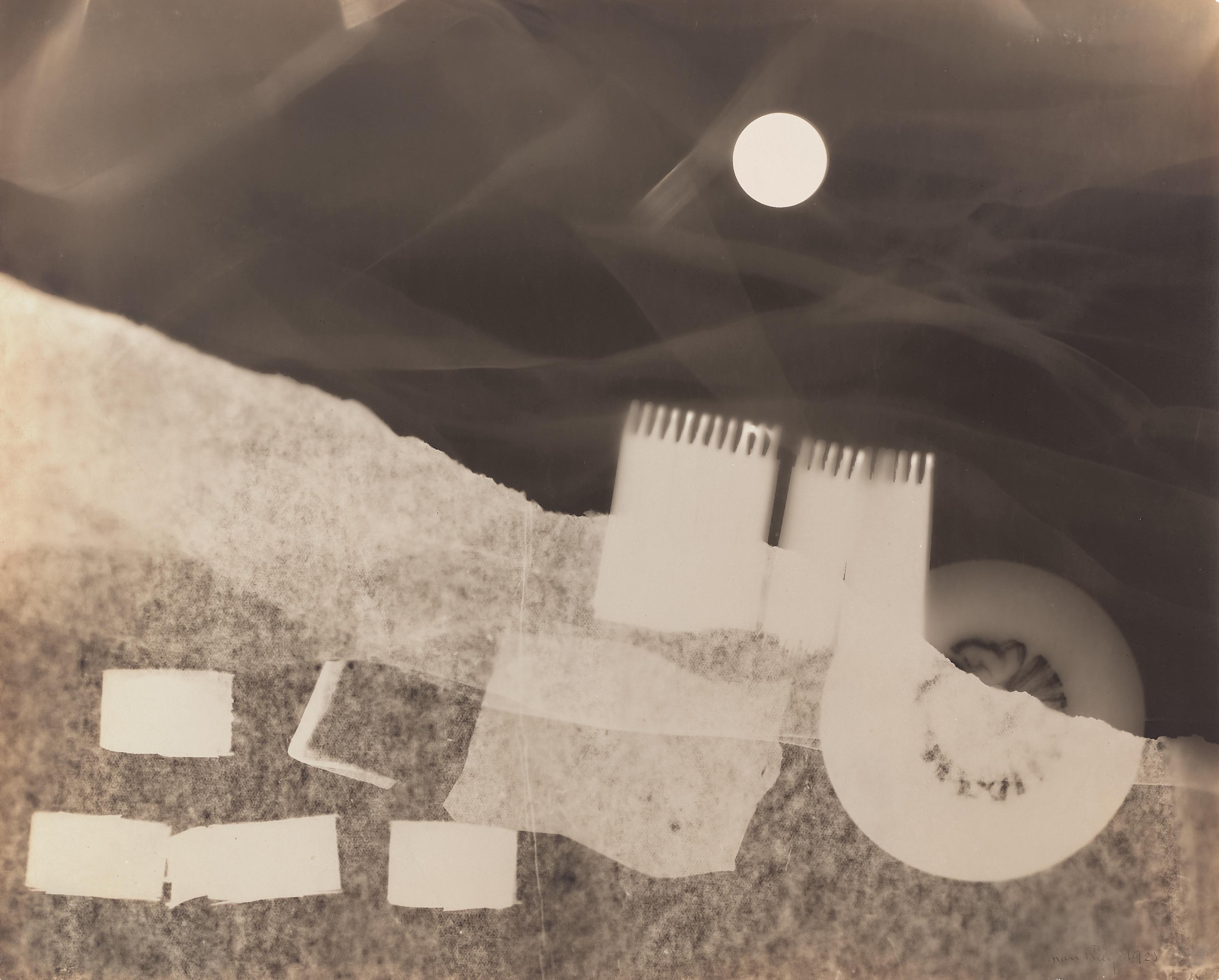
Fig. 5. Man Ray, Paysage de Suède (Swedish Landscape), 1925. Gelatin silver print, 9 3/16 x 11 5/8 in. (23.4 x 29.5 cm). Collection of Christine A. Symchych and James P. McNulty. © Man Ray Trust / 2026 Artists Rights Society (ARS), New York
Notes
Giorgio de Chirico, Il Sogno di Tobia (The Dream of Tobias), 1917, oil on canvas, 23 1/4 x 19 1/4 in. (59.1 x 48.9 cm). The Metropolitan Museum of Art, New York, The Bluff Collection, Promised Gift of John A. Pritzker.
