Thirty-five works by Man Ray in the Bluff Collection were once owned by Arnold Crane (1932–2014), a Chicago collector, lawyer, and photographer. Of these, Crane acquired thirty-one directly from the artist. Four works, including Object to Be Destroyed (fig. 1), also bear inscriptions from Man Ray to Crane.[1] Such seemingly simple facts can amplify little-known histories of friendship and mutual inspiration, and, in this case, they add a historical dimension to the relationship between the collector and artist.
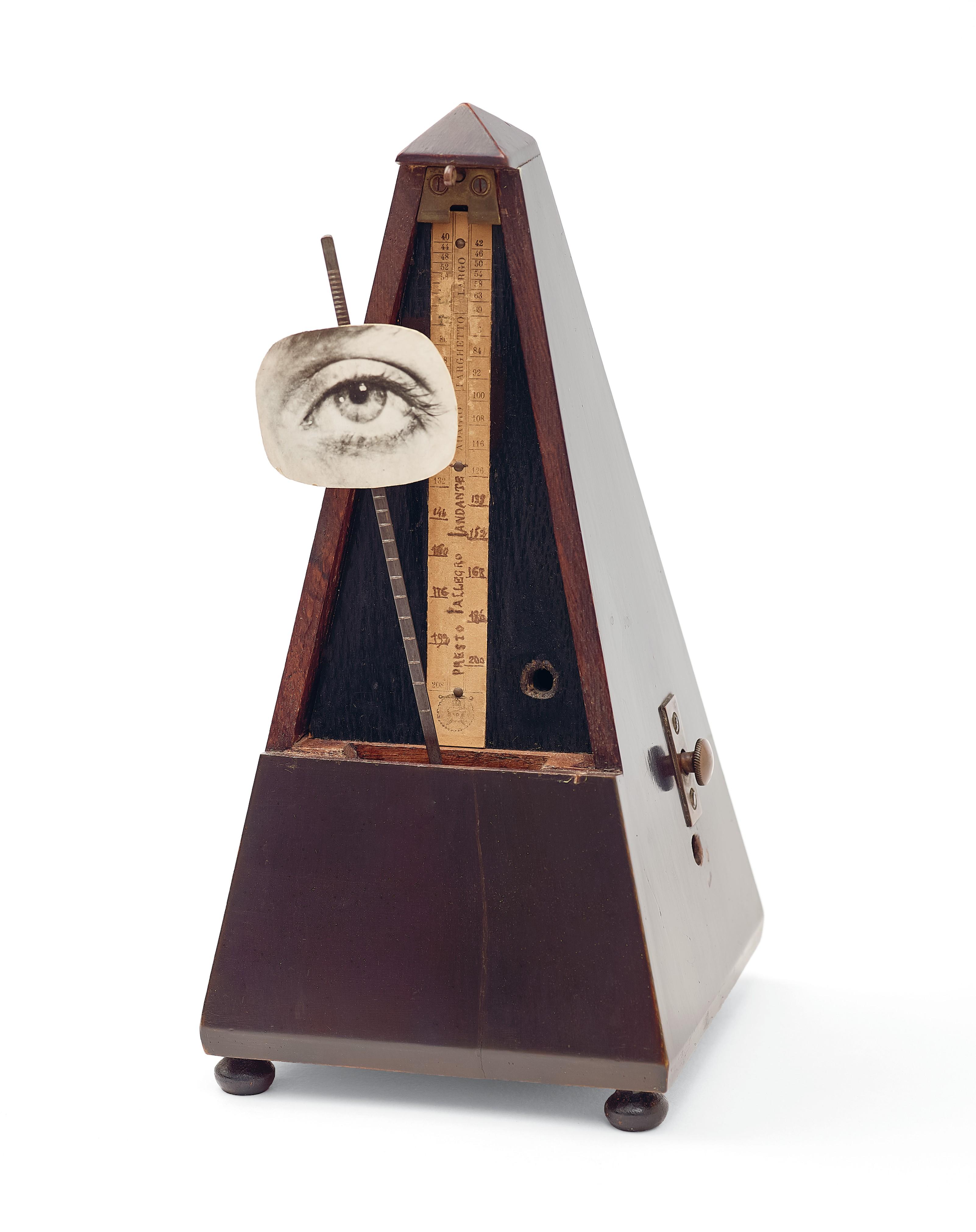
Fig. 1. Man Ray, Object to Be Destroyed, 1923 (1969). Metronome and gelatin silver print, 7 x 4 x 4 in. (17.8 x 10.2 x 10.2 cm). The Metropolitan Museum of Art, New York, The Bluff Collection, Promised Gift of John A. Pritzker. Signed, dated, and inscribed (bottom, in pen): “for Arnold Crane / Man Ray / Paris 1969.” © Man Ray Trust / 2026 Artists Rights Society (ARS), New York
The two men met in 1968 through an introduction by Jean Petithory, Man Ray’s editor, for the purpose of Crane’s project to compile a book of interviews and portraits of photographers.[2] Two months later, Crane acquired his first work by Man Ray, and over the next decade, until the artist's death in 1976, the two met regularly in the artist’s studio. Often their wives joined them, as an inscription in blue ink on the verso of Untitled (Ostrich Egg) (fig. 2) attests.
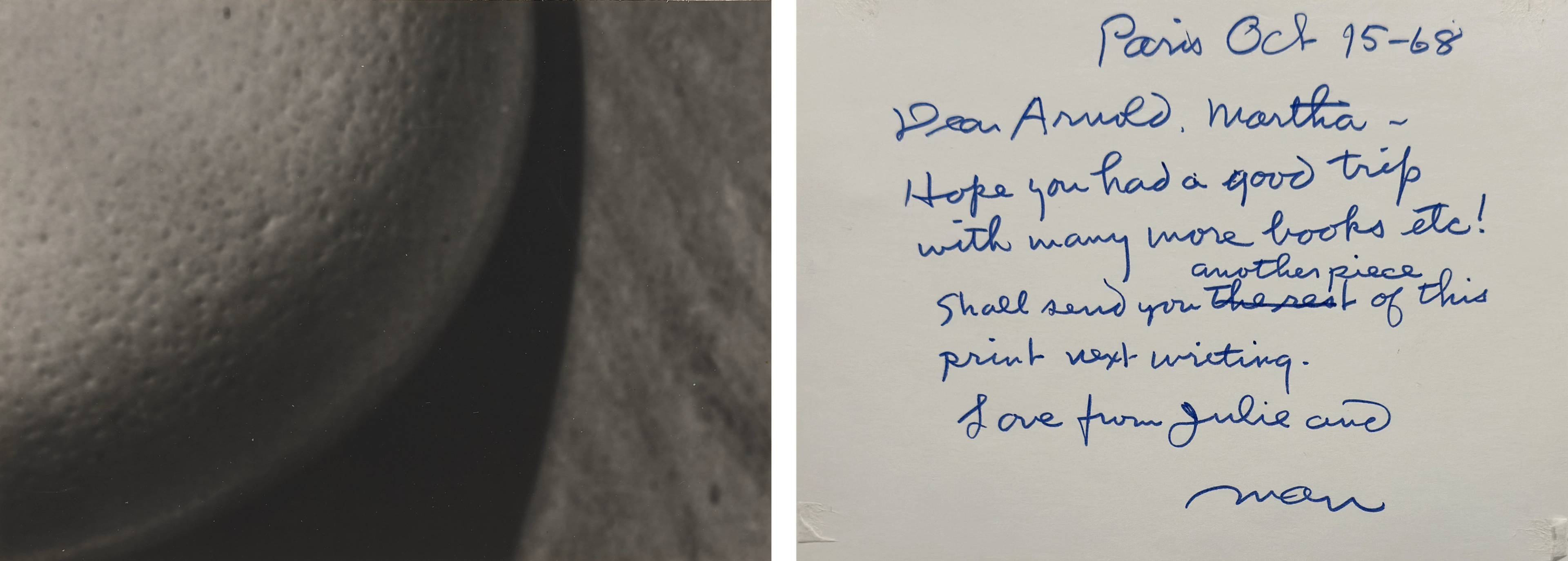
Fig. 2a,b. Man Ray, Untitled (Ostrich Egg), 1968. Gelatin silver print, 3 7/8 x 5 1/2 in. (9.8 x 14 cm). The Metropolitan Museum of Art, New York, The Bluff Collection, Promised Gift of John A. Pritzker. Inscribed (verso, in blue ink): “Paris Oct 15–68 / Dear Arnold, Martha – / Hope you had a good trip / with many more books etc! / Shall send you [the rest] another piece of this / print next writing. / Love from Julie and / Man.” © Man Ray Trust / 2026 Artists Rights Society (ARS), New York
During one of their first interviews Man Ray shared the difficulty in selling his rayographs for even the low price of $100 each.[3] Crane soon played a key role in creating the market for them, recalling: “He would charge outrageous prices, and I’d agree because I wanted the material that badly. Then he’d give me a gift that would more than make up for it. I don’t think he really wanted to sell, but I guess he must have understood my tremendous passion and interest.”[4]
The collector demonstrated exuberance in both his general purchases (by 1976, he had amassed roughly 55,000 prints spanning the history of photography)[5] and his specific reverence for Man Ray, whom he described as the “cornerstone of all that has happened in art in the past number of years.”[6] Reflecting back on his collecting practice in a 1979 interview, Crane recalled that, in the 1960s, “most of the museums . . . were unwilling to turn over any sums of significance for photographs except for the safe masters such as Stieglitz, Strand and Steichen or an Edward Weston. Those works were readily available at the galleries. I purchased those things which museums were either unwilling or unable to buy and I don’t regret it.”[7] As Mark Jannot has observed, early photography collectors operated without “authoritative published histories of the medium” or reliable guides, making collecting itself a way “to learn anything about the history of photography.”[8] Crane’s comfort with risk and his independence from any institutional guidelines allowed him to freely assemble his collection.
In 1973, the collection of works by Man Ray took the form of an exhibition that began at the Milwaukee Art Center and traveled to subsequent venues, including The Metropolitan Museum of Art, where it was the museum's first solo presentation of the artist's works.[9] Part of the exhibition was installed in the balcony galleries of The Met’s Vélez Blanco patio, thereby situating Man Ray’s photographic experiments amid sixteenth-century Spanish architecture (fig. 3). This was a display that Man Ray would surely have enjoyed, as he was, one critic remarked, “a creator himself of odd juxtapositions.”[10] The exhibition surveyed the artist’s photographic practice, presenting works that reflected the breadth of Man Ray’s experimentation with both method and subject. That a comprehensive exhibition of a living photographer could be drawn from the holdings of a single private collector was especially significant at a moment when photography was still emerging as a collectible medium. In the introduction for the catalogue, the then-director of the Milwaukee Art Center Tracy Atkinson stated that the respect between the two was mutual, noting that the artist “entrusted” Crane with many works he had previously intended to keep himself.[11]
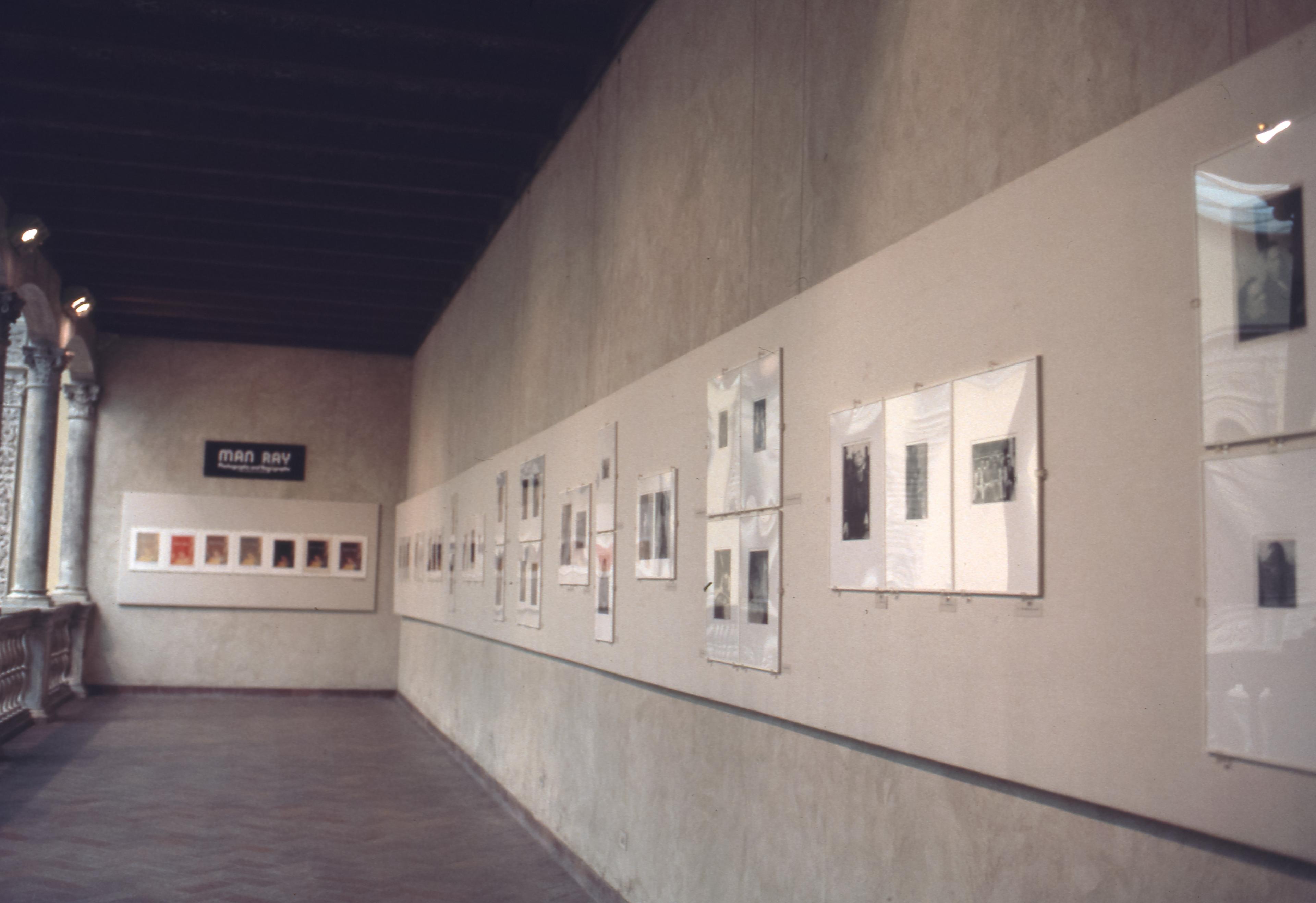
Fig. 3. Installation view of Man Ray: Photographs and Rayographs, The Metropolitan Museum of Art, New York, July 18–September 2, 1973
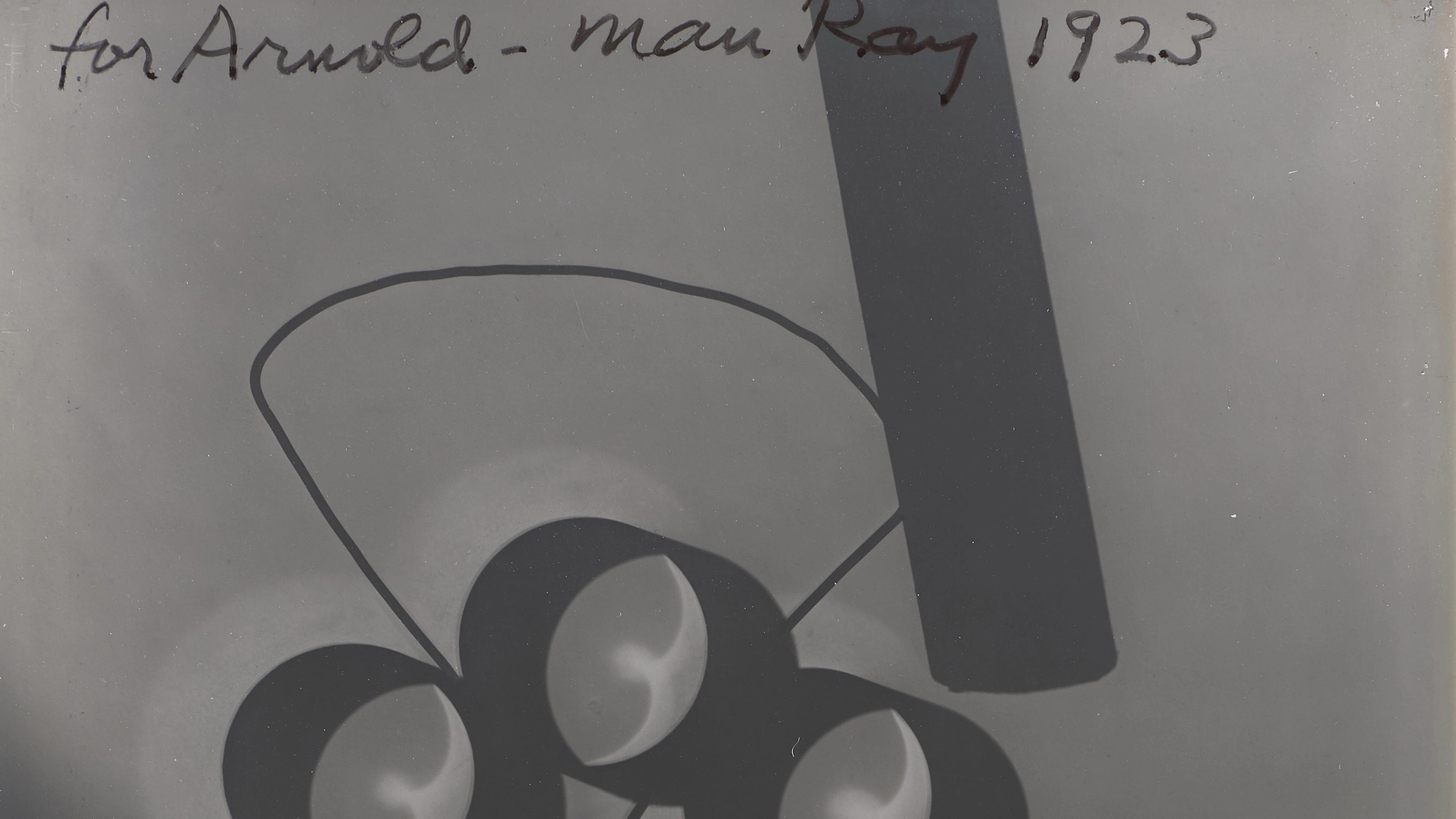
Just as an exhibition might demonstrate the trust and respect between an artist and a collector, so too can an inscription. Among the Bluff Collection works formerly owned by Arnold Crane are two negatives on which Man Ray wrote “For Arnold” in ink. One is a glass negative of a photograph of a 1923 rayograph (fig. 4),[12] and the other a film negative of an abstract composition dated to 1946 (fig. 5).[13] Neither object belongs to a genre such as portraiture in which one may expect an artist to add a personal dedication. Rather, both objects are experimental—perhaps an acknowledgment of something passed from one artist to another.
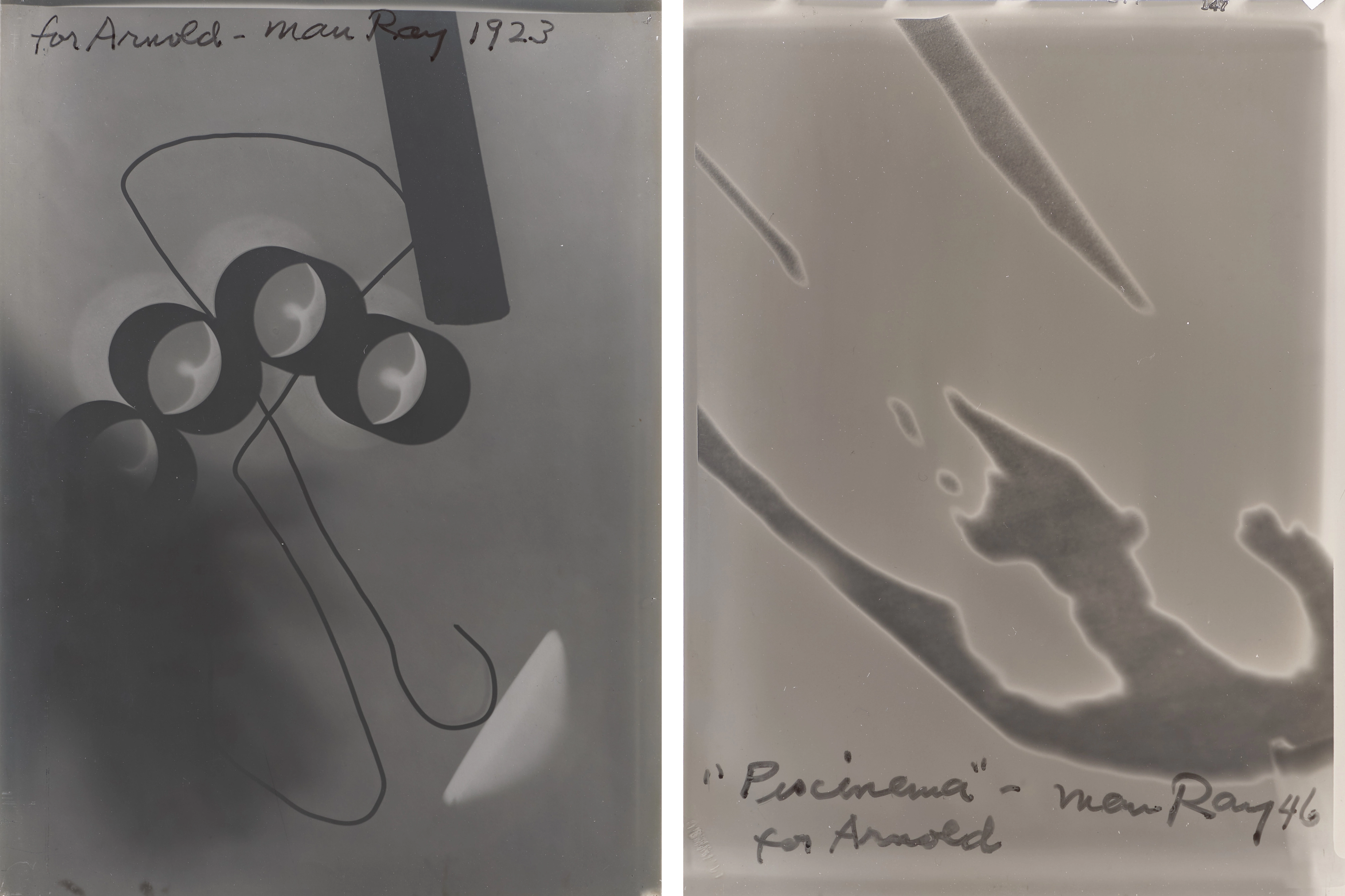
Fig. 4. Man Ray, Rayograph, 1923. Glass negative, 7 x 5 in. (17.8 x 12.7 cm). The Metropolitan Museum of Art, New York, The Bluff Collection, Promised Gift of John A. Pritzker. Signed, dated, and inscribed (top, in ink): “for Arnold – Man Ray 1923.” © Man Ray Trust / 2026 Artists Rights Society (ARS), New York. Fig. 5. Man Ray, Piscinema, 1946. Film negative, 4 5/8 x 3 7/16 in. (11.7 x 8.7 cm). The Metropolitan Museum of Art, New York, The Bluff Collection, Promised Gift of John A. Pritzker. Signed, dated, and inscribed (bottom, in black ink): “‘Piscinema’ – Man Ray 46 / for Arnold.” © Man Ray Trust / 2026 Artists Rights Society (ARS), New York
By adding legible inscriptions, Man Ray transformed these negatives from functional artist materials into permanent testaments to his relationship with Crane. The act altered the objects themselves: no further prints or films could be drawn from them, nor could they easily be sold to another collector or displayed with such a prominent inscription written on the recto. In this sense, the works became proof of Man Ray’s trust in his friend. A negative represents just the start of an artistic idea, the beginning stages of experimentation and production. Crane’s name on such an object might suggest that Man Ray viewed him as not only a collector but also a like-minded confidant, someone who understood the ideas he was exploring in his practice. Crane expressed a similar admiration for Man Ray in his 1973 exhibition catalogue essay titled “Renaissanceman,” referring to the artist as his “Dadafather,” and concluding with a heartfelt “We love you Man!”[14] Perhaps the two saw themselves in each other, both renaissance men.
Notes
These four works are also either postdated with the year of the work’s creation or the date of Crane’s acquisition.
Arnold Crane, On the Other Side of the Camera (Könemann Verlagsgesellschaft, 1995).
Arnold Crane, interview with Man Ray, June 12, 1968, transcript, Archives of American Art, Smithsonian Institution, cited in Wendy A. Grossman, “Surrealism and the Marketing of Man Ray’s Photographs in America: The Medium, the Message, and the Tastemakers,” in Julia Drost et al., Networking Surrealism in the USA: Agents, Artists, and the Market, arthistoricum.net, 2019, 260, https://books.ub.uni-heidelberg.de//arthistoricum/catalog/book/485.
Jane Allen, “Photography: Man Ray . . . Linking Camera to Canvas,” Chicago Tribune, February 11, 1973, sect. 6, 11.
Jane A. Mull, “Investors in the Camera Masterpieces,” Fortune 96 (June 1976): 142.
Arnold H. Crane, “Renaissanceman,” Photo Graphics: From the Collection of Arnold H. Crane (Milwaukee Art Center, 1973), unpag.
Elaine A. King, “Camera Interview with Arnold H. Crane,” Camera 58 (September 1979): 37. The Met acquired its first work by Man Ray in 1969 (69.5.21) and its first rayograph in 1987 (1987.1100.42).
Mark Jannot, “Arnold Crane Is a Photomaniac,” Chicago 40 (April 1991): 108.
The exhibition was organized by the Milwaukee Art Center (February 10–March 11, 1973). While Crane is not listed as the official curator, he seemed to have a strong influence on the selection of works. The presentation traveled to The Metropolitan Museum of Art (July 9–September 3, 1973); the Corcoran Gallery of Art, Washington, DC (January 9–February, 3 1974); the High Museum of Art, Atlanta (March 2–31, 1974); the San Francisco Museum of Art (July 10–September 8, 1974); Wellesley College Museum, Wellesley, Mass. (September 29–November 3, 1974); and the Minneapolis Institute of Arts (November 22–December 22, 1974). Under a separate agreement, Crane’s collection was also exhibited at the Museum of Contemporary Art, Chicago, in 1975. Thanks to Frank Violette Foss, the Milwaukee Art Museum’s archivist, for sharing this information.
Douglas Davis, “Playful Subversion,” Newsweek, July 30, 1973, 93.
Tracy Atkinson, “Introduction,” Photo Graphics: From the Collection of Arnold H. Crane (Milwaukee Art Center, 1973), unpag.
A print from this negative is reproduced in James Thrall Soby, Photographs by Man Ray, 1920 Paris 1934 (Random House, 1934), 98.
Crane donated a solarized print from the film negative to the J. Paul Getty Museum, Los Angeles (84.XM.1000.18), https://www.getty.edu/art/collection/object/106HPY.
Crane, “Renaissanceman,” unpag.
