The “spatialization of time,” as it was institutionalized, internalized, and conceptualized in the nineteenth and twentieth centuries, came to define modernity: time rationalized and routinized, above all by the clock. Beginning in the Renaissance, “clock time” had begun to discipline the workday, quantifying human existence.[1] “Time is everything, man is nothing,” in Karl Marx’s words. “He is at most the incarnation of time. Quality no longer matters. Quantity alone decides everything: hour for hour, day for day.”[2]
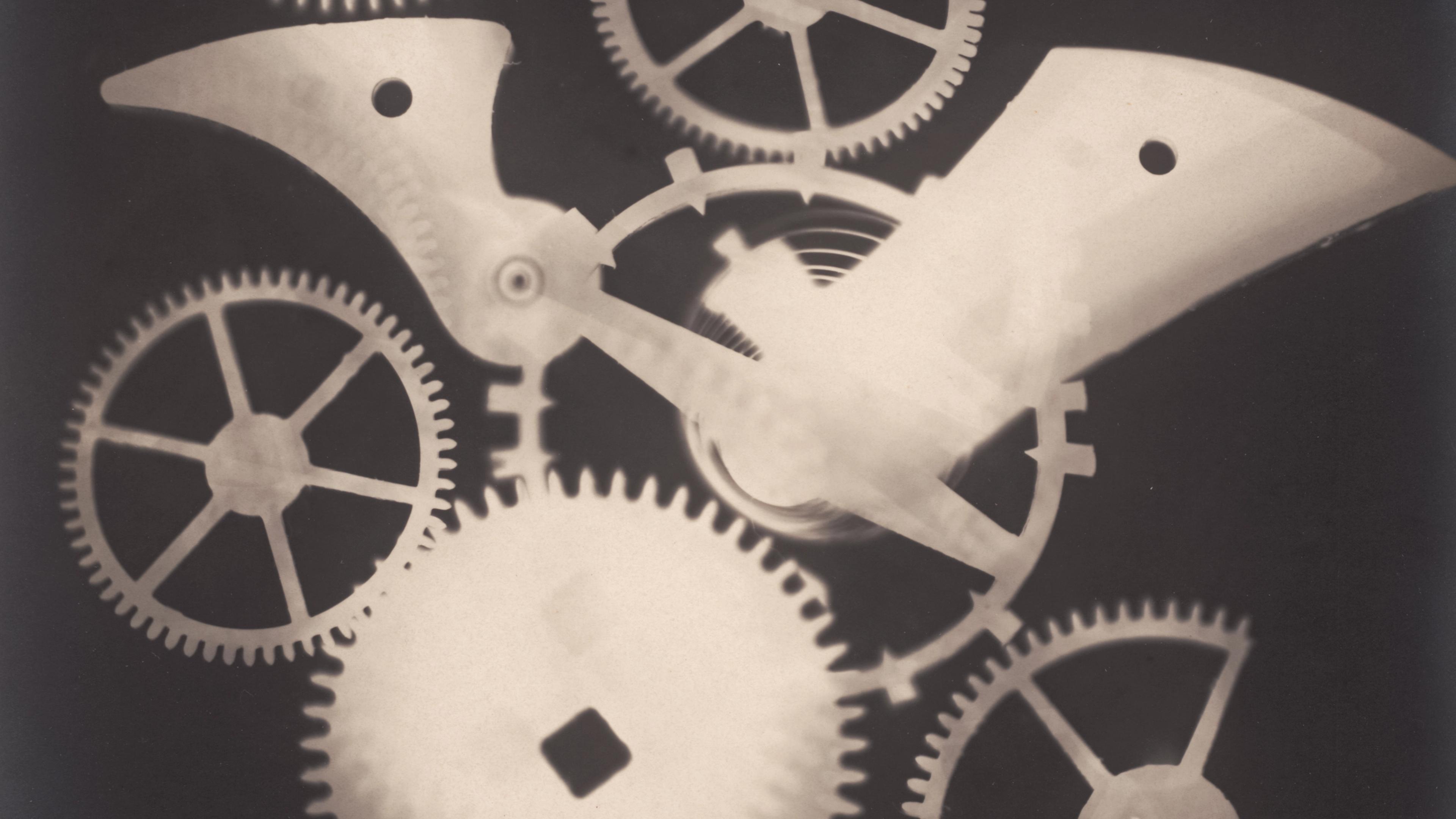
By “re-spatializing time,” I mean to challenge or refigure this notion of temporality. How might one spatialize time differently—not to divide and measure it, but to liberate it (whatever “it” is) from any such confinement? For Man Ray, in an untitled rayograph of 1924 (fig. 1) featuring clock wheels, it was by dissolving the object, leaving only the insides, the objects within the object: parts that are no longer parts of anything, or parts of no whole but the rayograph itself. The gears may touch (they overlap) but they remain unengaged. Free from the indignity of use, the forms float, suspended, quietly affirming their autonomy—from each other, from the object that once contained them, from the chronomechanistic system. The all-but-transparent netting in the foreground, a kind of oneiric wave (Louis Aragon’s “Une vague de rêves” [“A Wave of Dreams”] was published this same year), helps to grant the scene its dimensionality, wherein the upper gears appear to drift up but also . . . back and away (an appearance produced by successive exposures, perhaps, or by the manipulation of the negative).
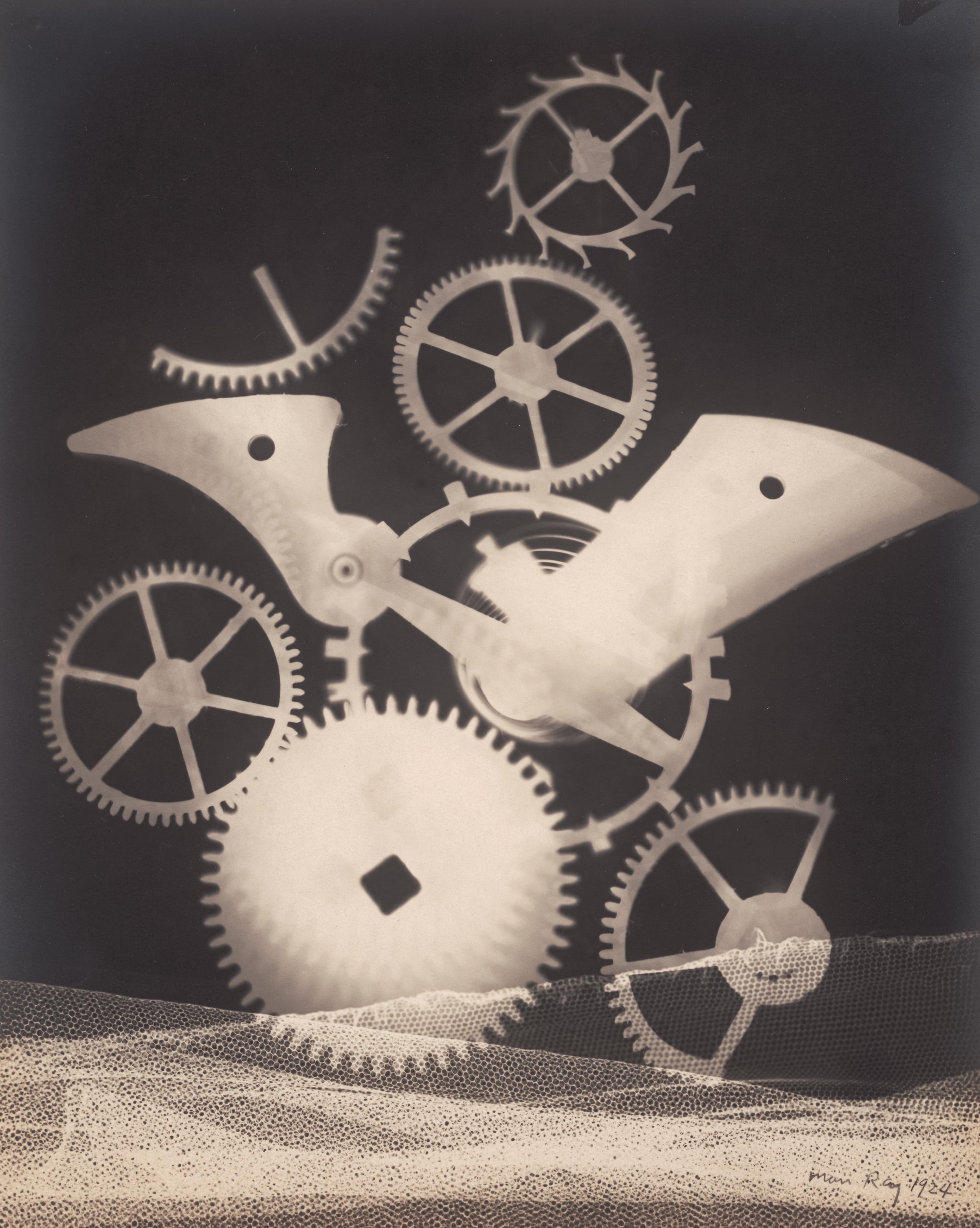
Fig. 1. Man Ray, Rayograph, 1924. Gelatin silver print, 11 3/16 x 9 in. (28.4 x 22.9 cm). The Metropolitan Museum of Art, New York, The Bluff Collection, Promised Gift of John A. Pritzker. © Man Ray Trust / 2026 Artists Rights Society (ARS), New York
Unlike the gears of L'impossibilité (Dancer, Danger) (1917–20, fig. 2), which appear ready to go, here the gears register a disintegration of the timepiece—or, better, its centrifugal dispersion. And the rayograph conveys none of the aggression toward time (and its object forms) that animates Object to Be Destroyed (1923, fig. 3), wherein Man Ray affixed the “eye from a photograph of one who has been loved but is seen no more” to the spindle of a metronome. He provided a different origin story for the assemblage in 1963, an account of the artist’s battle against the regulating mechanism: “One day I did not accept the metronome’s verdict. I smashed it to pieces.”[3] Devoid of any such aggression, the 1924 rayograph of clock wheels conjures the chronometric object world—choreographs its bits and pieces—into a spirit photograph, the gears not spatializing time but released by some other spatialization.
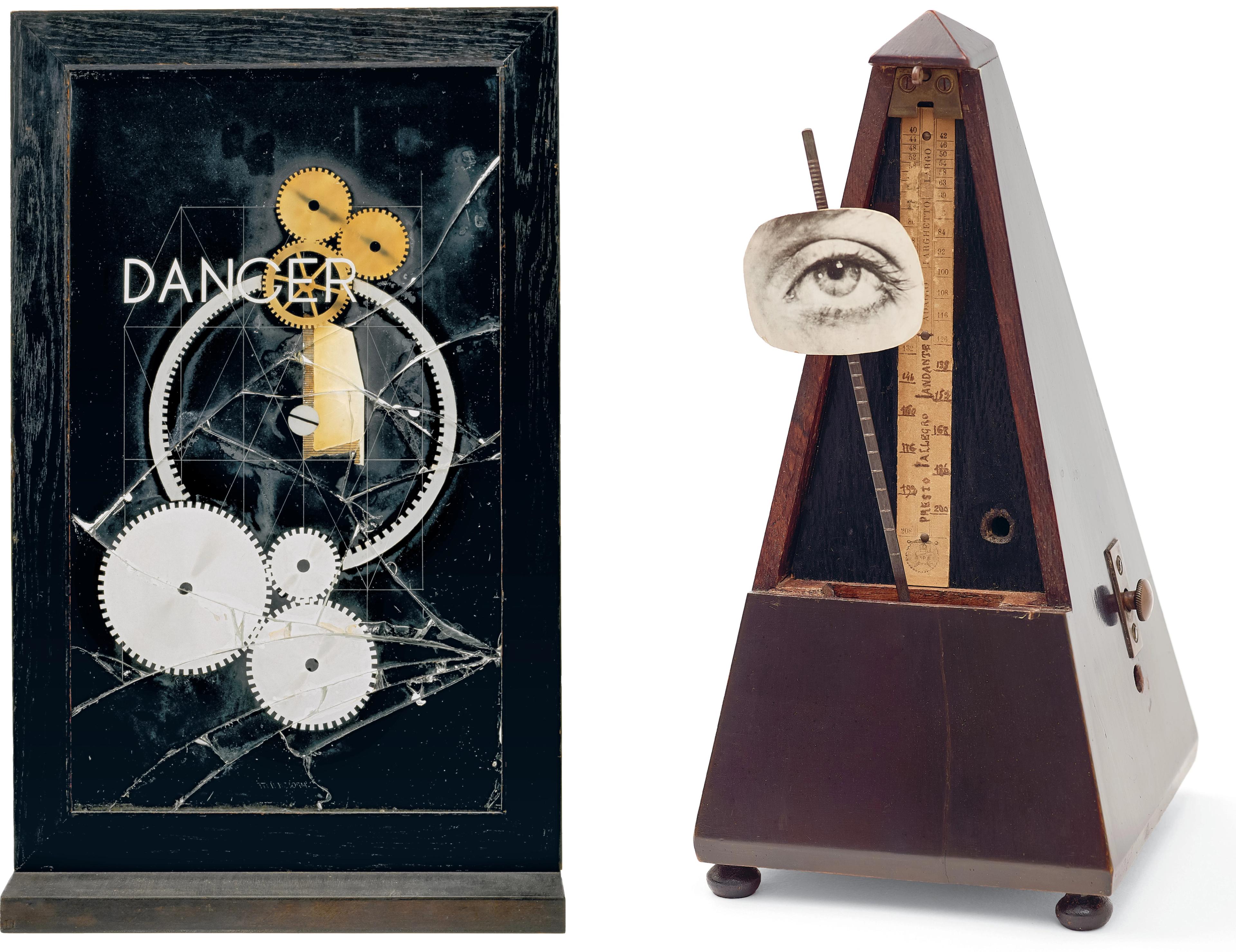
Fig. 2. Man Ray, L'impossibilité (Dancer, Danger), 1917–20. Airbrush painting on glass in a wooden frame, 27 7/8 x 17 11/16 x 10 13/16 in. (70.8 x 45 x 27.5 cm). Musée national d'art moderne, Centre Pompidou, Paris, Gift of Mmes Aube Breton-Elléouët and Oona Elléouët, 2003 (AM 2003-581). © Man Ray Trust / 2026 Artists Rights Society (ARS), New York. Fig. 3. Man Ray, Object to Be Destroyed, 1923 (1969). Metronome and gelatin silver print, 7 x 4 x 4 in. (17.8 x 10.2 x 10.2 cm). The Metropolitan Museum of Art, New York, The Bluff Collection, Promised Gift of John A. Pritzker. © Man Ray Trust / 2026 Artists Rights Society (ARS), New York
It is Henri Bergson, thinking not of the workday but of human perception, who most influentially objected to the way that time is treated as a series of measurable units laid out like points in space—rather than as real, lived duration (durée réelle). Between Essai sur les données immédiate de la conscience (1889, Time and Free Will) and L’Évolution créatrice (1907, Creative Evolution), he settled on a dominant trope, the cinema, to illustrate how we only ever perceive an illusion of mobility, as we are unable to access the “inner becoming of things” and the “flux of time” that is “reality itself.” Watching a film, we think we are witnessing movement, but what we actually see is a succession of fixed stills. It is within the fixed still that Man Ray unfixes the chronometric object, as though intent on disclosing “the things which flow.”[4]
Modernism, spurred not least by Bergson, never tired of challenging modernity in the temporal register: most patently, in prose fiction, by Marcel Proust, not just through the irruptions of involuntary memory in the search for lost time (1913–27), but in the Proustian sentence itself; in paint, by the melting pocket watches of Salvador Dalí’s Persistence of Memory (1931; The Museum of Modern Art, New York); and in very different prose, by Gertrude Stein’s “continuous present,” part of her fundamental recalcitrance toward temporal norms.[5] In exchange for Man Ray’s photographic portrait of her (1922), Stein composed, for him, her “Portrait of Man Ray” (1924): “Sometime Man Ray sometime. Sometime Man Ray sometime. Sometime sometime.”[6] The absence of predication, the repetition—together these concoct a temporal limbo within which Man Ray disappears.
What is remarkable about the limbo disclosed in this rayograph—remarkable indeed about so many of the rayographs—is how it displaces the human subject, as though confirming Walter Benjamin’s assertion in 1925 that the Surrealists “are less on the trail of the psyche than on the track of things.”[7] Or perhaps, in the case of Man Ray, on the path to the psychic life of things, “things that dream and talk in their sleep” (“des objets quie rêvent et qui parlent dans leur sommeil”), as Tristan Tzara put it in his preface to Champs délicieux (Delicious Fields), the album of rayographs that Man Ray published in 1922.[8] In the middle of the rayograph, the escapement pallets—inverted—evoke some kind of bird, uncannily vitalizing the object world, as Man Ray does most dramatically in Emak Bakia (1926), his cinépoème in which a white collar, liberated from its shirt and from human routine, dances all by itself (fig. 4). The rayograph with clock wheels reminds us that, as Freud put it, unconscious processes “bear no relation to time at all.”[9] Things that dream, however enclosed by the image that grants them their oneiric life, drift far beyond any time frame.
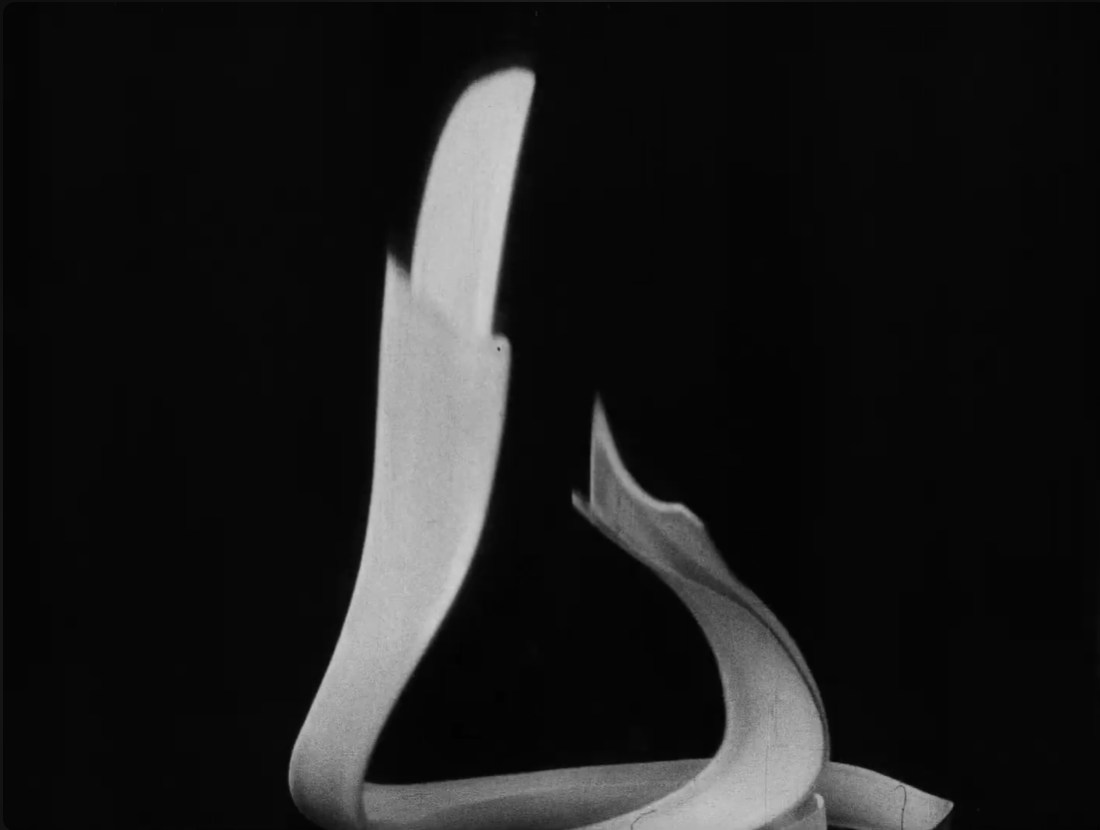
Fig. 4. Still from Man Ray’s Emak Bakia, 1926. 35mm film, black-and-white, silent, 19 min., 43 sec. Courtesy of WOMANRAY and CINENOVO. © Man Ray Trust / 2026 Artists Rights Society (ARS), New York
Notes
E. P. Thomspon, “Time, Work-Discipline, and Industrial Capitalism,” Past and Present, no. 38 (December 1967): 56–97.
Karl Marx, “The Poverty of Philosophy” (1847), in Karl Marx and Frederick Engels, Collected Works, vol. 6 (Lawrence and Wishart, 1976), 127.
For my analysis of the assemblage, which includes the quotation from Man Ray’s interview with Arturo Schwartz, see Bill Brown, “The Modernist Object and Another Thing (Man Ray),” Other Things (University of Chicago Press, 2015), 79–124.
Henri Bergson, Creative Evolution, trans. Arthur Mitchell (Henry Holt, 1911), 306, 344, 374.
As explained in “Composition as Explanation” (1926), and as exemplified by Three Lives (1905) and The Making of Americans (1911), which Stein described as “almost a thousand pages of a continuous present.” Gertrude Stein, "Composition as Explanation,” Selected Writings of Gertrude Stein, ed. Carl Van Vechten (Random House, 1946), 457.
See Anne Diebel, “Gertrude Stein’s Mutual Portrait Society,” Paris Review, May 14, 2018, https://www.theparisreview.org/blog/2018/05/14/gertrude-steins-mutual-portraiture-society/.
Walter Benjamin, “Dream Kitsch” (1925), trans. Howard Eiland, in Walter Benjamin, Selected Writings: Volume 2, ed. Michael W. Jennings et al. (Harvard University Press, 1999), 3.
Tristan Tzara, “La photographie à l’envers,” reprinted in Man Ray: 60anni di libertà = 60 ans de libertés = 60 years of liberties, ed. Arturo Schwartz (Eric Losfield, 1971), 104–8, quotation 108.
Sigmund Freud, “The Unconscious” (1915), trans. Cecil M. Baines, General Psychological Theory, ed. Philip Rieff (Collier Books, 1963), 135.
