Around 1028, Pope John XIX summoned Guido d’Arezzo (circa 991 or 992–1050), a Benedictine brother, to Rome from Arezzo, where he led the cathedral choir. Pope John wanted to verify rumors that Guido had developed a revolutionary method of teaching music “without pain.” In one afternoon, Guido taught His Holiness to sight read music and thereby catapulted himself and his pedagogical techniques into immortality. Guido died in 1050, but his teaching survived and traveled across the globe. The Franciscans took it to the New World in the fifteenth century, and in the 1680s, the Portuguese Jesuit Brother Tomas Pereira instructed the Kangxi Emperor using Guido’s method in Peking. In the eighteenth century, it reached North America via missionaries who taught Indigenous populations to sing sacred music on the west coast, and via English colonists on the eastern seaboard. Descendants of Guido’s method survive as a cappella shape note singing in Appalachia and in high school physics classes. Today, we examine one of music’s most iconic images, the art form and pedagogical aid that illustrates Guido’s teaching: the Guidonian hand.
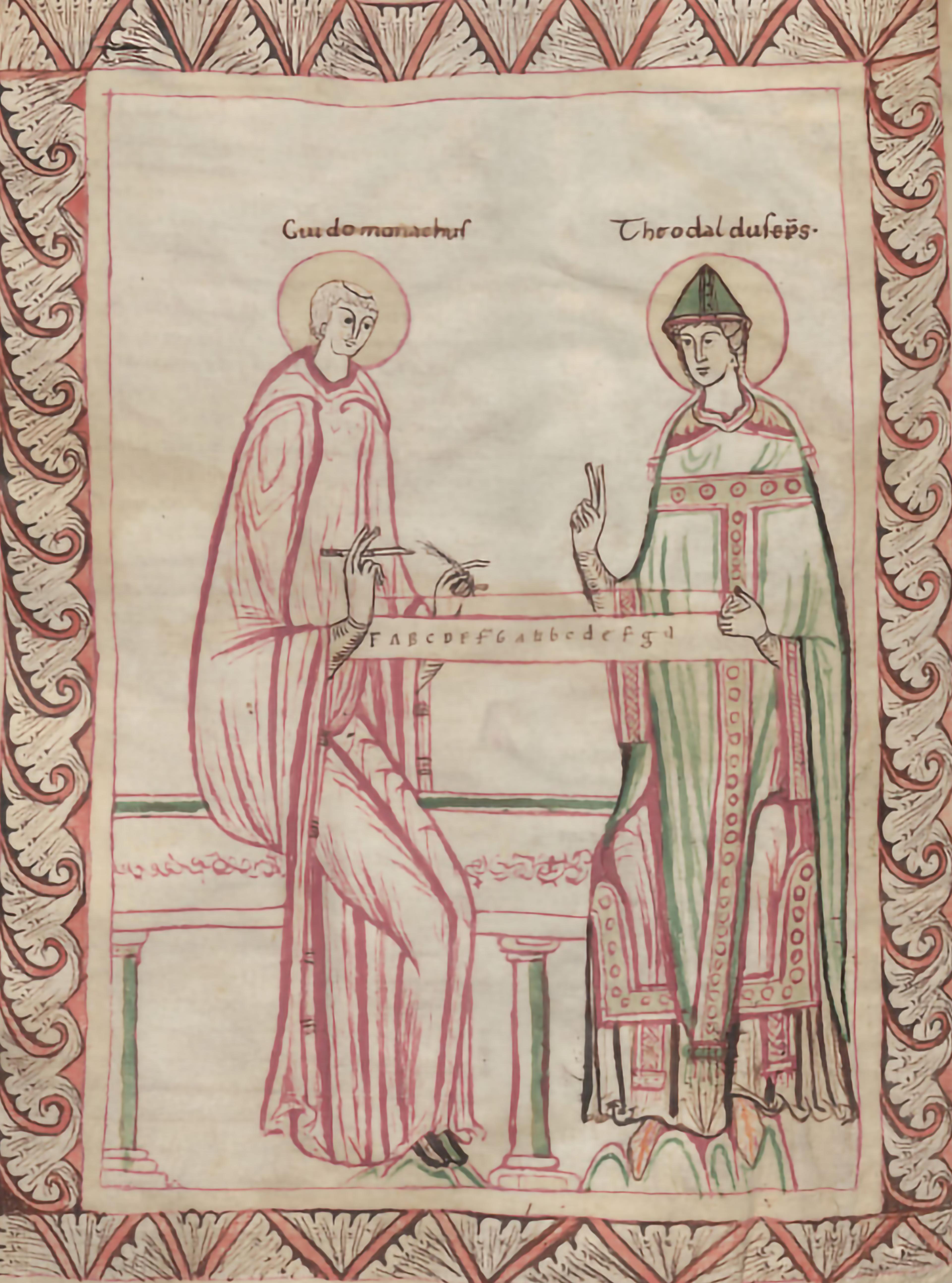
Musicological texts, 1180–1199. Cod. 51, fol. 35v. Courtesy Austrian National Library
Appreciating the Hand as more than an odd medieval symbol requires understanding what it teaches. In Guido’s day, there was no notation system for recording notes. Yet the Church’s sung liturgies meant that a monk needed to memorize at least seventy-five hours of music—a significant challenge for even the (few) literate. In his Prologus, Guido “advertised” his system as one that enabled children to learn singing easily, a humane alternative to the then typical method of teaching by beatings: “See what small boys can do under our direction, boys who until now have received whippings for their gross ignorance of the psalms . . . now, without a master, . . . sing correctly by themselves.”
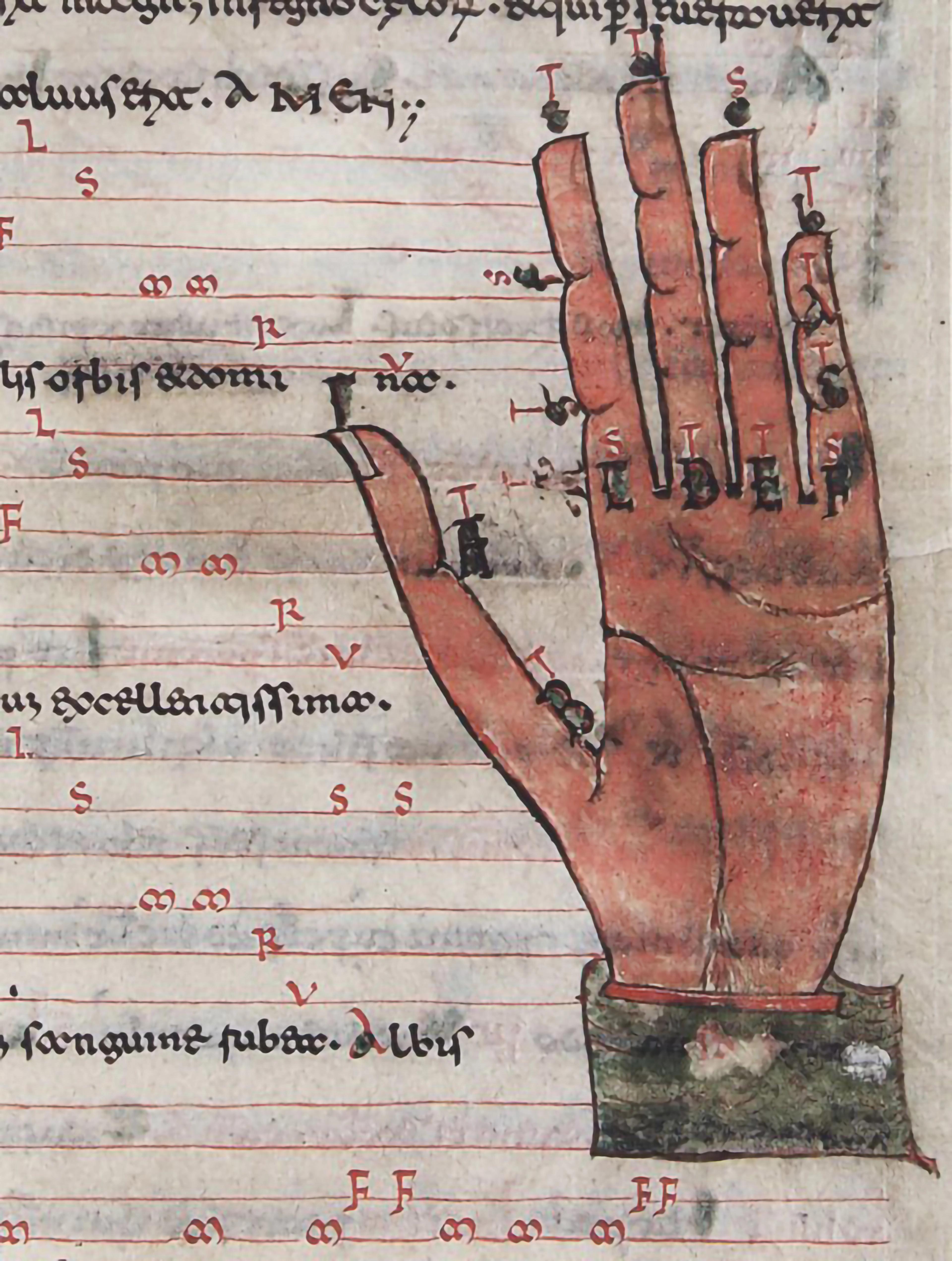
Mano guidoniana from Codice 318 dell'Abbazia di Montecassino (p. 291). Courtesy Wikimedia Commons
The linchpin of Guido’s brilliant new system was a four-line staff for musical notation, which he developed about 1020. The lines were pitched a musical third apart, to allow different pitches to be seen in reference to each other. Contemporary music, as Guido explained in his treatise Micrologus, published about 1026, used seven overlapping six-note hexachords. Guido gave each note of the hexachord a name—Ut, Re, Mi, Fa, Sol, La—taken from the first syllable of the words of each line of a universally familiar tune, the Hymn to St. John the Baptist. Conveniently, each line of the hymn began one note above the last, and since nearly everyone knew the tune, they knew which note and word began each line. By assigning one of these six-syllable names to each pitch, Guido enabled students to sing the melody using the correct corresponding pitches when any teacher called out the syllable names, a system that came to be known as solmization (after the pitch “sol”). Initially controversial because it was so revolutionary, solmization spread quickly and drew the Vatican’s attention. It was the “wonderful” invention that so impressed Pope John.
The Hand was a further refinement of Guido’s solmization technique, not really described by Guido himself but universally attributed to him. By associating a finger joint with each of Guido’s syllables, a teacher could avoid the need to call out the syllable names by simply holding up one hand and pointing to particular “notes” on the other. Hand diagrams ascribed four notes from Guido’s solmization system to each finger and three to the thumb, and sometimes depicted the highest note floating above; each finger joint was labeled accordingly. The first and lowest note, at the tip of the thumb, was known as gamma ut, whence the term gamut (as in “running the gamut”). One alternate name for the Guidonian hand is “gamut hand.”
Hand illustrations, which proliferated from about the time of Guido’s death in 1050, show (with one or two exceptions) left hands: since right-handedness preponderates, the right hand was the pointer that demonstrated on the left. On most Hands the notes are shown in a spiral, starting at the top of the thumb and running down to the palm and then around the finger joints; variants show notes in ladder form, with notes ascending up the finger joints. The Hand diagram thus became known as the Guidonian hand not because we have one known to have been drawn by Guido himself, but because all Hands illustrate Guido’s method of teaching untrained people to sight read music, and medieval sources all treat the Hand as Guido’s invention.
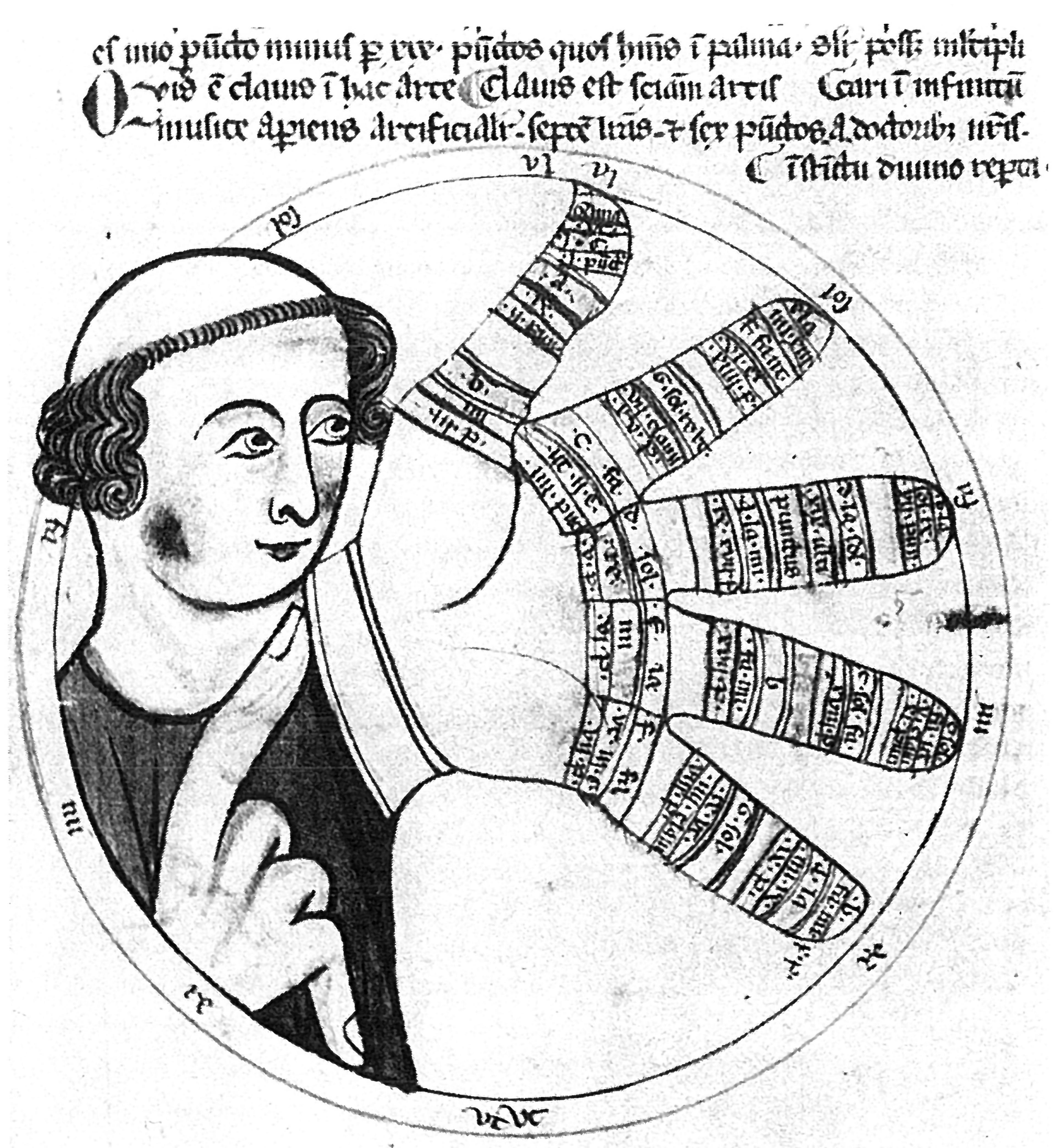
An example of a Guidonian hand drawing from a 1274 manuscript. Original Biblioteca Ambrosiana, Milan, Italy, MS D.75 inf, fol. 6r. Courtesy Wikimedia Commons
Depictions of the Hand became more elaborate musically, as later scholars added glosses to Guido’s original solmization, and artistically, as the Hand migrated from utilitarian instructional tracts into finer manuscripts recording important teachings. Some medieval European Guidonian hands, produced for the richest monasteries or courts, were highly sophisticated works of art, while others were folk art versions of the same idea. Below are utilitarian rather than decorative examples: the only color used is red for emphasis, and the writing is straightforward rather than elaborately decorated.
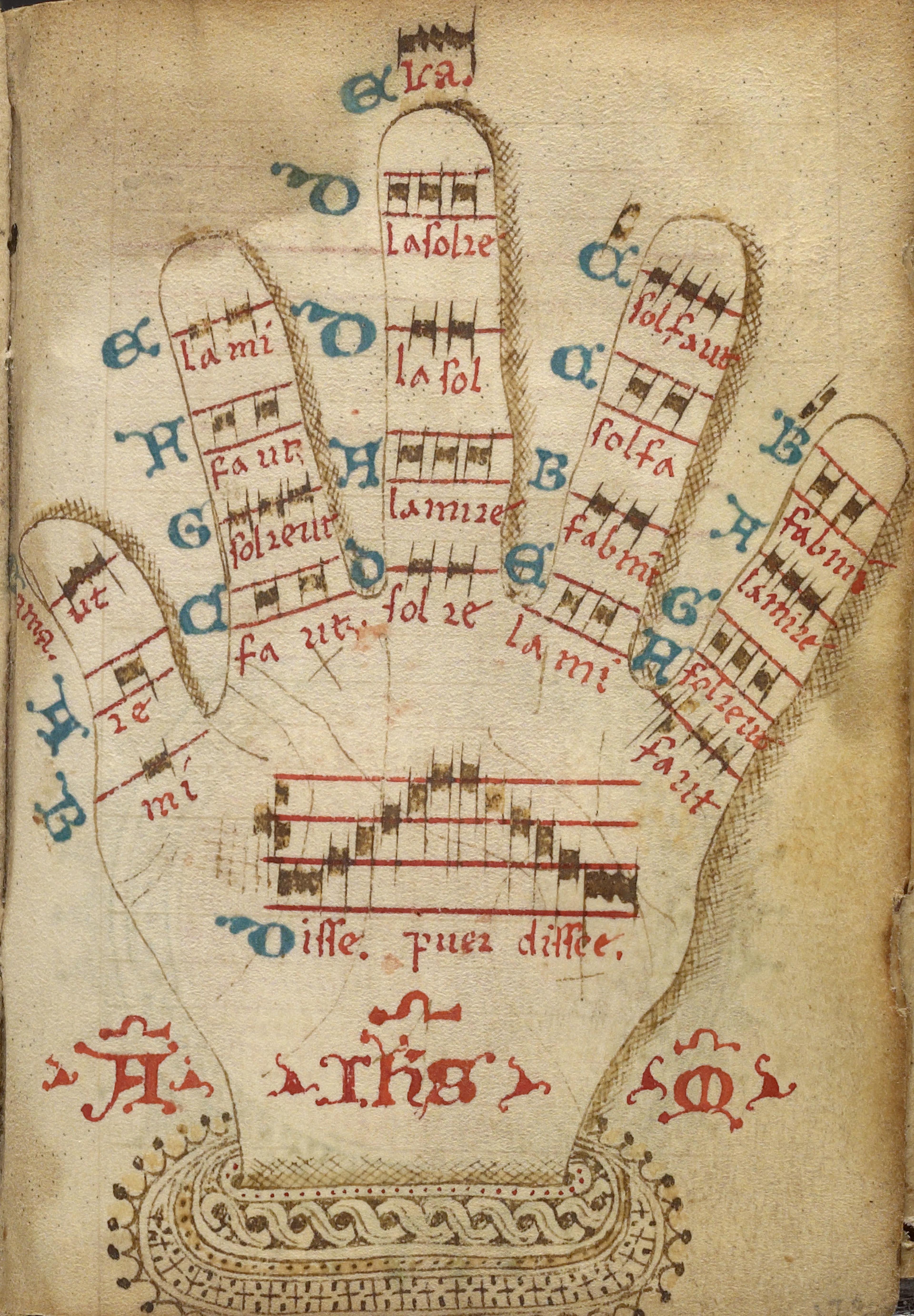
Liturgical miscellany featuring a Guidonian hand, between 1450 and 1499. Italy. Brown, red, and blue ink on parchment, 3 1/2 x 2 1/2 in. (8.9 x 6.4 cm). Kislak Center for Special Collections, Rare Book and Manuscripts, University of Pennsylvania Libraries
The eleventh to sixteenth centuries saw the publication of a huge body of Guidonian hands. While the use of the Hand diminished as music grew more sophisticated and literacy rose starting in the seventeenth century, hand illustrations continued to be devised into the eighteenth and nineteenth centuries, with increasingly complex annotations to accommodate the increasingly complex music of later eras. During the Renaissance, for example, many editions of Vitruvius’s famous treatise on architecture included the Guidonian hand, in an effort to illustrate the relationship between music and architecture, as well as to teach the differences between ancient Greek tetrachord-based music such as would have been heard in Greek theaters, and “contemporary” hexachord-based music: the harmony of architectural spaces and intervals were seen as comparable to musical harmony. This concept of musical harmony originated with the Roman writer Boethius, who posited that “musica” brought the heavens and the body into harmony.
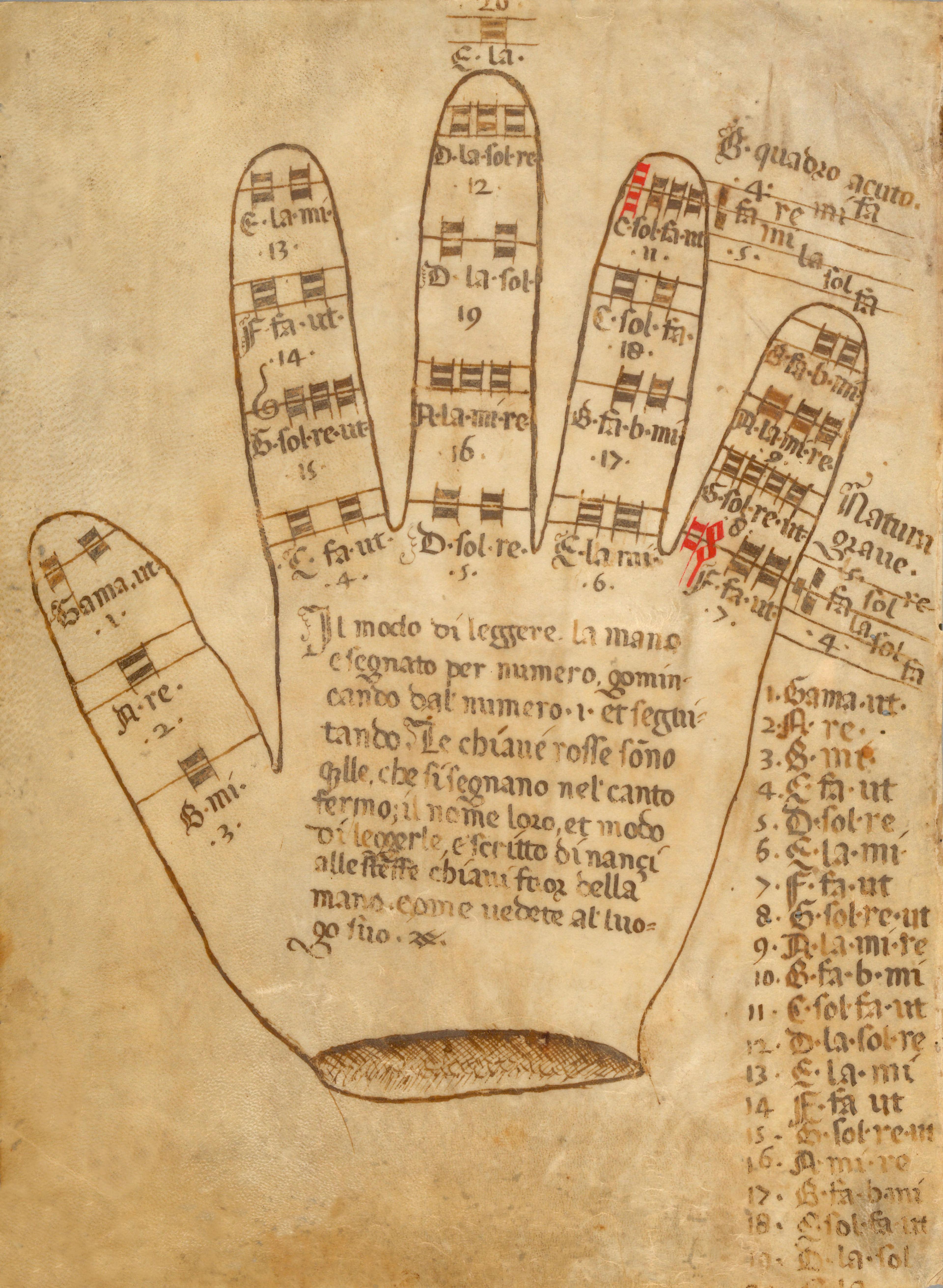
Guidonian hand in a manuscript from Mantua from the last quarter of 15th century. Courtesy Wikimedia Commons
Although Guido’s musical innovations are indisputable, one reason that the Hand was accepted so quickly may be that it did not appear in a vacuum. Hand imagery extends through millennia and across cultures. Aristotle said that “the soul is like the hand, for the hand is the instrument of instruments.” Hand prints are among the very earliest recorded art, some more than sixty-five-thousand years old, from Sulawesi. Ancient handprints and stencils appear on every inhabited continent, and continue through Picasso and Le Corbusier. The hand as a pedagogical device, often mnemonic, is also ancient—at least as old as Classical Greece.
In music pedagogy, the most direct precursors to the Guidonian hand are the so-called “singing hand,” or chironomy, which used hand gestures to indicate which notes to sing in the Byzantine liturgy, and a Greek poem from circa 900 CE which explained the use of the hand as a mnemonic device to teach Western liturgical chants via a twelve-line verse in hexameters. Today these are little known; by contrast, the “Hand of Bede”—or Paschal Hand, devised by the Anglo-Saxon music-lover known as the Venerable Bede (673–735)—remains quite celebrated. Bede called his hand a “computus”; like Guido’s, it attributes a different significance to each finger joint (nineteen if one hand was used, twenty-eight if both were used), though Bede’s computus was used for calculating the date when Easter falls.
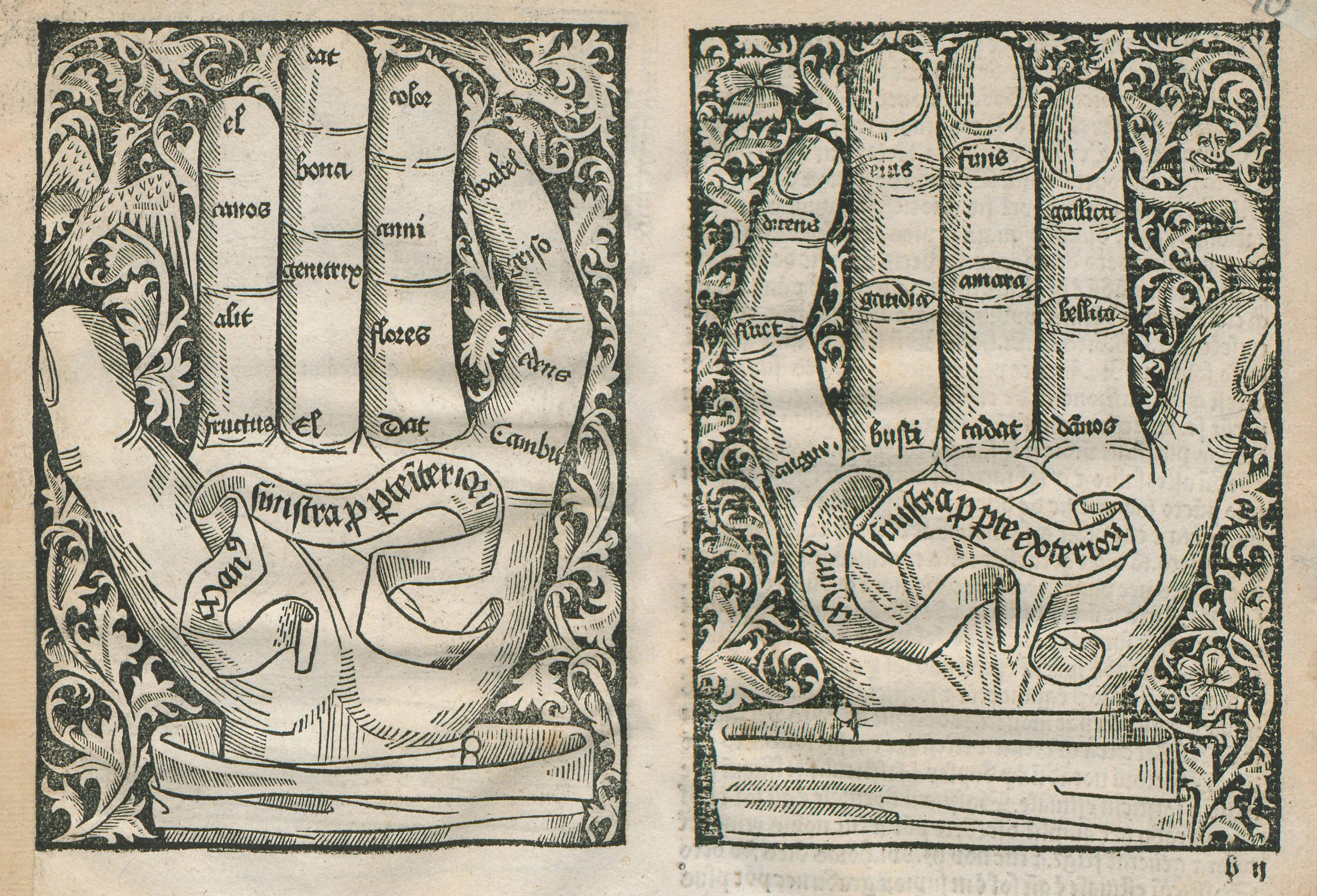
A woodcut illustration from Anianus’ Compotus Cum Commento (1492), an adaptation of Bede’s ca. 725 CE method of computing the date for Easter. Courtesy National Library of Medicine
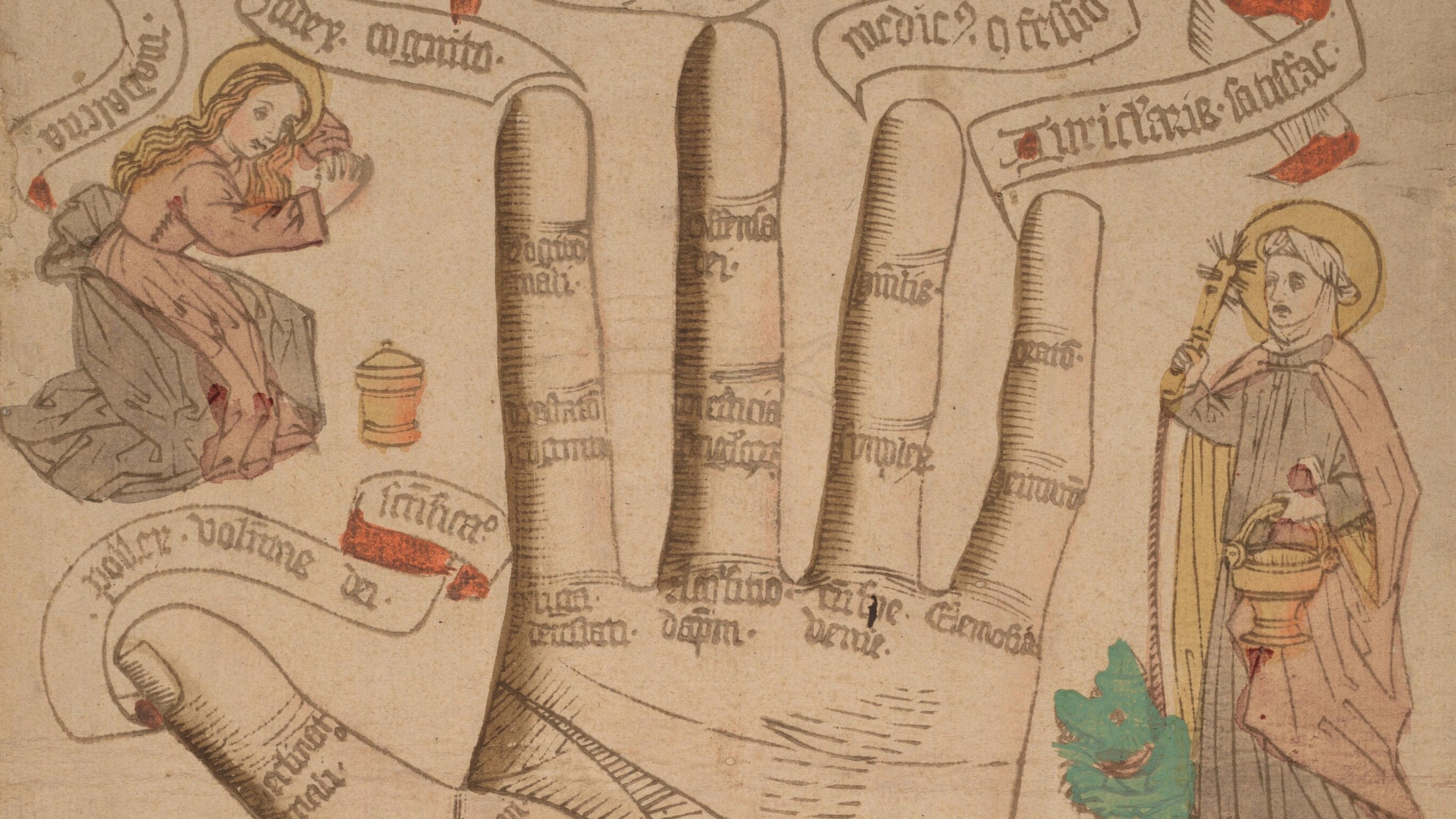
Other “hand” devices developed simultaneously with Guido’s. One, the Speculum Humanae Salvationis, was a mnemonic aid to preaching. Developed in the fourteenth century, each of the 192 images in the Speculum denotes different Old and New Testament themes. The hand imagery sometimes included in the Speculum’s prologue is a mnemonic aid to meditation on the stages of penitence. In one fifteenth-century woodcut from Lake Constance, the hand is flanked by identified images of Saints Mary Magdalene and Martha, urging the reader, finger by finger in Latin, to recognize the will of God, acknowledge evil, repent evil, confess it, and do penance for it.
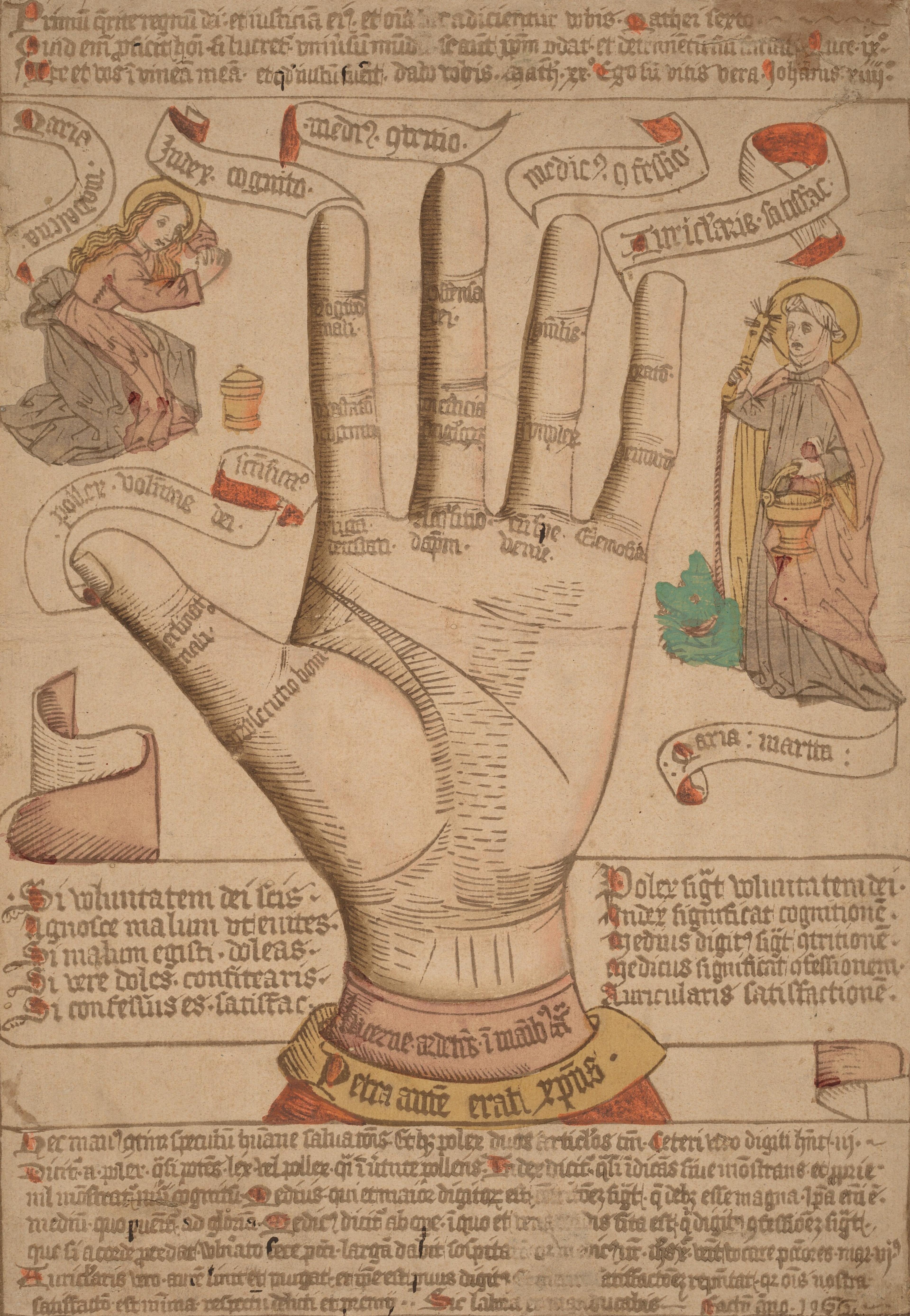
The Hand as Mirror of Salvation, 1466. Netherlandish, believed to be from near Lake Constance. Woodcut, hand-colored in rose, green, yellow and gray; printed by friction in brown ink, 15 3/8 x 10 5/8 in. (39.1 x 27 cm). National Gallery of Art, Washington, DC, Rosenwald Collection (1943.3.639)
The unusual Hand of Meditation painted on a pew in the Church of St. Mary in Bishop’s Cannings, WIltshire, resembles the Speculum’s Hand of Penitence and was a didactic tool for medieval monks. The translation provided by the church of the Latin motto on the palm says “what you should reflect upon” and the thumb and each finger relate to a specific area for meditation: that life is short, that death is certain, and the like. The legend at the bottom reminds the reader that wealth on earth cannot go with you when you die; only your deeds accompany you.
England was an especially fertile and long-lasting ground for Guido’s pedagogy. In 1749, an organist described having to memorize Guido’s solmization syllables when learning the instrument. England was also the source of perhaps the longest-surviving descendant of Guido’s teachings. During the English Protestant Reformation, renewed emphasis on a cappella (or unaccompanied) singing, especially by the Puritans, meant that Guido’s method of teaching singers to get the notes right without an organ to follow obtained new importance. From New England, the pioneer descendants of these nonconformist Protestants, many of whom eschewed instrumental music in church, spread south and west in the United States. Their singing style became particularly entrenched in Appalachia, where community music-making, rather than performances by professionals, was the norm. It came to be known as shape note singing.
Shape note singing used four note shapes—triangle, oval, square, and circle—a simplification from the six notes of Guido’s hexachord system. The difference in the shapes of the notes helped those with no musical training to learn to sight-read, even “those who have not the advantage of an instructor.” The first shape note songbook was copyrighted in 1798 in Philadelphia by William Smith and William Little.
Shape note singing found immediate popularity, although not among the sophisticated musical communities of the eastern seaboard, where it was disdained as insufficiently refined. Instead, it gained traction in the mountains and upcountry of the American South, where its simple approach appealed to churches, camp meetings, and revivals that prized participation. Shape note singing, also known as Sacred Harp singing, never died out, but since the 1980s has spread outside its traditional strongholds in Appalachia. Today it can be found all over the United States and Canada, where communities gather to enjoy unaccompanied singing—a testament to Guido’s legacy.
This essay is published in conjunction with the exhibition Musical Bodies, on view through September 27, 2026.
Notes
Susan Forscher Weiss, “The Singing Hand,” in Writing on Hands: Memory and Knowledge in Early Modern Europe, ed. Claire Richter Sherman and Peter M. Lukehart (University of Washington Press, 2001). This contains a comprehensive list of examples of the survival of Guido’s teachings.
Bruce W. Holsinger, Music, Body, and Desire in Medieval Culture: Hildegard of Bingen to Chaucer (Stanford University Press, 2001), 274.
In the Epistola, Guido expounded his solmization theory of attributing named syllables to the notes, which are diagrammed onto Hand illustrations.
Manuscript Codex 1248, Liturgical Miscellany, 6.f.122r, University of Pennsylvania Kislak Center for Special Collections.
Aristotle, De Anima, 3.8, quoted in Weiss, Writing on Hands, 7.
Leo Treitler, “Homer and Gregory: The Transmission of Epic Poetry and Plainchant,” The Musical Quarterly 60, no. 3 (1974): 333–72.
Jean Michel Massing, “Review: Writing on Hands,” Print Quarterly 20, no. 4 (2003): 416, https://www.jstor.org/stable/41826496; Paul Jackson, “The Depressing Chair of Bishops Cannings,” Random encounters with the unusual, August 25, 2014, https://unusual-encounters.blogspot.com/2014/08/the-depressing-chair-of-bishops-cannings.html.
Weiss, “The Singing Hand,” 41, fn. 26.
Robert C. Delvin, “Shape-Notes, ‘The Sacred Harp’ and the Hollow Square: an American Musical Tradition,” Illinois Wesleyan University Faculty Colloquium, November 20, 2010.


