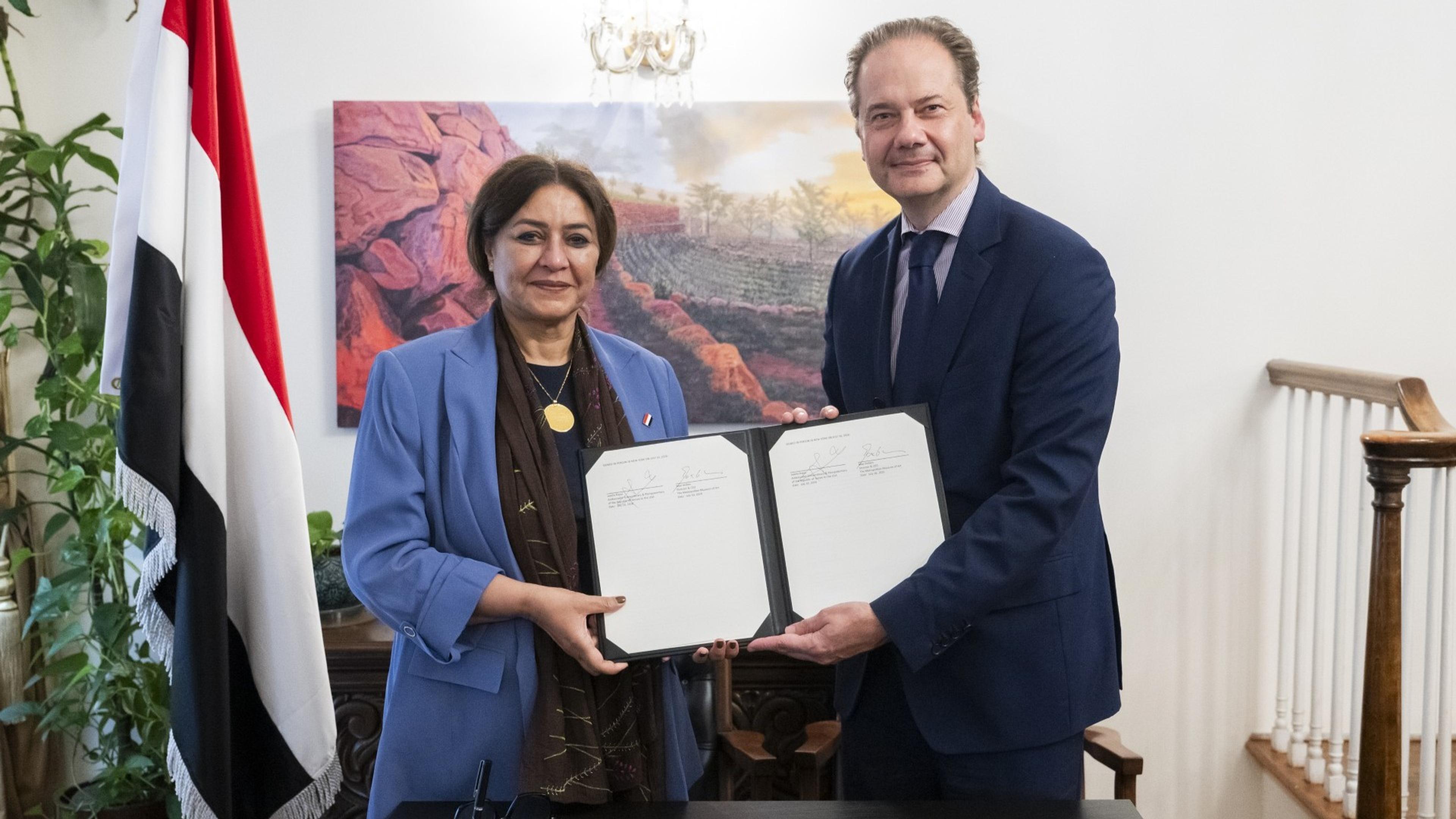
(New York, July 28, 2026)—Today, The Metropolitan Museum of Art and the Republic of Yemen announced the loan of two ancient stone fragments to the Museum. The works were recently voluntarily repatriated to Yemen from a private collection in San Francisco.
The loan agreement was signed by Ambassador Jamila Ali Rajaa and Max Hollein, The Met’s Director and CEO, during a ceremony at the Permanent Mission of Yemen to the United Nations. Both works date to the 1st millennium BCE.
This agreement builds on previous collaborations between The Met and the Republic of Yemen to care for ancient artworks. In 2023, The Met initiated the return of two artifacts from its own collection following proactive provenance research that determined the works should be returned, and reached a historic agreement with the Republic of Yemen for the works to remain at the Museum for ongoing care and display. In 2024, The Met helped facilitate the repatriation of another 14 ancient sculptures from a private family collection in New Zealand; the Republic of Yemen also loaned those objects to The Met for study and safekeeping.
Max Hollein, The Met’s Director and CEO, said, “The Met is committed to studying and presenting the world’s shared cultural heritage in partnership with experts and colleagues from across the globe. We are grateful to be entrusted with the care of these artworks from the Republic of Yemen and extend our deepest appreciation to Her Excellency Ambassador Jamila Ali Rajaa for her collaboration. These loans are particularly exciting in anticipation of the 2027 reopening of our renovated galleries for Ancient West Asian Art, which will provide a dynamic space for our visitors to encounter the cultural production of the region, including ancient Yemen’s remarkable artistic legacy.”
Her Excellency Jamila Ali Rajaa, Ambassador of the Republic of Yemen to the United States, said: “This agreement demonstrates that ownership and preservation are not competing objectives. Through mutual respect, transparency, and genuine partnership, we recognize Yemen’s rightful ownership of these extraordinary cultural objects—which were recently repatriated from a private collection to Yemen—while ensuring that they will continue to benefit from The Metropolitan Museum of Art’s world-class conservation and public engagement.”
This newest loan comes during the renovation and reinstallation of the Museum’s galleries for Ancient West Asian Art, which are set to reopen in 2027 and will provide reimagined space for visitors to explore the collection and learn about the rich and diverse cultural heritage of West Asia.
Both artifacts coming to the Museum are made of sedimentary stone and feature carved imagery of horned animals. One is a fragment of a stela bearing an inscription in Sabaean and depictions of ibexes, dating probably to the 8th-7th century BCE. The other, also from the mid-first millennium BCE, is a relief fragment decorated with stylized antelope heads. The imagery and style of both pieces strongly associate them with the kingdoms of ancient Yemen, which thrived through trade in frankincense and other commodities north across the Arabian Peninsula.
New Galleries for Ancient West Asian Art
The Met will present ancient art from Yemen in newly reimagined galleries devoted to the Art of Ancient West Asia, opening in 2027. The Museum is currently undergoing the first comprehensive rethinking of these collections in over 25 years. Designed by the architectural firm NADAAA, led by Nader Tehrani, the $40 million renovation of over 15,000-square-feet of gallery space also encompasses new galleries for the art of ancient Cyprus, and create a more connected and accessible visitor experience while bringing new scholarship and interpretation to the fore.
The dynamic reinstallation will highlight new research and diverse narratives that contextualize objects and the people who made them within their own time, as well as within contemporary discourse. The project is strengthened by The Met’s engagement with archeologists, scholars, artists, and cultural leaders from the region represented in the new galleries. Avenues of collaborative exchange throughout the multi-year reinstallation included the pioneering custodial agreement with the Republic of Yemen in 2023, joint research with the Republic of Iraq, and fellowships, residencies, and interpretation with colleagues from across the region.
Cultural Heritage at The Met
One of the most critical areas of focus for The Met’s provenance research efforts is ancient art, archaeological materials, and other cultural property, including works of art from once-colonized areas. As part of its commitment to the shared stewardship of cultural heritage, The Met collaborates with countries around the world to exchange information, museological resources, collection care, object loans, and more. This collective understanding is deepened further through convenings with international experts, interpretive framing within gallery displays, and the global accessibility of research and object histories via metmuseum.org.
About The Met
The Met is currently ushering the Museum into the future by renovating one-quarter of its two-million-square-foot building on Fifth Avenue galleries. These reimagined spaces will tell new stories through the breadth of the collection, while improving visitor experience, infrastructure, and sustainability. This remarkable $1.5 billion capital campaign includes: the acclaimed Michael C. Rockefeller Wing for the arts of Africa, Oceania and the Ancient Americas (opened spring 2025); the new Condé M. Nast Galleries (opened May 10, 2026, with the inaugural exhibition Costume Art); new galleries for the Arts of Ancient West Asia and Ancient Cyprus (opening 2027); reimagined spaces for dining and retail inside a newly reactivated entrance off The Met's plaza (opening 2027); and the transformative Tang Wing for Modern and Contemporary Art (opening 2030). Learn more here.
The Metropolitan Museum of Art was founded in 1870 by a group of American citizens—businessmen and financiers as well as leading artists and thinkers of the day—who wanted to create a museum to bring art and art education to the American people. Today, The Met displays tens of thousands of objects covering 5,000 years of art from around the world for everyone to experience and enjoy. The Museum lives in two iconic sites in New York City—The Met Fifth Avenue and The Met Cloisters. Millions of people also take part in The Met experience online. Since its founding, The Met has always aspired to be more than a treasury of rare and beautiful objects. Every day, art comes alive in the Museum’s galleries and through its exhibitions and events, revealing both new ideas and unexpected connections across time and across cultures.
###
July 28, 2026
Image: Paula Lobo