Looking back over his long career, in 1975 Man Ray told the British photographer Cecil Beaton: “In whatever forms my work is finally presented ... it is designed to amuse, bewilder, annoy or to inspire reflections, but never to arouse admiration through any technical excellence usually sought for in works of art. The streets are full of admirable craftsmen, but so few practical dreamers.”[1] In the time since the presentation of Man Ray: When Objects Dream (2025) at The Metropolitan Museum of Art, the first exhibition devoted to the artist's rayographs and their place in his oeuvre, the works have continued to spark curiosity, creativity, inquiry, and altogether new ideas, making Man Ray the perfect focus for the inaugural program year of the Bluff Collaborative for Research on Dada and Surrealism.
The Bluff Almanach is a new form of research offering from The Met, gathering contributions from artists, writers, scholars, and specialists inside and outside the Museum, and designed to capture the many activities that took place in the first year of the Bluff Collaborative’s research program. In “Acts,” you'll find videos of some of the performances commissioned in 2026 by the Bluff Collaborative in coordination with Met Live Arts, which included two sold-out shows by the band SQÜRL, who set their original music to the four films Man Ray made in the 1920s. We also feature clips from Five Acts for Five Friends by the dancer and choreographer, and 2026 MacArthur Fellow Trajal Harrell, which was inspired by the legacy of Dada among the Black Mountain College group of John Cage, Merce Cunningham, Jasper Johns, Robert Rauschenberg, and Cy Twombly. Performed over two days in the Petrie Court and the Temple of Dendur at the Museum, the work made its U.S. debut through our project. You’ll also be able to watch the premiere of artist Alex Da Corte and musician and composer Emily Well’s Glass Age. On a winter night, among the sculptures in the courtyard of The Met’s American Wing, Da Corte and Wells shared with the gathered audience a stream of images and songs—a poetic rumination on the connection between ideas, objects, and people in our time.
In “Conversations,” you'll find interviews with artists who share our interest in trying to understand the stakes of Man Ray’s explorations. Met curator Stephen C. Pinson spoke with Alison Rossiter in her studio and toured her marvelous collection of vintage photographic papers. Author and radio host John Schaefer sat with Jim Jarmusch and Carter Logan, members of SQÜRL, to discuss their interest in the artist; it was Schaefer who commissioned the score and first performance in 2015. Related to this, you'll also find a video by Womanray and Cinenovo that details some of the work involved in their restoration of Man Ray's first film, Retour à la raison (Return to Reason), made possible, in part, by The Metropolitan Museum of Art.
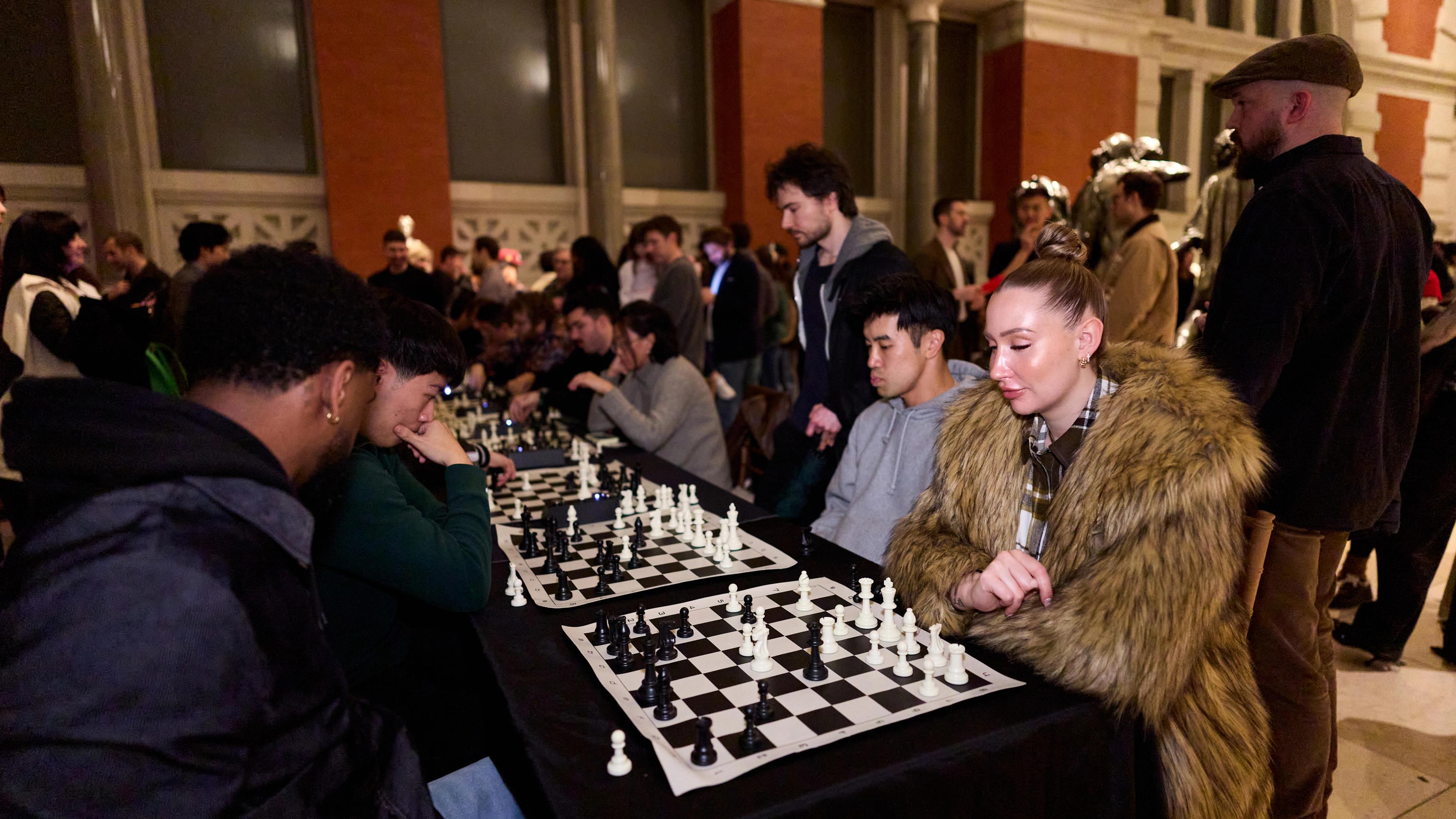
Among the activities during the first year of The Bluff Collaborative was a Chess Night on January 9, 2026, organized with the Met Education Department and the Pawn Chess Club. More than 850 people gathered in the Carroll and Milton Petrie European Sculpture Court and the adjacent cafe to play on dozens of chessboards, in honor of Man Ray
The Almanach offers numerous articles centered on aspects of Man Ray’s artistic production. “Object Studies” includes fascinating reports by conservators Tess Hamilton, Nora Kennedy, and Katherine Sanderson at The Met, and by independent conservator Paul Messier, that recount research projects around rayographs. In “From the Archive,” Mary Chan and Mallory Roark add context to a set of inscriptions by Man Ray and consider the relationship between objects and their collectors. And “Essays” gathers writings by scholars Bill Brown, Noam M. Elcott, Susan Laxton, Janine Mileaf, Poole Park, Mark Polizzotti, and Adrian Sudhalter that focus on works featured in Man Ray: When Objects Dream, many of which were also subjects of discussion during a Study Day in January 2026. That program brought artists, conservators, curators, and scholars together for a day of careful looking, and we are especially grateful to our enthusiastic participants and for the collaboration of both the Leonard A. Lauder Research Center for Modern Art and The Met’s Education Department.
Inspired by the experimental nature of Dada and Surrealist publications, we also include an “Enqûete”—this time, posing a seemingly simple question for our times: “Dada or Surrealism?” We invite you to consider this question and to be in touch with us if you have an idea or contribution for the 2026–27 research program, which will be dedicated to the theme of “Echoes and Traces.”
Notes
Man Ray, as quoted in Cecil Beaton and Gail Buckland, The Magic Image: The Genius of Photography from 1839 to the Present Day (Little, Brown, 1975), 145.
